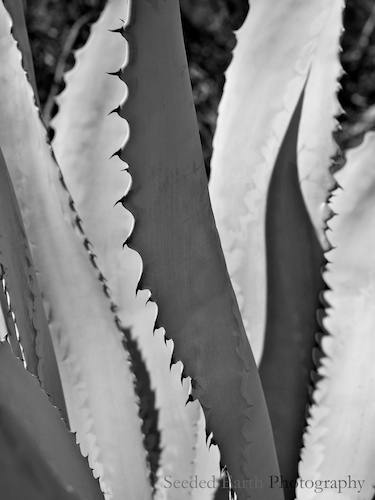
‘Agave Americana’–not a cactus, though frequently referred to as one. Spines are sharp–very sharp. Speaking from experience. Photographed at the Boyce Thompson Arboretum, an arboretum specializing in arid plants, world-wide, and located near Superior, Arizona–about an hour east of Phoenix.
The Awakening
The sun finally peeked out from the clouds yesterday evening, and I insisted on postponing dinner until I could get a few photographs of a tulip bed I had my eye on. Once I was there, the sun played peek-a boo with me, and so it took me nearly an hour of waiting, and on and off shooting, to get the photos I wanted. All 98 of them! But with rain forecast for the next 3 days, it was now or not this year.
I finally took the leap and have started shooting totally in manual (instead of aperture priority which always sounded easier) and in RAW. Why I waited so long is beyond me. In many ways, it’s easier. I found myself always over-riding the aperture pre-sets anyway, so I’m not doing much, if anything, different, but it feels a lot better. And if I can get used to a single photo file being between 10 and 20 MB, then all will be fine. (I can remember when my first computer had 64K–the entire computer–so the size tends to boggle my mind. And fill up my memory cards quickly!)
This tulip reminds me of a rose, unfolding slowly, filled with promise. But I like that the tulip has less complexity and needs hardly any tending. And that it shows up early in the season when the need for flowers and color is heightened and really appreciated.
I’ll be switching between the local color and the photos from the trip to the Southwest. It makes me a bit dizzy, but I have so much I still want to share from the trip, mostly from Arizona. It will take me a few months, but I love re-living my trip through my photography.
Desert in Living Color
On our April trip to the Southwest, we visited the Boyce Thompson Arboretum near Superior, Arizona, about an hour’s drive east of Phoenix. The arboretum features collections of plants found not only in the Sonoran Desert, but in arid and desert lands around the world.
For anyone who thinks deserts are mostly sand and cactus, I offer this photograph as proof that the desert does indeed come alive in color.
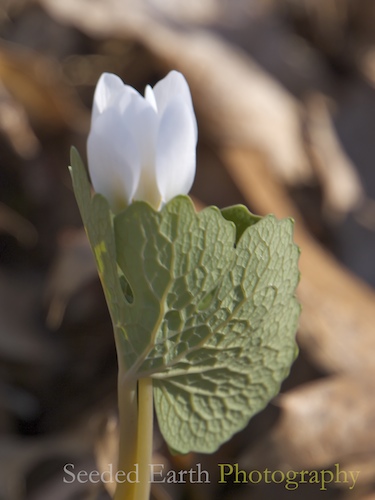
Bloodroot
My first wildflower of the season. The wildflowers seem late this spring, and during my walk deep in the woods this morning I found only the foliage of the anemone and hepatica. Usually both are blooming by the last two weeks in April. But I did discover a few bloodroot, just beginning to bloom. This tiny flower is still wrapped gently in its leaf–like a dainty maiden with a shawl wrapped protectively around her shoulders.
The plant is native to the southern half of Wisconsin, and a few counties in the northern part as well. It usually blooms in April and May, in woods or the edges of woods. The plant was called bloodroot because it has deep red sap that was used by Native Americans as a dye.
Chiricahua National Monument
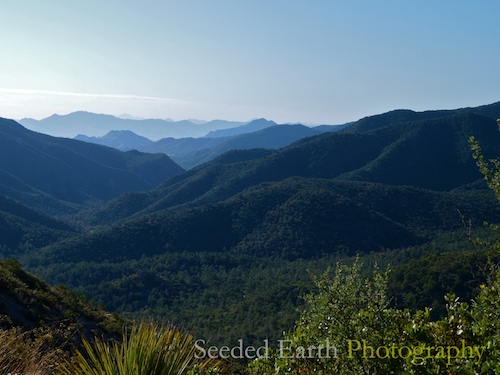
Located in a remote spot in southeastern Arizona, Chiricahua National Monument is a gem most people have never heard of. But a stop at this monument, which was established in 1924, is well worth the time and effort required to get here. The park is called a sky island because it is an isolated mountain range that seems to mysteriously arise from the surrounding grasslands. At its highest point, the sky island rises to 9,763 feet.
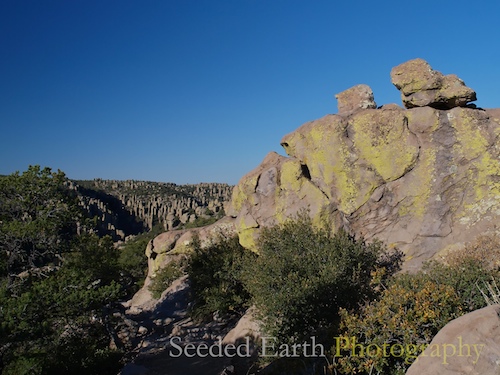
A wonderful part of the park is seen when you follow a winding, mountain road into the heart of the park. Rock pinnacles loom over the road and stretch for miles in every direction. Hiking in the wilderness areas which comprise 80% of the park is a rather solitary experience.
Lichens decorate the rocks and add a yellow, white, or even a lime green sheen to the rock surfaces.
The park is especially noteworthy in that four ecosystems meet in this range. There are the northern slopes seen in the first photograph which are covered with Douglas fir and Ponderosa pine, most typically found in the Rocky Mountains. If you look to the southern slopes, the second photo, you will see Apache pine and Mexican pinyons which are common in the Sierra Madre range in nearby Mexico. Yuccas from the Chihuahuan Desert meet with the prickly pear cactus of the Sonoran Desert. In all, there are over 1,200 species of plants documented in less than 12,ooo acres of land.
And to make things even better, the campground is nestled in a pine forest, with roomy sites, and staffed with friendly rangers. It all makes the experience just about perfect.