We camped on the shores of the Lake of the Ozarks, in the southern part of Missouri, and awakened to harsh croaking sounds. I quickly discovered that these calls belonged to a group of herons enjoying the foggy dawn with a bit of companionable fishing.
Pussy Willows
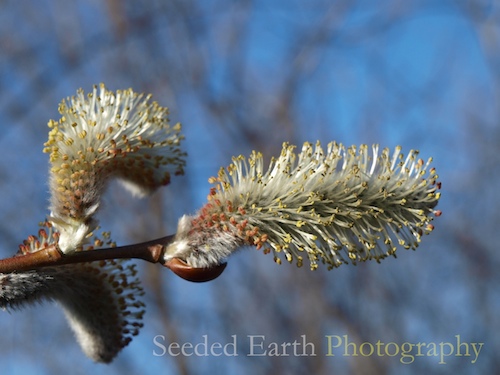
More catkins.
It’s easy to understand how the Fantail Pussy Willow (salix sachalinensis or salix udensis ‘Sekka’) got its name, with the lovely, curving sweep of its branches. It is also known as the Dragon Willow. It is a highly ornamental shrub, with a beauty that extends to all four seasons. In the summer, the leaves are a deep green and glossy, and its branches sprawl horizontally and it resembles a huge tropical shrub. The leaves turn a rich yellow in autumn. In winter, its shape is low and distinctive from all the other willows, and its lines are accented by a snow covering.
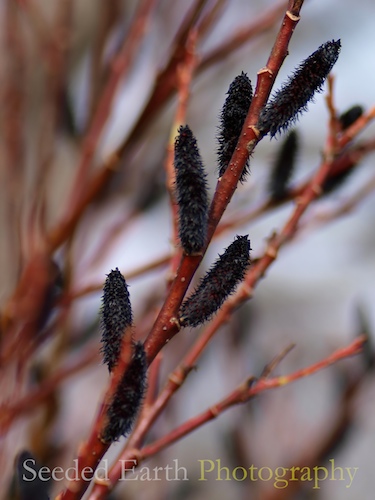
The Black Pussy Willow (salix melanostachys) has catkins that emerge black, then turn red and finally show a hint of white. This is a willow that often pops its catkins while snow is still on the ground. The orange-red branches make a nice display against the black pussy willows.
Both of these willows are frequently used in floral arrangements.
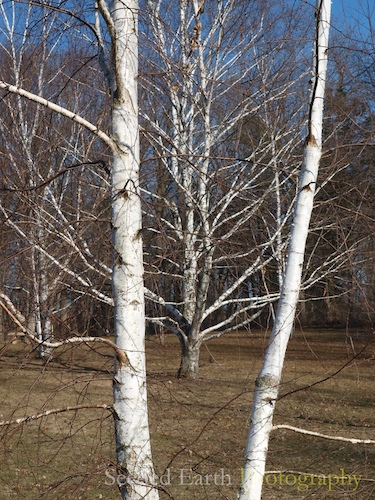
A Framed Birch Tree
When I walked in the Arboretum earlier this week–before the snowstorm hit this morning–I took note of the hundreds of different trees that are on display.
I love how the trees in this part of the park frame the tree standing farther away. I love to see the striking white bark of these birches.
Catkins
I went for a walk at the University of Wisconsin Arboretum looking for a hint of spring. And I found all the willows covered with catkins.
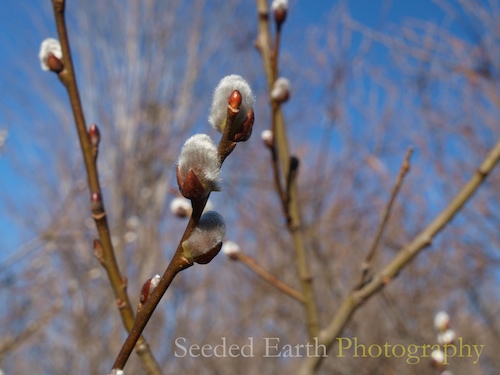
The goat willow (Salix Caprea), frequently referred to as the pussy willow, is a common tree species. It is a wetlands plant in the wild, and if not pruned, it will grow up to 20 feet tall. Catkins are a true harbinger of spring, and it is tradition at my home to bring a few branches of pussy willows into the house as spring’s first bouquet.
The Dappled Willow (Salix Integra) is also known as The Japanese Willow or ‘Hakuro-nishiki’ and is one of the smaller willows, often grown as a shrub or small tree. The catkins appear in early spring just before the leaves unfurl. Willows are one of the earliest trees to leaf out, often as much as 4 weeks before other trees.