second in the series on winter wabi-sabi
The golden coin-shaped leaves of this plant contrast the winter blue sky. And yes, for once the sky was so blue it reminded me of the bright skies I typically see in the west.
second in the series on winter wabi-sabi
The golden coin-shaped leaves of this plant contrast the winter blue sky. And yes, for once the sky was so blue it reminded me of the bright skies I typically see in the west.

Wabi-Sabi Treasure © 2009
My great-grandmother, Sarah Margaret Smulling, was 18 years old when she made what she referred to in her diary as her “comfort” and entered it in the county fair. She brought home a blue ribbon. (still attached)

Antique Embroidered Comforter 1884 © 2009
Sarah was born in 1866; she sewed and painted this coverlet c. 1884. She lived on a farm in Clark County, Missouri, near the town of Kahoka, where her older sister and brother-in-law had a millinery shop. Her sister brought home the scraps from her shop, and shared them with her younger sisters. Most evenings, after the farm chores were done, Sarah and her sisters would all gather and each would sew or decorate their “comforts” or other pieced items.

Embroidered Fan © 2009
Since the girls were using scraps from a well-established and profitable shop, they had access to the finest of materials. Silks, damasks, moires, chintze, brocades, velvets, and fine cottons were all available for their use. Sarah did several appliques on this piece. The most elaborate was this orange fan.
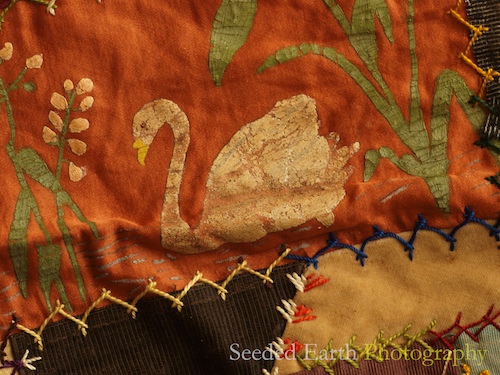
Hand Painted Swan on 1884 Comforter © 2009
Sarah evidently had some talent in the arts. She was the only girl in the family who actually painted on her fabric. Most of the small paintings are of the more common varieties of flowers–daisies, violets, wild roses–but she also painted several butterflies and this swan.
The quilt is done in mostly browns, neutrals, and oranges. The one thing I find amazing is the border Sarah added to her handiwork–a five inch wide swath of bright pink chintz. The fabric has suffered from lots of use and improper storage. There are quite a few worn pieces of fabric in the delicate materials. Nonetheless, I consider this one of my family’s heirlooms. Definitely wabi-sabi.
The entire set of photographs, including more close-ups of different sections of the coverlet are in this flickr set.
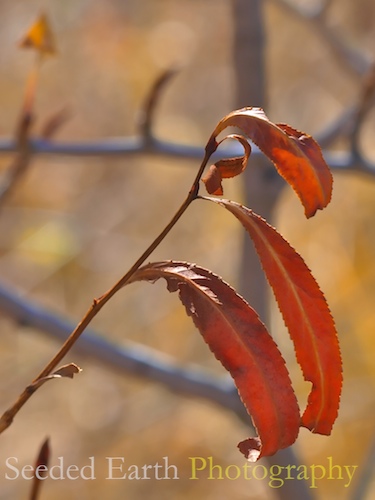
fourth in the series, wabi-sabi
Wabi-sabi is characterized by humility, restraint, simplicity, naturalism, profundity, imperfection, and asymmetry [emphasizing] simple, unadorned objects and architectural space, and [celebrating] the mellow beauty that time and care impart to materials. ~ Introduction: Chanoyu, The Art of Tea
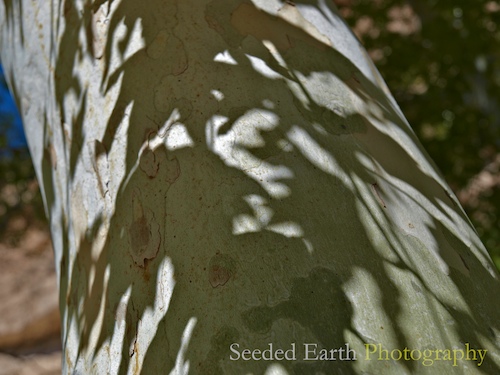
third in the wabi-sabi set
Greatness exists in the inconspicuous and overlooked details. Wabi-sabi represents the exact opposite of the Western ideal of great beauty as something monumental, spectacular and enduring. Wabi-sabi is about the minor and the hidden, the tentative and the ephemeral: things so subtle and evanescent they are invisible to vulgar eyes. ~Leonard Koren
A different way of seeing an Arizona Sycamore tree. Shadows. Leaves. Bark.
Another photograph from my archives, taken in October last year, at Montezuma’s Castle National Monument, north of Phoenix.
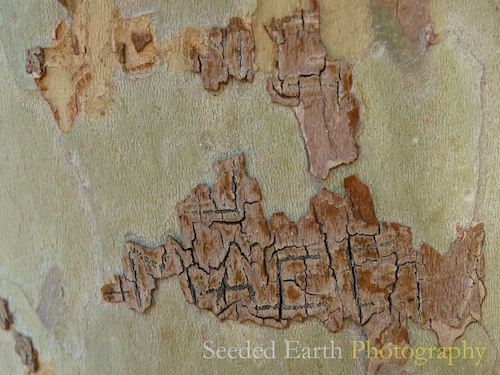
second in the wabi-sabi set
The bark of the Arizona Sycamore produces a pleasing composition, the pale greens and brown tones play well off each other.
This tree was photographed at Montezuma’s Castle National Monument, just north of Phoenix. The Monument protects Native American dwellings tucked into the breaks of a mountain. The property has many Arizona sycamores and velvet mesquites. Quite a lovely place in the fall, with Arizona’s moderately high temperatures offset by the welcoming shade of the tall Sycamores and a cooling stream running through the property.
This is the second photograph in the wabi-sabi series.