Wired! Black Crowned Crane

The International Crane Foundation in Baraboo, WI maintains a collection of captive cranes, including several black crowned cranes, which helps their work in crane preservation: captive breeding and reintroduction into the wild. Their work also demonstrates endangered species management for the public, and facilitates breeding and education information elsewhere in the United States and abroad. It is the only place in the world where you can see all 15 crane species.
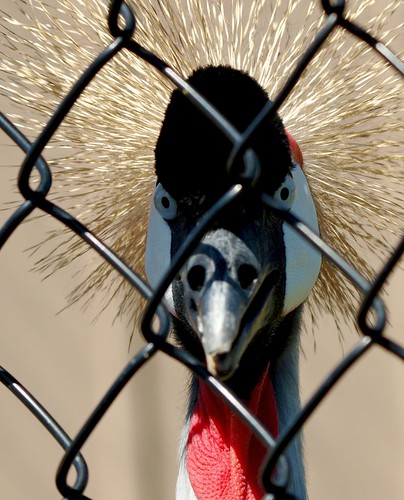
Black Crowned Crane

Black Crowned Crane © 2008

When I visited the Crane Foundation earlier this month, this crane was especially interested in my camera, and made several attempts to get a little too close. Maybe I didn’t ask for the appropriate model release!

The Black Crowned Crane is indigenous to the Sahel region of Africa. The ICF in coordination with Wetlands International has coordinated a conservation plan for these birds. There are approximately 40,000 Black Crowned Cranes in existence, and their numbers are declining.

The most serious threats to this crane species are illegal capture for the pet industry. An ancient tradition in West Africa to keep domesticated cranes in the household compounds persists to this day. But an additional threat is an intensified international trade in the birds in the last 30 years. Also degradation of the species’ habitat – the wetlands and grasslands of West Africa due to drought, destruction of tree cover and overgrazing – is a factor in their declining numbers.

A regional African program has been set up to provide alternative income opportunities for crane traders and for distribution of community-based information and conservation methods in Nigeria and the Sudan.
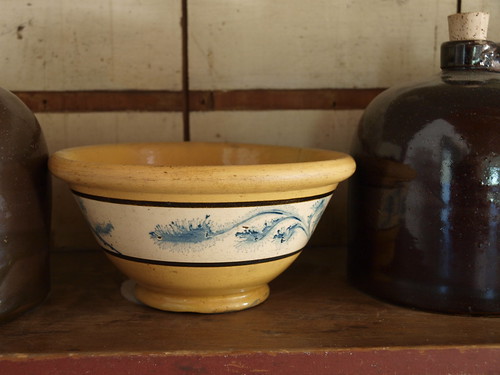
Just a Simple Yellow Bowl

Yellow Bowl, circa 1850

Yellow Bowl, circa 1850 © 2008

Let’s see. It’s been a long day. And my cat is making odd noises in the kitchen – never a good sign. But this yellow bowl was rather nice when I spied it sitting on a shelf among other antiques. A basic shot of a very old  bowl sure beats a synopsis of the economic news or the political scene bashing. I think I’m going to go indulge in a hot fudge sundae. When in over-drive, think chocolate.

Fungi on the Forest Floor

Fungi on the Forest Floor

Fungi on the Forest Floor © 2008

These fungi are cool, but I tell you. I am terrible when it comes to trying to identify these things, and fungi are not things you want to mis-identify, so I won’t even try.

I do remember copying this information awhile ago – information about fungi in general that I found fascinating. This is what I saved from one who is more expert than I am:

“Recent DNA analysis indicates that fungi are closer related to animals than to plants. Fungi are so peculiar that they are regarded as neither plant nor animal, but rather their own thing. The divergence of animals and fungi has been estimated as taking place some 965 millions of years ago.”

If you’d like a general introduction to the world of fungi you can visit the fungus pages at www.backyardnature.net/2fungi.htm

Heirloom Gardening

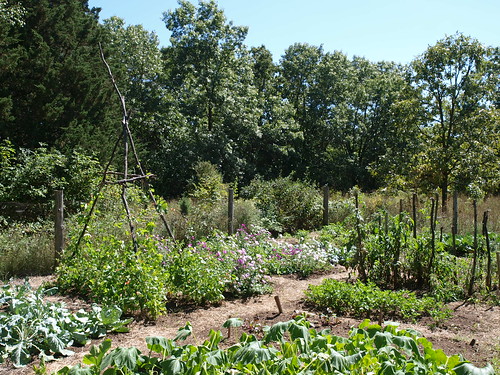
Polish Heritage Garden

Polish Heritage Garden © 2008

I love gardens. All kinds of gardens. Flower gardens, community gardens, Japanese gardens. And a recent visit to Old World Wisconsin sparked an interest in yet another type of garden – the heirloom garden.

It was a perfect summer’s day when I went exploring a few weeks ago. Old World is a great place to go when you want to both get in a little outdoor exercise and visit a museum. Though there is tram service to the various areas, I chose to walk the paths and managed to add nearly 4 miles to my pocket pedometer. And I discovered my favorite parts were outside, too – the thirteen heirloom gardens that sported colorful flowers and vegetables, and looked like paintings right out of the 19th Century. All of the gardens in the museum are typical of those found in the historical period from the 1850s through the 1890s.

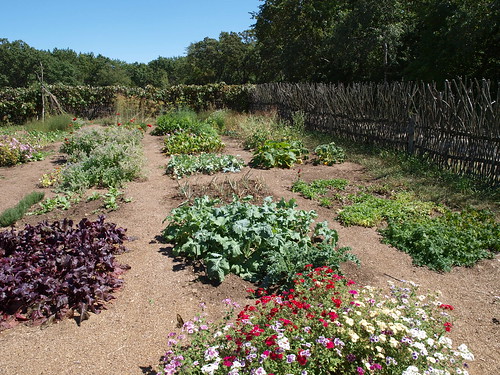
German Heirloom Garden

German Heirloom Garden © 2008

Heirloom gardens use only plants that are cultivars that were commonly grown before large scale agricultural practices were introduced. These vegetable plants have kept their traits through open-pollination and the fruits are propagated by grafts and cuttings. These varieties are becoming less prevalent because plants are now chosen for their consistency, their hardiness to tolerate shipping and storage, and their tolerance to drought or pests. Though these qualities are desirable when growing food is a huge agri-business, these plants are not the best nutritionally nor do they taste the finest.

The gardeners at Old World also use farming techniques from the time period. If it wasn’t done in the late 19th century, it isn’t done in these plots either.

In the last decade, the heirloom gardening movement has been increasing. The gardens at Old World Wisconsin provide some mighty incentive. The vegetables and fruits I sampled tasted great.

Prairie Grasses in Wisconsin

Say the word “prairie” and many people visualize Laura Ingalls in her log cabin or rolling wagons crossing open prairie land, the wagons filled with settlers on their way out West in search for a better life. But I’m thinking most really have no idea of what a prairie looks like up close.

Sure, most know there are lots of sunflowers and yellow goldenrod wildflowers and some tall grass, but ever give thought to the hundreds of varieties of grasses that make up the tall grass and short grass prairie lands. Obvious, right?

Well, maybe not so obvious at all. It’s easy to overlook grasses. I mean, it’s just grass, right?  So let me show you just how different a few of these grasses really are.

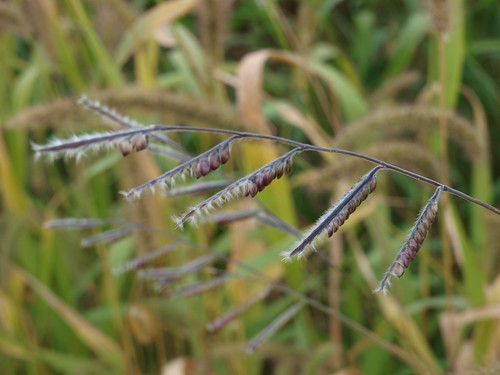
Side Oats Grama Grass

Side Oats Grama Grass © 2008

This prairie grass is found in the high prairies in southern Wisconsin and extends to central Wisconsin in fewer numbers. It’s one of my favorite grasses to look for – I love the purply-blue fruits hanging in a row like someone pinned them on a clothesline.

When buffalo roamed the region, this was their main source of food. It’s an easy grass to identify – all those oats are hanging off to one “side”. So it is side oats grama grass. Grama is from gramen, the Latin word meaning grass.  1 1/2 to 3 feet tall.

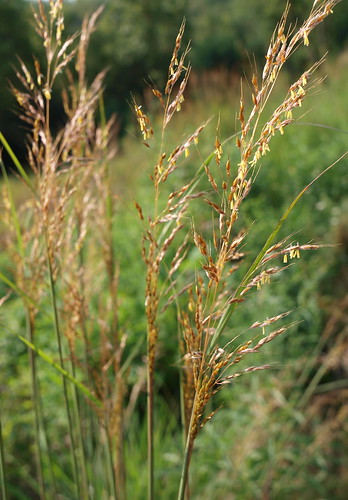
Indian Grass

Indian Grass © 2008

Before agriculture and tended crops developed, Indian grass was second only to big blue-stem grass as the most important plant in the tall grass prairie, both in its numbers and in its nutritional content.

It is extremely drought resistant because of it’s extensive deep root system – typical of the prairie plants. The frequent prairie fires do not damage these grasses – they are highly adapted to the burns. This grass was one of the taller one,  usually standing 6 to 9 feet tall.

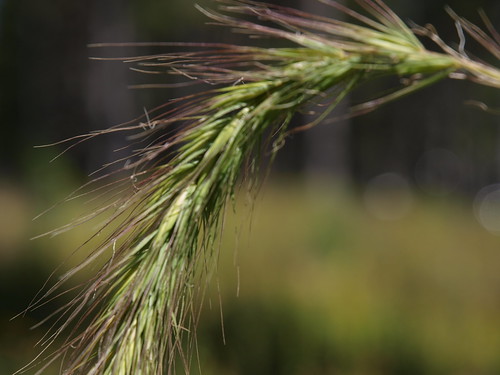
Canada Wild-Rye Grass

Canada Wild-Rye Grass © 2008

This is one of the most important grasses in the tall grass prairie. It acts as a nurse crop for prairie seedlings early in the growing season before it declines as the warm season grasses mature. Canada Wild-rye Grass grows 2 to 5 feet tall and forms a loose sod. Native Americans used the seed for food, as did a multitude of large and small animals.

The grasses had other uses besides as food.They were used as fuels, and also the fibers were woven into mats for internal walls in small cabins, window coverings, and floor coverings.