Down on My Knees

Antique Flowers Shot While Kneeling in Grass in White Jeans

Antique Tin Flowers Photographed While Kneeling in Grass in White Jeans © 2008

Today – it is only 9:43 am – and already I have had one of those life lesson days. You’d think I wouldn’t have to expose my mind to such philosophical points of view so early, but lessons are not planned. They simply happen. Here’s today’s lesson:

Don’t Skip the Basics

How obvious! Yes? No!

I’m frazzled these days – change of seasons, change of life, changes in life. Ordinary and not-so-ordinary living kinds of things. My mind was full this morning chewing on all those nasty bits and I was giving it unlimited chomping privileges.

But there were things to do, whether or not I wanted to do them, and I had baskets of dirty clothes and a rainy day and a morning without a deadline or appointment. Good time for tackling the ever-erupting laundry hamper. Mind half on my task, I sorted the clothes in the appropriate piles and carried the first load down to the washing machine.

Whites were first. I hate white clothes – all that underwear and a dozen-plus tee-shirts to be sorted by sizes and folded. White socks without their mates.  A few cotton shirts that actually need ironing. (Why, I ask myself over and over, do I wear these shirts? Because they feel so clean and crisp when I need that clean, crisp feeling, I answer). And a pair of white jeans.

I pulled out the spot remover and tackled hard-to-erase grass stains from the knees of the jeans, stains that were ground in well. Ground in while I was kneeling in a thick, wet lawn to take a close up photo of an antique tin flower that had caught my eye. The stain came out, but it took a while. A rather long while.

After all the clothes were in the machine, I realized I hadn’t checked pockets. Water was spraying all over, the suds were bubbling, and I simply didn’t feel like putting my hands in the soapy mess.

“Nah,” I convinced myself, way too easily. “Nothing in those pockets. Just jeans.” And so I clunked the lid down and went off to tackle the challenges in my world. I planned on counteracting all those garbage thoughts with some wholesome journal writing.

I was really into my words when the washer stopped, and feeling more than a little irrationally irritable at the machine, I stalked over to it and dumped the clothes from the washer into the dryer. I was back in my favorite writing nook when a thought crept out of my brain for examination. “Do you want to check those pockets now?” it whispered.

“NO,” I retorted. It’s a little sad when you find yourself screaming – and you are sitting all alone in a quiet house.

So of course, you know what happened, don’t you?

There was a cheap black ink pen in my pocket. It made it through the wash cycle, but the plastic ink tube erupted in that warm dryer and leaked ink into my tumbling clothes. And then the ink tumbled and tumbled through those white clothes as they tumbled and tumbled through the dryer.

I retrieved my clothes when the buzzer sounded.

Jackson Pollock would have been proud.

So the few seconds it would have taken me to do the basics have turned into hours now needed to clean the inside of the dryer, salvage what I can of a mound of black spattered white clothing, and decide how to replace the necessaries that need replacing.

I just put my second load into the washing machine. And I paid more attention and did the complete job this time. Including pockets. That mindfulness thing. Be aware. Pay attention.

Oh, yeah! Mindfulness. I’m thinking it even applies to doing laundry.
Tall Grass Prairie Wildflowers

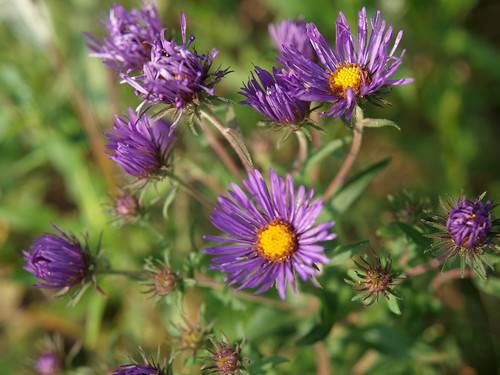
New England Asters

New England Asters © 2008

The last show of wildflowers in the prairies are in bloom. The prairies are full and thick, now beginning to yellow a bit. The New England Asters are easily cultivated, and found in many gardens, but they are especially handsome in the thickets of grasses on the prairie.

Rosin Weed

Rosin Weed © 2008

What a name for one of the most perfect prairie wildflowers I’ve seen in a long time! Rosin Weed is an excellent flower for the prairie, and used extensively in prairie restorations as it is attractive to bees, butterflies and birds.  Its sap contains resin which was once used as a chewing gum. (Ick – I’d rather have peppermint myself.)

Blue Vervain

Blue Vervain © 2008

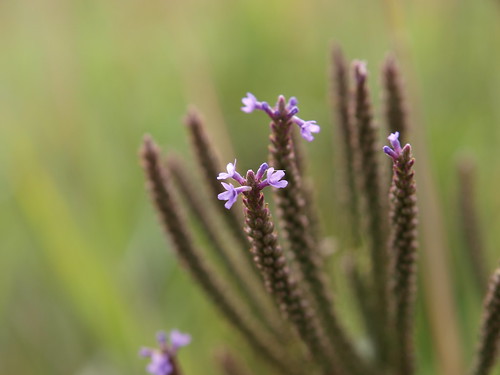
This would be an easy flower to miss, except it grows so tall the flowers tend to stick out over many of the shorter grasses. The Blue Vervain flowers themselves are tiny – less than 1/4″ wide – but the plant stands up to 6 feet tall.

Vervain was a popular plant, well-known for its many medicinal uses – made into a brew and used as a tonic, an aphrodisiac, and a sedative. Centuries ago it was hung on European peasants’ doorways to ward off the devil and other evildoers, and it was worn as an amulet to bring good luck.

Grasshoppers on A Cattail (X-Rated)

Grasshoppers on Cattails

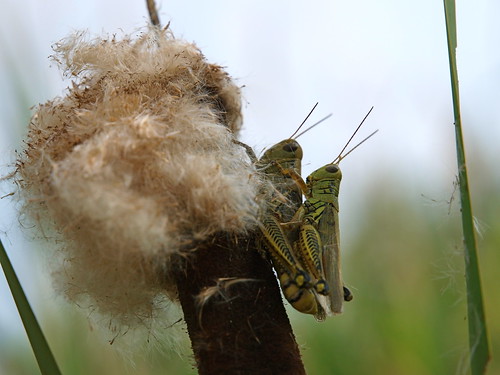
Differential Grasshoppers on Cattail © 2008

While hiking in the prairie just north of Madison, I noticed a cattail that had exploded with seeds. Upon further examination, I discovered two grasshoppers partially hiding in all the fluff. They seemed quite preoccupied and didn’t appear to mind my camera lens pointing within inches of them.

I think this may be my first ‘insect’ shot. I usually am too impatient to wait for insects, but this was a ready to take photo.

When I went to do some research on these complicated looking creatures, I found hundreds of pages of information on grasshoppers. I had no idea there were so many different grasshoppers.  I concluded that these were a pair of Differential Grasshoppers – what an odd name! – by the unmistakable black chevron pattern on their hind legs. Pretty cool pattern.

Wonders in the Tall Grass Prairie

http://farm4.static.flickr.com/3158/2815659223_713b8ee610.jpg

Path through a Tall Grass Prairie © 2008

A path leads through a small segment of a tall grass prairie. Oak savannas are spreading into the prairie in the background. This prairie will have a prescribed burn next year.

Fire plays an important role in managing prairies, just as it has been a natural and frequent occurrence on the grasslands for thousands of years. The prairie flowers, grasses and animals all rely on the burning, which prevents invasion by larger shrubs and trees, and removes most of the accumulation of mulch that typically smothers the growth of the small prairie plants, some nearly microbial in size.

Gayfeathers

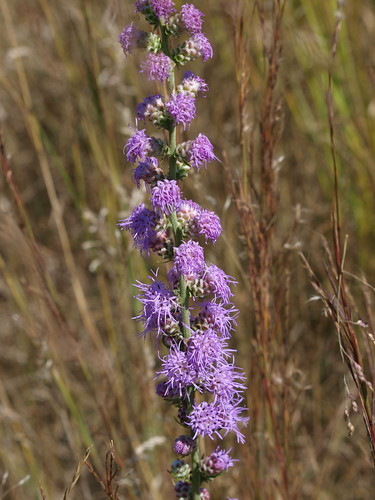
Marsh Gay-feather, A.K.A. Marsh Blazing Star © 2008

This late season prairie wildflower, Liatris spicata, blooms from the top down, instead of the more common bottom to top growing pattern. It is a favorite of many species of butterflies. It is a rather spectacular plant, ranging in height from 2 to 4 feet tall.  In fall, the deep brown seed head attracts dozens of yellow finches for a dramatic show. It is more common the further east you travel, though it was once abundant in southern Wisconsin.

Native Americans and early settlers considered the plant an important commodity due to its medicinal properties as well as its nutritional use. The Lakotas ground its roots to make an appetite stimulant, and also ate the entire plant to treat heart ailments. it was said to strengthen the “bound muscle with poor rhythm.” The plants’ corms were also used the Lakotas, as well as by other tribes and early settlers, as winter food.

Big Bluestem Grasses

Big Bluestem Grasses © 2008

The big bluestem is the tallest of the grasses, waving upwards of 8 to 10 feet tall. It is also referred to as turkey-foot grass, as the grass often splits into threes near its top.

There are five very well adapted perennial grasses which predominate the tall grass prairie or grassland biome: big bluestem, little bluestem, Indian grass, switch grass, and prairie dropseed. This woven masterpiece of fibers, which thread themselves together in a protective matting, allows the prairie and its smaller plants and animals to survive threatening winds, fires, drought, and prolonged, harsh winters.

I think there is nothing lovelier than walking through a tall grass prairie at this time of year, the winds gently pushing the tall stems above my head, and searching in the yellow-brown for purple asters, sunflowers and other late wildflowers – the harbingers of autumn.

Sunny Yellow Prairie Flower

Sweet Coneflower © 2008

This is a close cousin of the black-eyed Susan, the foliage is firmer and the plant tends to grow taller, up to 4 1/2 feet in height.  The name comes from the plant’s perfumery – rather a sweet anise- or vanilla-scent lingers when the leaves are crushed.

Summer is Browning

Browning Leaves

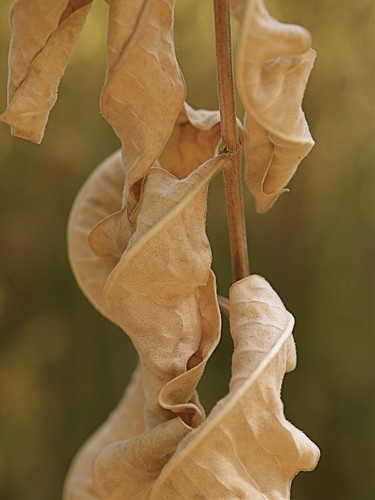
Browning Leaves © 2008

Out and about this Labor Day weekend, always seems like this is the last weekend of summer, though the calendar insists otherwise. But studying the prairie signs on this morning’s hike, everything looks very fall-ish. Seeds are turning dark and scattering, the asters are beginning to show purple, berries are ripening, and the leaves are turning a soft shade of brown.