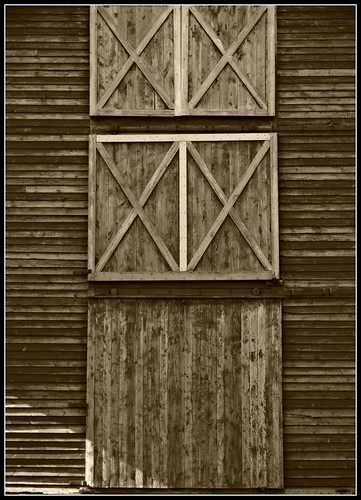
Barn Doors at Dawn © 2008 Bo Mackison
Three story barn. Three doors. At sunrise.
Door County WI.
Barn Doors at Dawn © 2008 Bo Mackison
Three story barn. Three doors. At sunrise.
Door County WI.
Whitefish Dunes State Park is on the Lake Michigan side of Door County, the large peninsula extending off the north-eastern part of Wisconsin. It has the only significant area of sand dunes on the western shore of Lake Michigan. The state of Michigan, 98 miles across the lake, sports much larger areas and much taller sand dunes.
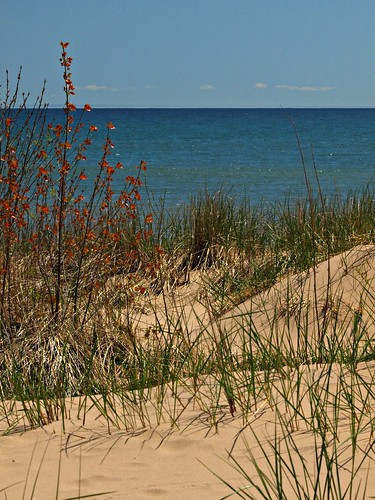
Lake Michigan Shore © 2008 Bo Mackison
Lake Michigan is the only one of the Great Lakes entirely within the borders of the United States; the others (Lakes Huron, Ontario, Erie and Superior) share with Canada. It is the largest freshwater lake in the US and the fifth largest lake in the world.
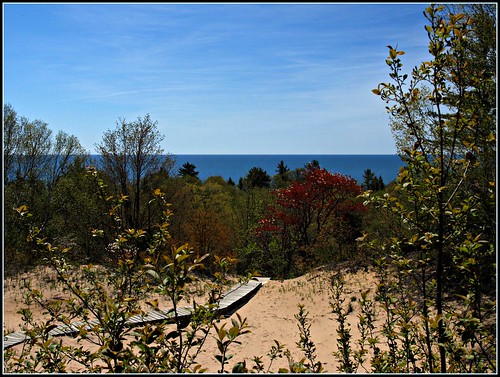
On Top of Old Baldy © 2008 Bo Mackison
A boardwalk leads to the top of one of the older sand dunes, Old Baldy, protecting the plants on the sides of the dune while allowing visitors to get a great view of Lake Michigan.
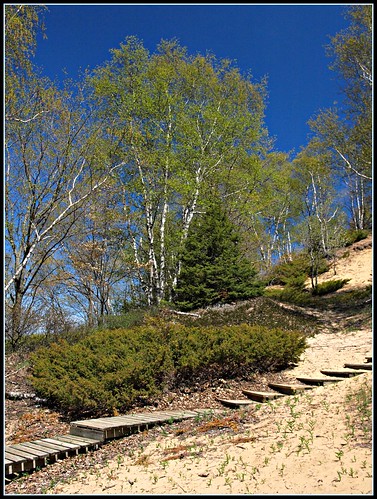
Sand Dune Trail © 2008 Bo Mackison
The Whitefish Dunes and the Whitefish Bay area were home to eight distinct and significant Native American villages, inhabited intermittently from 100 BC to the early 1800s, and the site is protected and listed on the National Register of Historic Places.
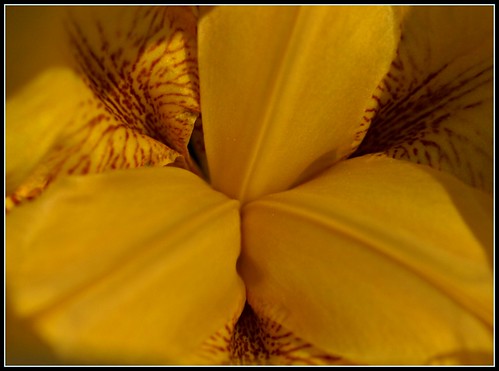
Garden Iris, Exposed © 2008 Bo Mackison
A yellow iris from stock that my grandfather grew when I was a young child, nearly 50 years ago. It is a deep golden yellow and it’s mahogany markings are stunning. This photo shows the very depths of the iris flower, at it’s very core.
This view is fitting – it represents the origins of my love of gardening and nature. My grandfather and I spent hours together each day from early spring to late fall out in his gardens. There I learned to tell the difference between a flower and a weed, to plant a seed and transplant a plant, and to care for a garden and then reap its rewards – beautiful flowers, luscious vegetables, and deep satisfaction and joy sharing in the beauty of nature and her gifts.
Three more wildflowers that I photographed last weekend in Door County.
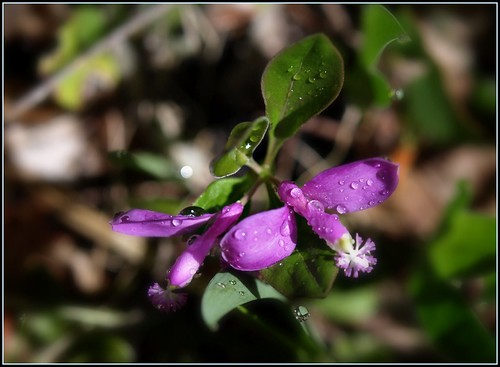
Gaywings © 2008 Bo Mackison
This little wildflower is Gaywings, also called Fringed Polygala, and it looks to me like a miniature airplane, grounded after a thunderstorm. It closely resembles an orchid, but is a member of the milkwort family. Folklore has it that if a tea made from the plant was consumed by nursing mothers or the plant was fed to cows, it would increase milk production. Found in northeast to north-central US and eastern Canada, it blooms in May and June.
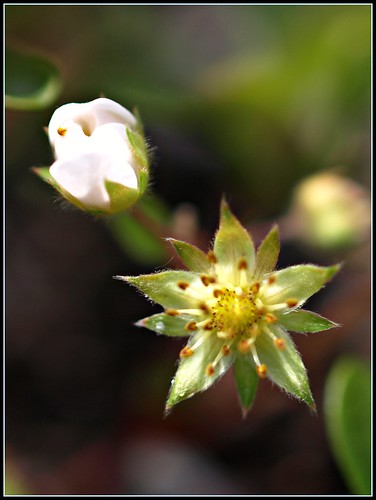
Small-Flowered Crowfoot © 2008 Bo Mackison
The Small-Flowered Crowfoot is a buttercup, but doesn’t much look like one except that it has many separate stamens and pistils. It is poisonous, though some Native American tribes pulverized the root and soaked it in water to make an antiseptic to cleanse wounds. The greenish flower is less than an inch in diameter and grows near the ground, so it is easy to miss. It blooms May through early June.
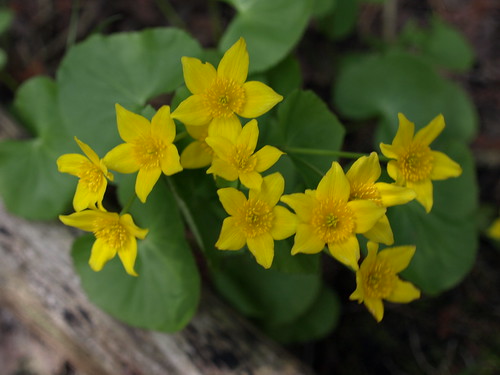
Marsh Marigold © 2008 Bo Mackison
The Marsh Marigold is one of only a few wildflowers that can grow in the middle of a stream. It has been known to grow so profusely as to give the water a yellowish glow. It was used medicinally to cure colds, anemia and convulsions, though the plant contains toxic glycosides which are only made harmless upon cooking. The flower blossoms make a sweet wine and they can also be used as a yellow dye. It blooms from late April through June.
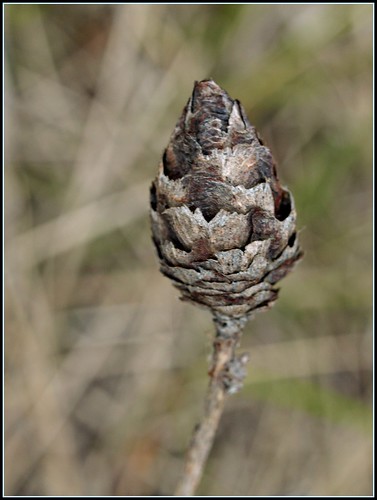
Willow Pine Gall © 2008 Bo Mackison
Can anyone out there identify this? Looks like a small tree or bush, about 2 feet high, and I found it growing in the Ridges Sanctuary in Northeastern Wisconsin’s Door County.