Articles by Bo Mackison

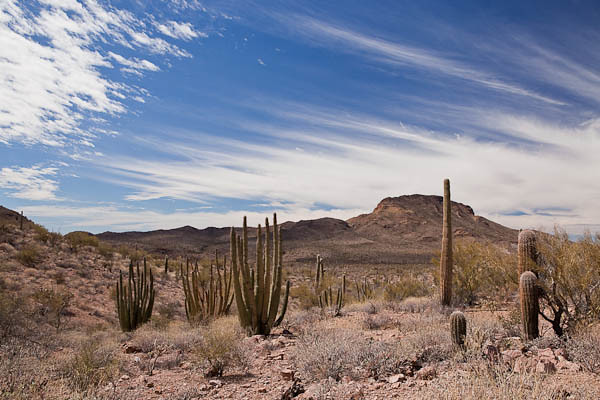
Organ Pipe Cactus National Monument

Organ Pipe Cactus at Organ Pipe Cactus NM

click Organ Pipes at Organ Pipe Cactus NM

Tramadol For Sale Online Journal Entry:

Tramadol 50 Mg Price 8:50 am. 74˚ F, windy, gusting to 30 mph. Sunny, no clouds, but dusty in the distance–the faraway mountains that I usually see in detail are obscured in a dust cloud.

Buy Valium Online Without Prescription I am quite fond of the organ pipe cactus. It doesn’t really live in this part of the Sonoran Desert, it has been planted by the Desert Museum staff. Before I go back to Wisconsin, I want to make one more trip Organ Pipe Land, to Organ Pipe Cactus National Monument, nearly three hours west of Tucson.

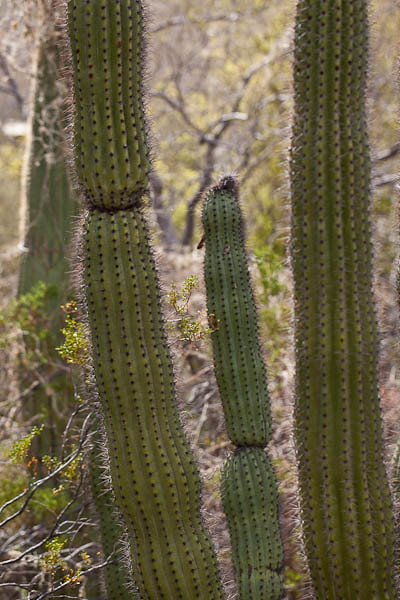
go to site Organ Pipe — this one has 14 arms. Are they called arms? Most of them come straight from the ground. Two arms on this plant have split–like twins–and have a V-shape at the top.

18 feet–tallest. 8 inches–shortest.

I wonder what makes the girth of the cactus pull in–like a cord was tightened around its circumference and then removed, leaving an indentation. It’s a handsome specimen with lots of strictures. I like its shape. It is more interesting, the changes. Wouldn’t be as visually appealling if each arm was perfectly smooth, all the way from bottom to the very tip.

Just like people. The prim and proper aren’t nearly as interesting as those who don’t insist on showing the world only their perfect selves. It seems the more mistakes one makes, the more chances, risks that person has taken, the more they have learned.

Mistakes = trying over and over until the problem is solved, the project is finished.

Sometimes a mistake is apparent–this organ pipe had a virus and one of its ends is malformed, bulbous, some might say it is ugly, but I think its curves and bubbled surfaces are distinctive. It doesn’t lessen the worth of the organ pipe in my eyes. It gives me something more to study, to contemplate. It’s like a bit of decoration on the cactus plant.

———

Bo Mackison is a photographer and owner of Seeded Earth Studio LLC. She is living in Tucson for two months, exhibiting her photography in art shows, taking photographs, and blogging about photography, art fairs, and living life “solo.”
Lessons from an Organ Pipe Cactus

Organ Pipe At Desert Museum

Organ Pipe Cactus © 2011 Bo Mackison

Sometimes I get so frustrated with carrying out my grand plans, I wish I could perform magic. I wish for a magic wand or a magic trick, when in actuality, all I need to do is do the work until the project is completed. Do the work? Does that mean I have to write all the steps down on a to-do list and then grind my way through each step until the project is completed?

Well, the bad news is, yes. Sometimes that is exactly what is required.

But there’s good news, too. Sometimes the plan requires walking down new paths, thinking new thoughts, exploring, questioning. All the while muttering, like Alice once did, “Curiouser and curiouser!”

———

I went to the Arizona Sonora Desert Museum early this morning. They open at 7:30 am which I think is a perfect time for an outdoor museum to open, especially one located in the middle of the Sonoran Desert. I can spend a couple of hours exploring the desert and taking photos, then spend a half hour writing in my nature journal while sipping a raspberry ice tea, and I pull my car out of the parking lot as the Sunday crowd is waiting in line to get in.

I spent quite a lot of time studying the plants, walking a while, then stopping again, taking my sweet time. Twice, I had a museum docent question me. The first gentleman asked me if I was OK. (I was. Yes, indeed. More than OK–I was feeling great.)  The second docent asked me if I was looking for something special. Well, I was looking for something special, but I didn’t say so because I didn’t know what I was looking for–and I didn’t, until I saw it.

Mostly, I was looking for new growth. For a sign of spring (what I, as a Midwestern, thinks of as spring) on this first day of spring. You would expect to see all kinds of growing things in the desert in spring, but it doesn’t work like that. It has only rained once since I arrived in Arizona on February 7th and then it was only a sprinkle. So there is much that is dry in the desert, and not much evidence of new growth.

———

Bo Mackison is a photographer and owner of Seeded Earth Studio LLC. She is living in Tucson for two months, exhibiting her photography in art shows, taking photographs, and blogging about photography, art fairs, and living life “solo.”
Empire Ranch

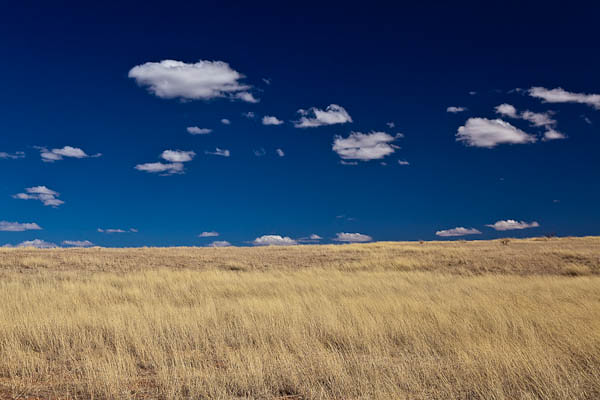
Grasslands

Sacaton Grasslands © 2011 Bo Mackison

I went on an “explore” yesterday. I headed east, and ended up on a narrow and dusty road, wiggled my car through a mountain pass near Madera Canyon, and crossed the Santa Rita Mountains. After an hour of driving, I ended up on the eastern side of the “Ritas”, near the town of Sonoita.

Then I saw a sign. It read “Historic Empire Ranch”. That was good enough for me. I turned and followed the road for a mile or so, eventually coming to another sign which informed me I was traveling in the Las Cienegas National Conservation Area. I don’t think too many people explore this part of Arizona, but I found it rather fascinating. Even more so when I started researching the ranch on the internet. I came across all kinds of interesting tidbits.

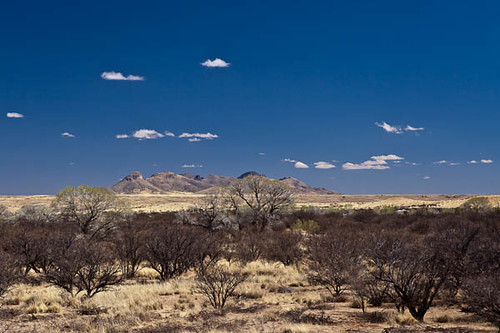
Mesquite Bosque

Mesquite Bosque © 2011 Bo Mackison

Las Cienegas NCA includes five of the rarest habitat types in the American Southwest: cienegas (marshlands), cottonwood-willow riparian forests, sacaton grasslands, mesquite bosques, and semi-desert grasslands. These habitats are home to a great diversity of plant and animal life, including several threatened or endangered species.

Bosque, the Spanish word for woodland, is used in the Desert Southwest to describe a woodland that develops near desert streams and rivers. It is a riparian habitat — the desert gives way to a ribbon of green where water flows and provides enough water to sustain trees and plants not commonly found in desert habitats. The most common trees are mesquites, usually Velvet Mesquite,  slow-growing trees that rarely exceed 25 feet height. The mesquite bosque is great habitat for mammals, birds, insects and reptiles.

There are a few cottonwoods and willows growing nearer the water source–the pale green trees which grow taller than the mesquite. And the Whetstone Mountains are in the distance.

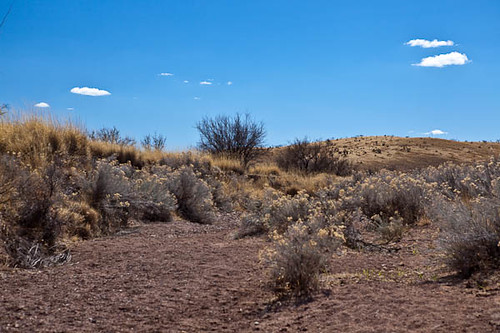
Dry Creek Bed

Dry Creek Bed © 2011 Bo Mackison

Not sure if this is the Las Ciengas creek bed or not. The Las Ciengas was described in my research as a perennial water source, but this has been an extremely dry year, so perhaps the water table is below the surface. This is one of the few areas that had something beside grasses and mesquite growing, so there was certainly water near the surface.

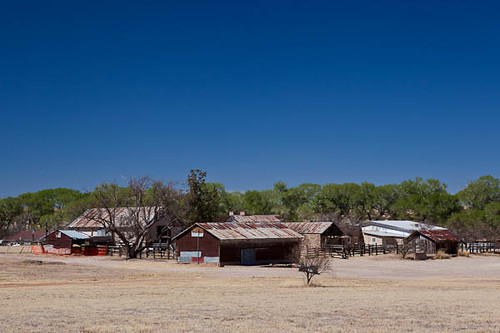
Empire Ranch

Empire Ranch Historic Buildings © 2011 Bo Mackison

After driving across miles and miles of grasslands, I came across this spread. The Empire Ranch is both a historic place  and a working cattle ranch. Located 45 miles southeast of Tucson near Sonoita, Arizona,  the Ranch began as a modest 160-acre spread in the 1870s. It was purchased by Walter Vail and his partners, and after many land purchases, the ranch ended up being almost one million acres in size. The 22 room Empire Ranch House is listed on National Register of Historic Places.

But the most interesting information I found was the extensive (and impressive) list of movies and television shows that had been filmed at the ranch or in the nearby area.

A partial list includes:

  • click Gunfight at the O.K. Corral, Burt Lancaster, Kirk Douglas, Rhonda Fleming (1957, John Sturges)
  • go to link Gunsmoke, James Arness, Dennis Weaver, Amanda Blake, several shows (1955-75 TV series, various directors)
  • watch The Cowboys, John Wayne (1972, Mark Rydell)
  • get link Pocket Money, Paul Newman, Lee Marvin (1972, Stuart Rosenberg)

So…now does this region look more familiar? So this is where the wild, wild west was…I’ve probably seen this wild country in quite a few old cowboy movies and television shows. Maybe you have too.

Amazing what can be discovered when you turn off the main road to see what there is to see.

———————

Bo Mackison is a photographer and owner of Seeded Earth Studio LLC. She is living in Tucson for two months, exhibiting her photography in art shows, taking photographs, and blogging about photography, art fairs, and living life “solo.” She crossed the mountain to see what she could see, and discovered a “bonanza” of history.
Solo in the Desert

Spiny Saguaro

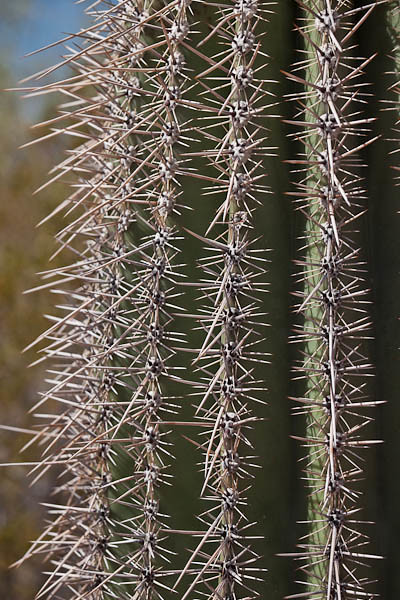
Spiny Saguaro © 2011 Bo Mackison

It seems I wasn’t paying close enough attention, and I’ve plunged into a sticky situation. Figuratively. It’s not that I’ve literally run into the sharp spines on this giant cactus. No, but today has been more of a challenge than I had hoped to deal with. I had family visitors for a few days, and I enjoyed showing them the local sights. Now they are back to the Midwest and I’m on my own again. So today I struggled with the “living solo” part of my Arizona plan.

I also learned a valuable lesson. When I was first on my own, in early February, I kept to a routine. I visited new places, went on lots of hikes, took photographs and processed them, and spent time reading, journaling, and exercising. It worked well for me, but I’m having difficulty getting back to my routine.

I know all the proper things to do when unexpected “blues” show up. Deep breathing, relaxation exercises, lots of distractions – reading, writing, listening to music. But I’m still struggling.

What I would really like is a big dose of chocolate, but unfortunately there isn’t any in the casita. Maybe tonight is a good night to get some extra sleep. The sun will be up bright and early tomorrow – and I’ll be up early, too. Ready to say hello to a new day.

——————–

Bo Mackison is a photographer and owner of Seeded Earth Studio LLC. She is living in Tucson for two months, exhibiting her photography in art shows, taking photographs, and blogging about photography, art fairs, and living life “solo.”
Hiking Madera Canyon – and Nature Journal Writing

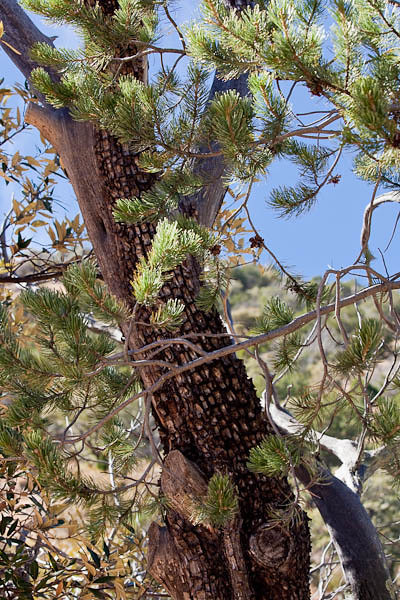
Alligator Juniper

Alligator Juniper ©2011 Bo Mackison

Another report from one of Southeastern Arizona’s Sky Islands. I hiked the nature trail in Madera Canyon. It’s a well known area for birders from throughout the United States, but I was there in the middle of the day when there were only a few hummers and lesser yellow finches flying from tree to tree. Madera Canyon is in the Santa Rita Mountains and part of the Coronado National Forest, located about 20 miles south of Tucson.

I hiked a trail that was at an elevation of 5ooo feet, in an area called Middle Madera Canyon. A creek runs along the trail, but there was only a bit of water trickling through the creek bed. Mostly there were dried leaves and rocks in the creek, and a few pools of water, inches deep. It’s been an exceptionally dry winter and spring. I’d be curious to know what this creek looks like during a typical spring.

This is a riparian area. It has deciduous trees–mostly the Arizona sycamore and cottonwoods. There are fir trees at this elevation, mostly alligator junipers, and several varieties of oaks. The river runs quite strong most years to support the number of large trees near its banks.

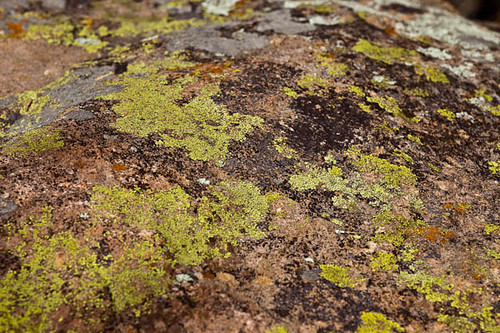
Green Lichen

Green Lichen © 2011 Bo Mackison

Another entry from my thirty minutes of “quiet time” and journaling exercise:

Many rocks, some covered with a light green lichen. There are several large pieces of dark gray slate. Dotted pink/gray granite. Another rock is pink/burnt orange and it has a sand-papery texture.

Sitting along side the creek. Moving water wriggles through the rocks, disappearing under last year’s dried leaves and fallen tree limbs. Moving water shimmers and shakes as it reflects sunlight, light rays bounce from mossy rock to mossy rock.

Still water is a mirror, showing the pool’s depth; it reflects my hand when I reach over the pool.

Two weathered limbs from the sycamore tree, each at least five feet long, are crossed to form a wishbone. Can I make a wish on a tree limb?  I wish . . .  to come back to Arizona next winter.

The sycamore tree’s bark looks like peeling paint flaking off an unpainted Wisconsin barn. Or does the barn look like bark from a mature sycamore tree? Arizona sycamores are different from the sycamores that grew in my neighbors’ yard in western Illinois. This sycamore is much smaller which makes sense as it grows with less moisture. The Arizona tree has smaller pieces of bark–looks like alligator hide.

The bark I remember from my childhood sloughed off the hundred foot tall tree in large pieces, rough and sand-papery, cream with silver gray blotches. As a child I wrote little stories for my grandpa on pieces of bark. My children did the same when they were young, writing “I love you” messages on the bark and offering them to me–gifts from the heart.

—————————-

Bo Mackison is a photographer and owner of Seeded Earth Studio LLC. She is living in Tucson for two months, exhibiting her photography in art shows, taking photographs, and blogging about photography, art fairs, and living life “solo.” She loves the sky islands and plans to visit several more before she returns to the Midwest.