Articles by Bo Mackison

Holliwell Bridge, A Bridge of Madison County

second in series of The Bridges of Madison County

source site second in series of The Bridges of Madison County

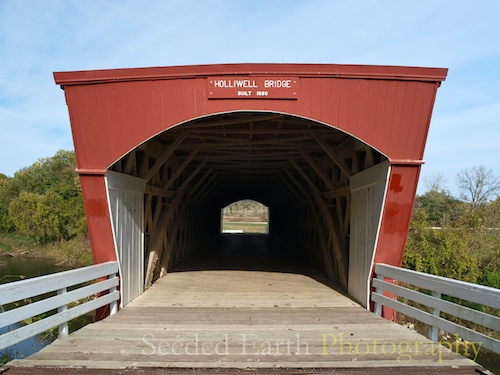
https://bettierose.co.uk/307_baker_fotor/ Built in 1880 by Benton Jones, it is the longest covered bridge in Madison County, Iowa. It measures 122 feet in length. It is one of only two bridges in the county that remains at its original site. It is located a few miles southeast of Winterset.
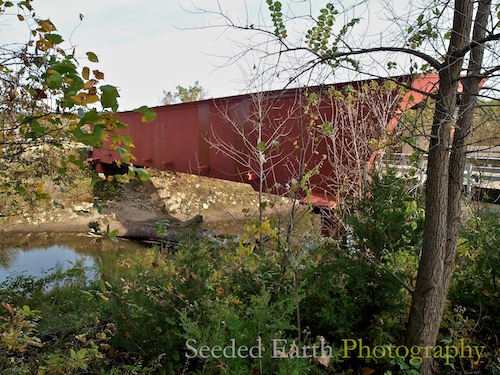
crosses the Middle River

enter site crossing the Middle River just outside of Winterset

Buy Soma Overnight It was featured in the 1995 movie, The Bridges of Madison County.

Imes Covered Bridge from Madison County

A Bridge of Madison County

see url First in a series of the Bridges of Madison County

Get Tramadol Online Remember the movie The Bridges of Madison County?   It was a hit in 1995, and nominated for an Oscar. (Meryl Streep for Best Actress in a leading role, but Susan Sarandon won for her role in Dead Man Walking.) Directed by Clint Eastwood, and produced by Eastwood and Kathleen Kennedy, the film is a narrative about choices and consequences.

https://www.completerehabsolutions.com/cognitive-screening-assessments/ The story begins: It is autumn, 1965. Robert Kincaid (Clint Eastwood) comes to Madison County, Iowa, to photograph the Roseman and Holliwell covered bridges. He is a professional photographer on assignment to the National Geographic magazine and he is lost. Pulling his green pickup into the driveway of a farmhouse, he asks for directions. Francesca Johnson (Meryl Streep) is at home, alone.  Her husband and two children are visiting the Illinois State Fair for the next 4 days. Francesca has been married for 15 years and is anticipating “time alone with herself” as the stranger approaches her for information.

https://hymnsandhome.com/disclosure-statement/ The movie was adapted for screen by Richard LaGravenese from Robert James Waller’s novel, The Bridges of Madison County.

https://geneticsandfertility.com/services/sperm-testing/ The Bridges of Madison County was made on location in Madison County not far from Des Moines in central Iowa.

Madison County originally had 19 covered bridges, but only six remain today.

The large number of covered bridges in this one county began as an economical move. The bridges were covered by order of the County Board of Supervisors in the early 1880s to help preserve the large flooring timbers. The floor boards were much more expensive than the lumber required to cover the sides and roof of the bridge.

Typically the bridges were named for the resident (or residents) who lived nearest to the bridge, an easy referencing method for the locals.

The oldest of the remaining covered bridges, the Imes  is 81 feet in length. It was originally located over the Middle River west of Patterson, Iowa. In 1887 it was moved to a spot over Clinton Creek southwest of Hanley.  The Imes Bridge was moved again to its present site over a natural ravine just east of St. Charles in 1977 and renovated in 1997. All 6 bridges are listed on the National Register of Historic Places.

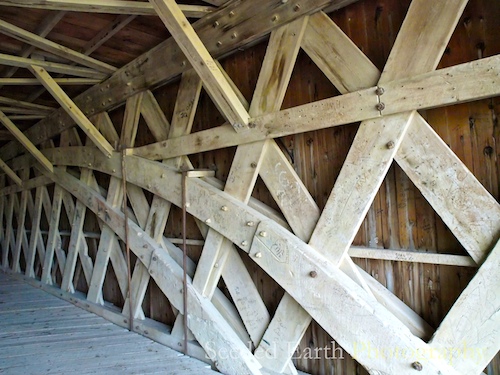
Interior Woodwork

Interior Woodwork

There is a fair amount of heavy duty wood reinforcing the inside of the barn.

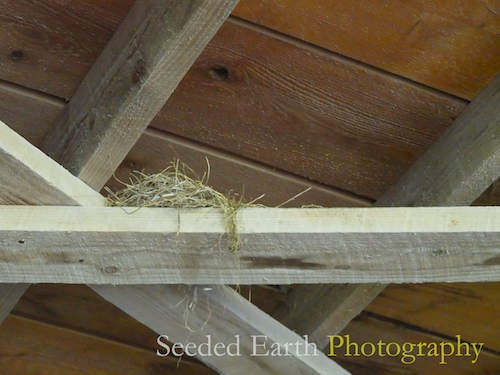
Even a Birds Nest Finds Cover

A Bit of Nature, Too

Even the birds’ can get their nest covered in Madison County–if they build them in the eaves of the covered bridges.

I took photographs of the six bridges last autumn, on our trip home from the Southwest. There are more to come.

(I am plain worn out posting all those “whites in winter” shots. At least the bridges are mostly red, and surrounded by green trees and grass.)

After the Storm

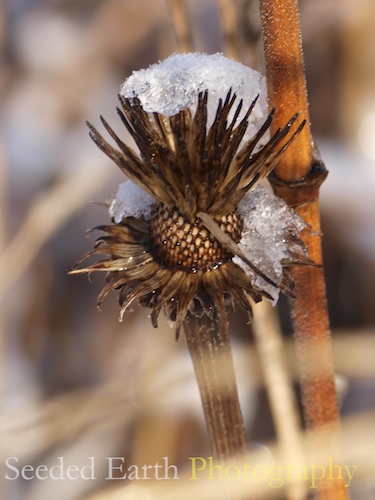
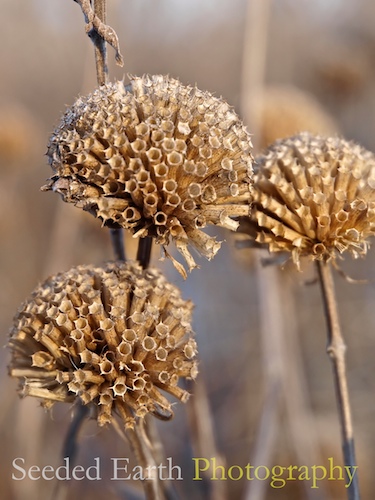
This Plant Wears an Icy Top Hat

This Plant Wears a Fancy Cap

Some photographers are sharing their photos of wildflowers in candy-pink and sunny-yellow.

In Wisconsin, the wildflowers are wearing crystals for dressing-up.

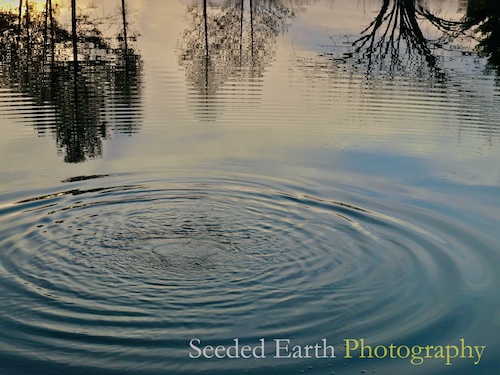
Ripples on the Pond

at Sunset

Reflection at Sunset

Things wabi-sabi have a vague or blurred feeling as they approach nothingness.  Bright, deep colorations fade into the colors of dawn and dusk.

Ripples radiating, gradually fading.
Reflection of the trees and sunset, gradually fading.
Fading into nothingness.

Wintering Over

another wabi-sabi bit of nature

another wabi-sabi bit of nature

“Simplicity is the core of wabi-sabi. Nothingness is the ultimate. But before and after nothingness, simplicity is not so simple.” Leonard Koren

Wabi-sabi asks that the essence is pared down, but not stripped of its poetry and emotional warmth. That which binds the meaningful into a whole remains intact. Wabi-sabi does not lessen the quality that compels one to look at something, and then look again and again.