Hell’s Half Acre – Lava Trails in Idaho

Hell’s Half Acre © 2010 Bo Mackison

You never know what you will see when you are on the road. Driving south on Interstate 15 in Idaho, we pulled off in a rest area to have lunch. I went for a walk around the area to stretch my legs and discovered two hiking paths behind the visitor center – two developed trails that stretch for several miles through the lava beds.

The lava trails pass through the Snake River Plain, a desert ecosystem, that has rough terrain and contorted scenery that have been created from repeated lava flows. These are not lava flows from the nearby Yellowstone explosions, but from less violent lava flows only 4100 years old.There are many native plants growing along the trail including juniper trees, sagebrush, rabbitbrush, bitterbrush and needle and thread grasses.
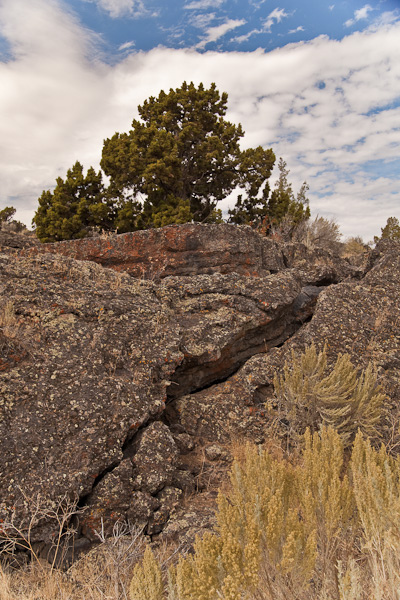
Utah Juniper on Lava Bed © 2010 Bo Mackison

The area has been designated a National Natural Landmark which affords it protection from development. The rest areas on both southbound and northbound I-15 have lava trails maintained by the Bureau of Land Management. They are located about 20 miles south of Idaho Falls; the exits are each marked “Blackfoot Rest Area”.

What a great find!
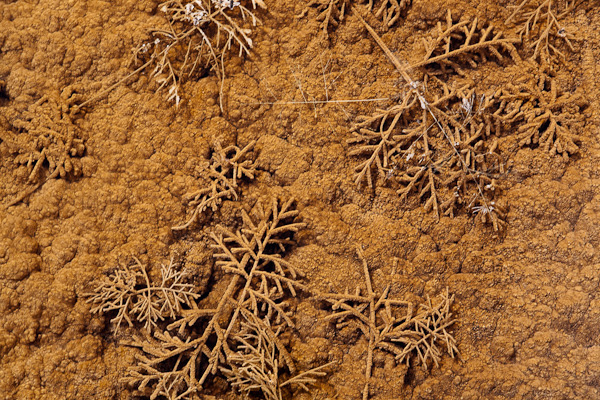
Mineralized Pine Needles in Mammoth Hot Springs

Mineralized Pine Branches © 2010 Bo Mackison

These pine needles were washed into the Mammoth Hot Springs and are lying in several inches of heated spring water. They will eventually be coated with mineral deposits. When the water stops flowing, they will turn into white travertine rock.

I love these close-ups of the hot springs. I took quite a few working on different compositions. Some have twigs, some branches, some a mixture of both. A few have white tips showing where they are exposed to air.

Scalloped Edges in Minreal Hot Springs © 2010 Bo Mackison

These were photographed at Canary Spring on the Main Terrace of Mammoth Hot Springs in Yellowstone National Park in early October.

Canary Spring at Mammoth Hot Springs

Mammoth Hot Springs in Yellowstone National Park

Canary Spring © 2010 Bo Mackison

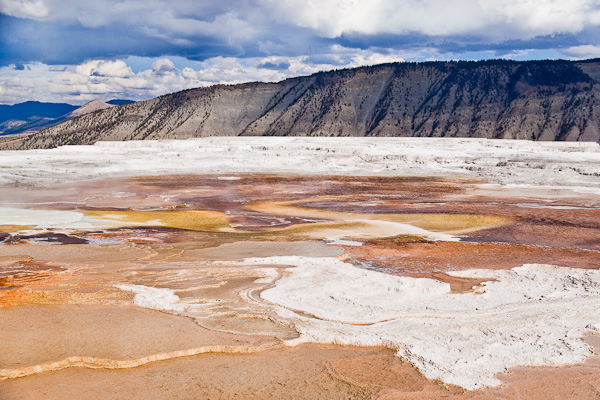
Not all of the terraces at Mammoth Hot Springs are chalky white and dry. Canary Spring at the top of the Lower Terrace flows with heated water that has been moving underground for many years. The vibrant colors – oranges, yellows, dark reds – are caused by cyanobacteria and algae mats. They depend on a stable flow of hot water to stay alive. When the water flow decreases or stops, the micro-organisms die and the colors turn into stark white travertine which covers much of the terraced landscape.

Canary Spring is near the top of the Main Terraces, reached by walking a series of boardwalks and stairways through the Mammoth Hot Springs or by driving the Lower Terrace Overlook Road just south of Mammoth.

Just one more thermal feature photographed in Yellowstone National Park.

Terraces at Mammoth Hot Springs in Yellowstone National Park

Lower Terraces at Mammoth Springs @ 2010 Bo Mackison

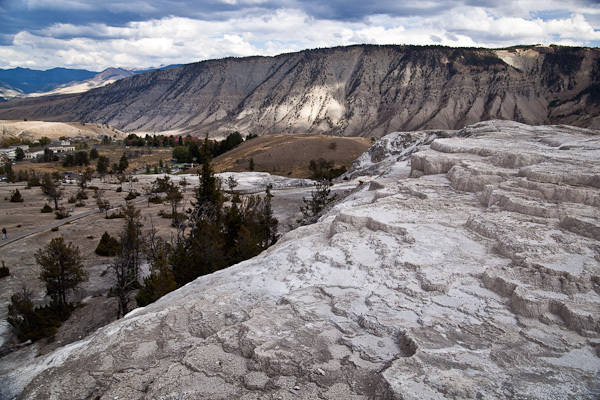
The Mammoth Hot Spring Terraces in the northwestern corner of Yellowstone National Park are easy to drive by. They look like large terraced white rock. Nothing spurting hot water, no geyser countdowns, no bubbling pools. You only get the rewards when you walk up and down the many planked steps and boardwalks. Then the beauty of the hot springs, often a rugged beauty, can be seen.

The terraces are formed when hot water carries dissolved calcium and bicarbonate to the surface of the terraces. The carbonate and calcium combine to form a hard rock known as travertine. The abopve photo features a large terrace of travertine — bright white steps which turn a greyish color as they weather. In other areas of the terraced hot springs, water is running and it changes the colors of the white-gray rock.

Not all areas of the terrace have water flows. When we were there a week ago, there were only two areas that had pools. Most of the hot springs were the whitish-gay dry travertine.

Emerald Pool at Yellowstone National Park

Emerald Pool © 2010 Bo Mackison

Emerald Pool is sometimes a lovely shade of green. That makes sense when you consider the water is a deep blue and the lining of the pool is a bacteria-laden yellow. However the pool has been decreasing in temperature because of a combination of natural debris and materials thrown into the pool by visitors. This is causing the rim of the pool to darken to a brown color.

I photographed this pool with and without a polarizing filter. Usually I preferred the photographs of the hot springs and geysers with the polarizer to cut the reflections from the surrounding features and sky. Not so this time. When I used the filter, the reflection of the sky and trees disappeared and the pool was partly a dark brown and partly a lighter muddy color. I preferred the photographs of Emerald Spring with the added colors from the reflections.
This hot spring is part of the Black Sand Basin located near the Old Faithful Complex in Yellowstone National Park.