Gratitude – A Desert Wisdom Card

Gratitude - A Desert Wisdom Card

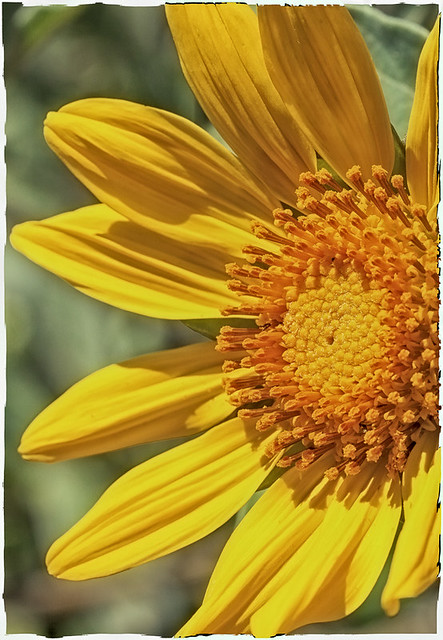
Sunny Sunflower © 2013 Bo Mackison

Gratitude unlocks the fullness of life. It turns what we have into enough, and more. It turns denial into acceptance, chaos to order, confusion to clarity. It can turn a meal into a feast, a house into a home, a stranger into a friend. ~ Melody Beattie

Sunflowers abound in the desert garden, grateful for the warmth.

When I see a sunflower with its face turned towards the sun, I am reminded how simple it is to turn my face to the sun. To give thanks for its presence, its warmth. To give thanks for all that is good – the blade of grass growing through pavement cracks, the rainbow peeking from stormy clouds, a bright flower adding color to the moment.

Gratitude makes sense of our past, brings peace for today, and creates a vision for tomorrow.
~ Melodie Beattie

Everyone knows that it is the polite thing to say thank you.

But university studies throughout the world, including a recent study from University of California at Berkeley, find that gratitude has positive physical and emotional effects. A gratitude practice — not just an occasional or perfunctory thank you — offers proven benefits: stronger immune systems, lower blood pressure, a measurable increase in joy, optimism,happiness, generosity and compassion, and fewer feelings of loneliness and isolation. Gratitude is not only good for the world, it is good for the individual.

“Cultivate the habit of being grateful for every good thing that comes to you, and to give thanks continuously. And because all things have contributed to your advancement, you should include all things in your gratitude.”
~ Ralph Waldo Emerson

It is easier to be grateful for the joys of our life, but even the rough spots deserve our gratitude.

We are the sum of our experiences – the difficult days, the soured relationship, the trip of a lifetime, a chance meeting of a stranger who becomes a treasured friend. Each experience has its own lesson.

GRATITUDE offers questions/reflections for journal writing, art activities, calls for action:

  •  The lessons we learn from each life encounter are valuable. Write about the gifts received, not only from the brightest of times, but also from shadow experiences. Notice your response as you write. Seek the hidden gifts in each experience and accept all gifts with gratitude. How easy or difficult is this process for you?
  • There are so many advantages to beginning a gratitude practice and it requires so little time, this may be one of those practices that you won’t want to skip. One of the main findings of gratitude studies is the effectiveness of practicing gratitude on a schedule. It is the habit — whether it be daily, three times a week, or weekly — that produces the benefit. There are many ways to begin or add a gratitude habit to your life:
    • Write your gratitudes in a gratitude journal. Write 5 a night. 10 every morning with your coffee or tea. Or set aside ten minutes and write until the timer rings. A gratitude journal also makes for a wonderful read when you need a pick-me-up.
    • Find a partner and play the gratitude game at a scheduled time. Tell each other 5 things for which you are grateful. Or take turns mentioning a gratitude while on your daily walk —  around the block, through your garden, to the mailbox and back.
  • Gather a collection of postcards. Pick up a few at your local drugstore, college bookstore, or tourist trap. Buy postcard stamps, too. Send thank you postcards. Everyone loves to receive a written thank you note.  Keep it simple, but be specific. “Thank you for listening to my worries at midnight.” “Thanks for the zucchini from your garden.” Thanks for taking care of my cranky cat.”
Claiming My Lineage – Grandma Prudie

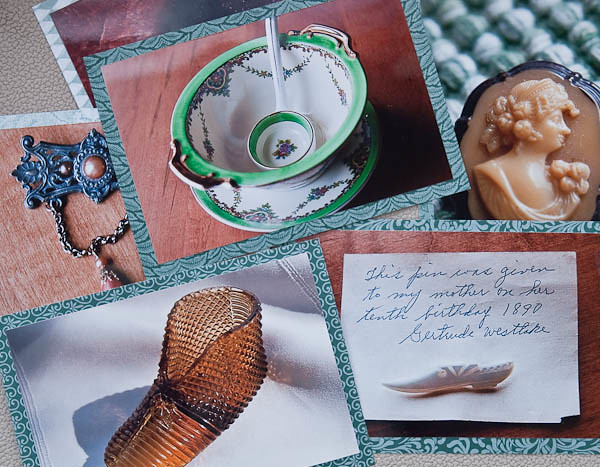
Remembering Grandma

Remembering Grandma © 2013 Bo Mackison

A grandmother is a little bit parent, a little bit teacher, and a little bit best friend. ~ Author Unknown

*** In Jen Louden’s TeachNow course, each participant is “invited to become a story gatherer and story creator,”  and to “claim and own our authority and lineage” in order to better step into the teacher we are (or are becoming). In order to claim my lineage, I recalled past teachers in my life – childhood, youth, student, adult – and identified those people, places, books, experiences — positive and negative — that were influential in shaping the person I am today.

This post is the second in a series on gathering stories and claiming my lineage.

I rocked hard in Grandpa’s rocker as I watched the kitchen clock. The minute hand barely moved. I’d waited nearly an hour. My Great Grandma Prudie had promised we’d pull taffy that morning, but the day was half over. Prudie kept her promises, so I practiced an uneasy patience.

We had watched The Lawrence Welk Show the night before – Prudie, Grandma, Grandpa, Dad and Mom and me. After the show, Prudie had looked at me with her trademark pixie grin nearly hidden in her wrinkled face.

“Bo, let’s go in the kitchen and check out the pantry. Let’s cook tomorrow.” I was always game when Prudie began a kitchen project which mostly involved satisfying her occasional sweet tooth. Prudie at eighty-one no longer cooked the family meals. After 60+ years of kitchen responsibility, she’d handed her apron over to her daughter, grand-daughter and great-granddaughters. But she occasionally enjoyed a kitchen adventure with me.

My unusual family living arrangement was one of my childhood blessings, and surely is a part of my creative lineage. Prudie was my mother’s mother’s mom. She lived in the first floor apartment with my Grandpa and Grandma, although her bedroom was in the back of my family’s upstairs apartment. My mother, father and I lived in an apartment on the second floor, and my bedroom was carved out of an attic space on the third floor. The spaces were a mix and match affair, few doors, no locks. I wandered freely from adult to adult, and learned by watching and doing the things they were doing — sewing, gardening, knitting, woodworking, cooking and baking. It was an endless potpourri of activity.

Prudie was a storyteller, and as long as my mother and grandmother were out of earshot, Prudie discussed any subject that came to her mind.  My mom and grandmother often forbade me to listen to Prudie’s tales, but Prudie only waved her hand at them in dismissal. “Pshaw!” she’d mutter, and then laugh.

Prudie thought children should learn about “real living.” She talked about life, even when life didn’t include Princesses and Prince Charmings.  Especially then.

She told me about marriages that were not the “happily ever after” kind. When Prudie was only nineteen, she’d married a railroad man. It was 1900. My grandmother was born a year later. When baby Pearl was a week shy of her first birthday, her father left for work, saying he’d be gone a fortnight, but he never returned. Family life wasn’t what he’d envisioned.

So Prudie and Pearl temporarily moved in with family while my great grandma took a practical nurse’s course by mail. She memorized two medical texts and some practical nursing books. Then she worked as a licensed practical nurse, caring for people in their homes, until she met the man she married when my grandmother was in high school.

The medical textbooks she studied from in 1902 lined the shelf of her bedside table throughout my childhood. Prudie let me page through the books whenever I wanted, never censoring the content. We would page through her Human Anatomy book as casually as we paged through my Little Golden books. The diagram of the body’s circulatory system in red and blue ink was equally as interesting as Brer Rabbit’s adventures.

“A child’s curiosity is a good thing,” she would say. “Children should be exposed to ideas, even ideas that are out of the ordinary or strange. Life is strange.”

We discussed women’s rights in detail. (“Women are just as smart as men, we can do anything with our minds they can do. You remember that. You wait and see. Your world will look a lot different from the world I grew up in.”)

We discussed education. (“You keep to your studies. That’s your ticket to the big world. No one’s ever gone to college in our families, but that’s no reason to stop you from stretching your wings. You go to college. Learn something you really want to learn.”)

We discussed relationships. (“Don’t ever stay with someone who doesn’t respect you, who doesn’t treat you as an equal. There is no shame is leaving a marriage if it’s not a good marriage. No shame at all. Better yet, marry a man who respects you. A good marriage is more precious than a pile of money.”)

We discussed beauty and art as she arranged garden flowers in vases or copied drawings from the Garden Extension pamphlets onto the backs of envelopes or brown paper bags that she then pinned around the hallway mirror. We kept warm under quilts that she pieced and sewed by hand and she taught me to crochet doilies by the dozens. (“There isn’t any excuse for a home not to have a bit of finery. It makes a person’s heart glad.”)

We discussed the importance of play and friendships and she allowed me to enter the world of her grown-up playtime, if only to serve the cake and pour the coffee. (“If I didn’t have the ladies over to play Pokeno and brag on my cake once a month, I’d grow up to be a cranky old woman.”)

I no longer have any interest in crocheting doilies or piecing quilts by hand, but I o remember the nuggets of wisdom my great-grandmother freely dispensed. I learned to value her opinions on women’s equality, education, relationships, and the arts. I learned to model her love for head-on living.

And I am grateful that she thought it only natural to feed a child’s insatiable curiosity with knowledge and hands-on experience.

———————

Bo Mackison is a photographer and owner of Seeded Earth Studio LLC. She is exploring her lineage with Jen Louden and other TeachNow participants.  Memories of Bo’s grandparents are in her thoughts often; she mentions them frequently in her gratitude journal.


Generosity – A Desert Wisdom Card

Completion - A Desert Wisdom Card

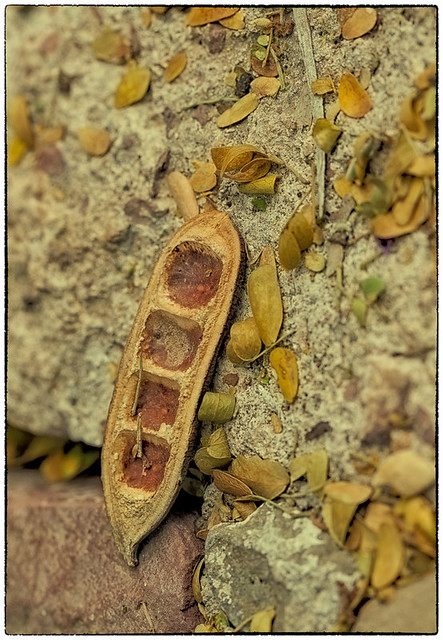
Seed Pod © 2013 Bo Mackison

“You give but little when you give of your possessions. It is when you give of yourself that you truly give.”
  ~ Kahlil Gibran

The four chambers of the seed pod are empty.

The seeds are scattered, and the earth is gifted with the possibility of new life. The seed pod has done its part.

Nature supports us with no request for thanks. The seeds open. The sun rises and sets. Plants grow, flower, set fruit, set seed. The seeds are dispersed, the cycle continues.

“For it is in giving that we receive.” St. Francis of Assisi

When we give of ourselves, when we give from our heart, we pass on our gifts and in doing so we also are the recipient.

The gift to oneself is in the giving — no expectations, no reciprocity, no keeping score. How our gift is received is not within our control, nor is it the reason for gifting. True generosity is unconditional generosity.

The wise man does not lay up his own treasures. The more he gives to others, the more he has for his own. ~ Lao Tzu

GENEROSITY offers questions/reflections for journal writing, art activities, calls for action:

  •  Time is a precious commodity, perhaps even more so than money. The pithy advice from Ben Franklin – “Time is money.” – encourages us to value productivity. But sometimes wasting time is exactly what we need. Thich Nhat Hanh offers this life recipe: “Smile, breathe and go slowly.” Consider stretching a five-minute walk into a ten-minute walk simply for the experience. No reminders to smell the roses, practice mindfulness – simply walk at a slower pace and notice what happens. A tiny gift of generosity to oneself primes the pump to practice generosity.
  • Generosity with one’s thoughts requires no planning, no financial encumbrance. Mental gifting of a blessing, a prayer, a kind thought reaps benefits for both the giver and the recipient. A simple Buddhist teaching, the Metta Chant, offers generous thoughts for all. “May all beings be well and safe, may they be at ease.” It is easy to remember and repeat frequently, although it can be a challenge to apply this gift to all equally.
  • Consider adopting a practice of generosity. Abandon a gift — a handwritten copy of a poem, an uplifting message, a small piece of art — where someone will unexpectedly find it, perhaps on a bench or hanging from a low branch of a tree. Attach a note of explanation that this is a gift for the finder.

————

Bo Mackison is a photographer and owner of Seeded Earth Studio LLC.  Bo is creating a deck of Desert Wisdom Cards for exploration and discovery, using a Sonoran Desert theme – its myths and stories, cultures and heritage, and the desert’s remarkable natural beauty and resources.

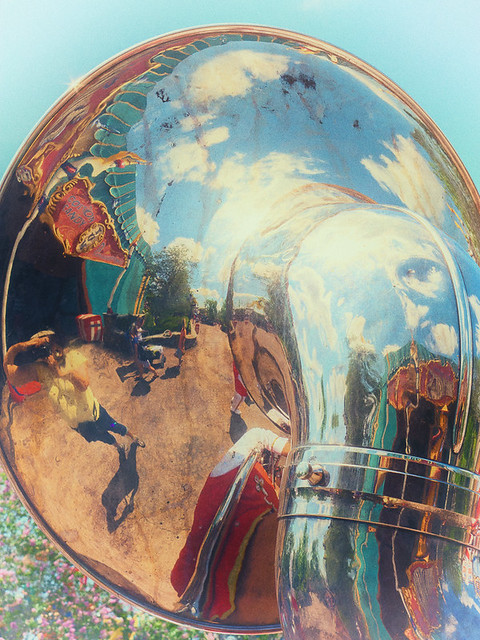
Tuba Reflection – A Self Portrait

Self Portrait in Tuba Reflection

Tuba Reflection – Self Portrait ©2013 Bo Mackison

We keep on moving forward, opening new doors and doing new things because we are curious and curiosity keeps leading us down new paths. ~ Walt Disney


The Main Street Philharmonic Marching Band.
Cardinal-red band uniforms, gold epaulets,
Shakos with white plumes.

A blue sky-fluffy cloud kind of day.
A tarnished tuba.
Sousa’s Fairest of the Fair.

Fantasy Land.
Where dreams come true, but still require hard work.

There’s always a new path to follow.
Explorations and adventures.

Take a photograph of the silver tuba,
and the photographer and her camera
shine in the reflection.

————–

Bo Mackison is a photographer and owner of Seeded Earth Studio LLC.  Magical photos happen in magical places.

Epcot Adventures

Fluttering Above Epcot

Fluttering Above Epcot © 2013 Bo Mackison

All our dreams can come true, if we have the courage to pursue them. ~ Walt Disney

I’m on my way home after spending a week at Disney World, celebrating birthdays and family. Disney World isn’t exactly my type of habitat. Deserts and prairies are more my style. But I have to admit that a visit exploring the Magic Kingdom, Epcot, and Animal Kingdom is an eye-opening experience.

I kept imagining the working mind of Walt Disney as he created the first Disneyland in 1954. His idea of having a theme park with five different lands – Main Street, Fantasy Land, Adventure Land, Tomorrow Land, and Frontier Land — for families to enjoy and explore still has an amazing appeal.

A Florida Disneyland was a twinkle in Walt Disney’s eye when he died in 1966; his brother Roy completed the dream and Walt Disney World opened in 1971. There isn’t a space that doesn’t hold a bit of magic, a surprise, or a moment that makes one smile remembering the memories of the early world of Disney.

———–

Bo Mackison is a photographer. She is waiting in an airport, imagining all the creative projects awaiting her in her studio in Wisconsin.