Parting Gifts from the Desert

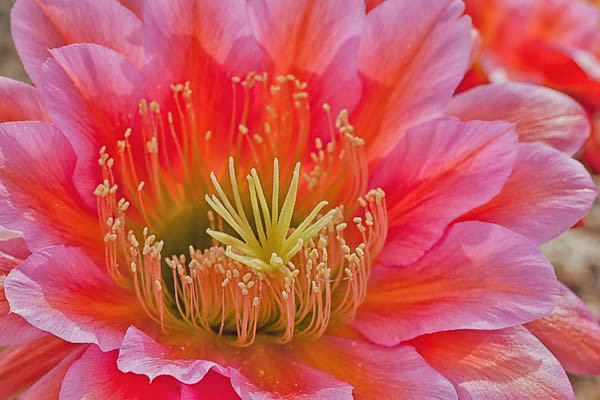
Macro Torch Cactus

Torch Cactus © 2012 Bo Mackison

My heart found its home long ago in the beauty, mystery, order and disorder of the flowering earth. ~ Lady Bird Johnson

I am on the home stretch — literally. In 36 hours, I will point my car towards the east, and then north, to begin the long drive home. Happily, Sherpa is flying in tomorrow, so no one has to drive alone for three and a half days.

I had today and tomorrow scheduled with packing, returning library books, changing addresses, saying good byes with neighbors and arranging for the many things that need arranging before a long trip.

And then I received an email from the Arizona Sonora Desert Museum. They were sending a short note to all their members  to let us now that the dazzling “Fireworks Cacti” were now in full bloom, and would be for only a few days.

So instead of following my original plans, I made room in my schedule for a three-hour photo shoot of some of the most unusual cactus flowers I have ever seen.  The flowers are in all the warm colors one associates with desert and heat — yellows, hot pinks, oranges, reds. Once I saw the cacti all in bloom, I had a very difficult time leaving. (I finally left after I’d taken over 600 photos, but only because I had filled my 16 gig memory card — and that’s a huge card!)

So — the cactus are called Torch Cactus, and they bloom for only a few days each year. They are not a native plant to the Sonoran desert, but they thrive here, and have become a landscape favorite because of their hardiness and beautiful color displays.

I promise. There are many more amazing photographs of these very photogenic flowers to come.

—————–

Bo Mackison is a photographer and owner of Seeded Earth Studio LLC. She traveled to Arizona to live and photograph the desert’s beauty for one hundred days. Getting ready for a drive.
Desert Yucca

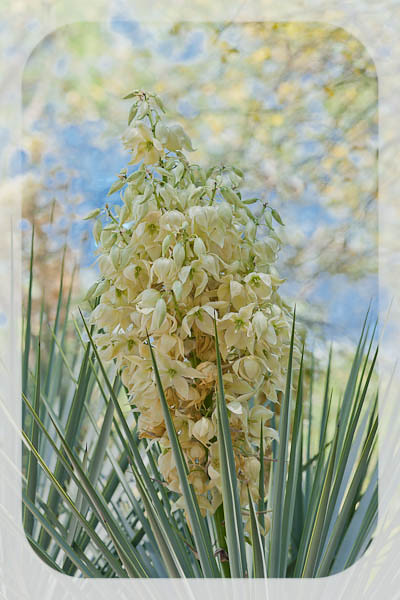
Yucca in Bloom

Yucca in Bloom © 2012 Bo Mackison

The yucca is one of the more prominent plants in the desert Southwest when in bloom, sending a long stalk eight feet into the air topped  with white flowers.

These kinds of plants are common in the desert. For much of the year they grow low to the ground, green sharp spikes in a rosette. And then, spring arrives, a  few rainfalls followed by hot weather and the yuccas bloom soft and white.

The desert is a study in contrasts.

——————–

Bo Mackison is a photographer and owner of Seeded Earth Studio LLC. She traveled to Arizona to live and photograph the desert’s beauty for one hundred days. Down to the last two desert days.

Living the Desert Life – A Summary in Book Spine Poetry

Desert Views, The First Month

Living the Desert Life, The First Month © 2012 Bo Mackison

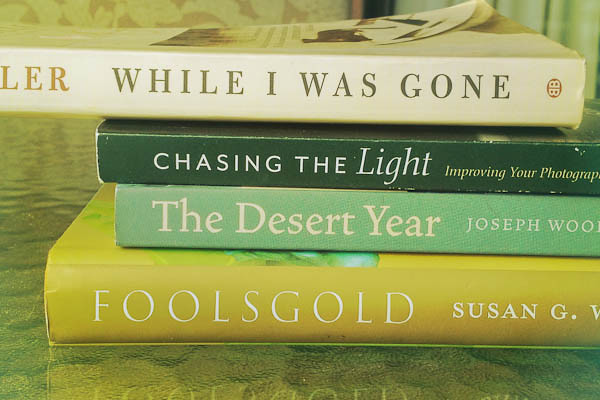
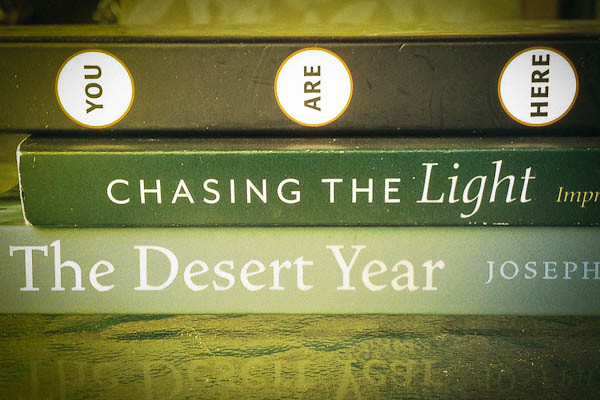
Here is the challenge: use book titles to create small haiku-like poems. A challenge I couldn’t resist.

And so I began. Considering I had limited resources while staying in Arizona, I decided to do a trilogy of book spine poetry using the theme of “living the desert”. That way I could use several titles more than once.

Living the Desert Life, The First Month

You are here.
Chasing the light.
The desert year.

Desert Views, The Second Month

Living the Desert Life, The Second Month © 2012 Bo Mackison

Living the Desert Life, The Second Month

While I was gone
chasing the light –
the desert year.
Foolsgold.

Desert Views, The Third Month

Living the Desert Life, The Third Month © 2012 Bo Mackison

Living the Desert Life, The Third Month

Savor
The desert year,
Chasing the light.

——————-

Bo Mackison is a photographer and owner of Seeded Earth Studio LLC, is  living and photographing in southern Arizona for a hundred days. Only three more days left.

Shrimp Plant

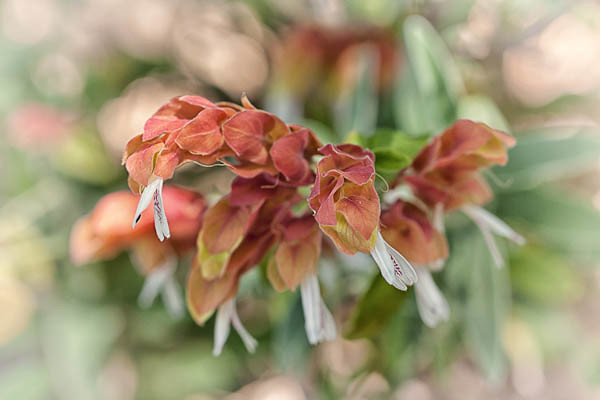
Shrimp Plant in Vignette

Shrimp Plant in Vignette © 2012 Bo Mackison

The sun doesn’t shine for a few trees and flowers, but for the whole world’s joy.  ~ Henry Ward Beecher

Yes. There is a plant called a Shrimp Plant, and once you’ve seen one, you forever know why it is called the shrimp plant. It looks almost good enough to eat. Roasted shrimp from Tucson’s first 100˚ day – yes, indeed! I was hungry and they looked tempting . . .

I visited the Tucson Botanical Gardens this morning, thinking I could be back home before it became too hot. I was wrong. I spent way too much time photographing Zen Gardens and wheelbarrows and shadows and fountains and sprinkling cans . . . you get the idea.

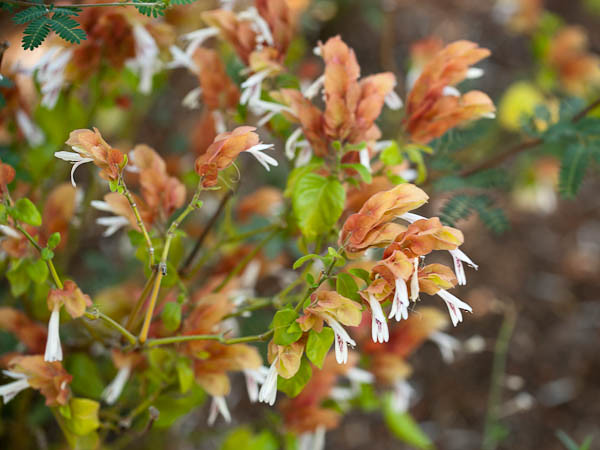
Shrimp Plant

Shrimp Plant © 2012 Bo Mackison

I also photographed this Shrimp Plant just before I left the gardens. Yes, it was two in the afternoon and way too bright, but happily these plants were in the shade. And yes, I was a bit worn out and did not set up my tripod because I had just packed it in order to leave.  But the wind was cooperative, I suppose, in that there was no wind.  And so I took several quick snaps of these beauties.

Really! Have you ever seen a flower that was as shrimp colored as a shrimp? And a flower that was both shrimp colored and the shape of a shrimp?

From my internet research, I discovered that these are tropical plants, native to Mexico, but popular as house and garden plants in the states of Texas and Florida. I didn’t see any references to Shrimp Plants in Arizona, but I know where several are blooming.

Visit the Tucson Botanical Gardens to get a look at the real thing.

———–

Bo Mackison is a photographer and owner of Seeded Earth Studio LLC.


Prairie Dog Babies

Six Week Old Prairie Dog Babies

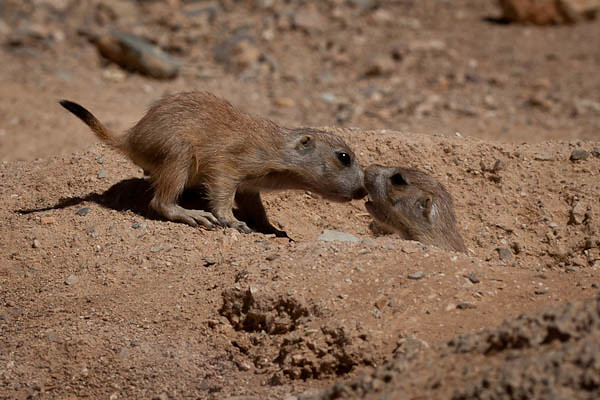
Prairie Dog Babies © 2012 Bo Mackison

Aren’t they cute? These prairie dog babies are about six weeks old, and it was only their second day out in the sun. Their mama had kept them safely in their nesting burrow until they were ready to meet the big world. They rub noses to greet each other, to say “hello”.

Animals aren’t one of my usual subjects, but I was wandering around the Arizona Sonora Desert Museum yesterday. I followed a path I had never been on before, rather amazed that in my dozens of visits to this mecca of desert learning I had never traveled this loop. I found myself in front of a large open exhibit of native black-tailed prairie dogs.

There were maybe fifteen to twenty adults out of their burrows, cavorting in the sun, standing watch, signaling to each other with a variety of calls and shrieks, and in general doing the animal things they do. One of the more interesting gestures I observed was a leap in the air from an alert standing position accompanied by a shriek – evidently an “all clear” signal. An attention getter, for sure.

It was a hot day and when I spotted an area of shade with an inviting bench, I stopped for a sit in the shade. Two nearby docents were discussing the prairie dogs with a couple from British Columbia, and it was evident from their exuberant commentary that they were true fans of these Prairie Dogs. In a few minutes I found out a huge amount of information:

  • Prairie dogs were once a common animal on the US Plains and in the western states, but eradication by ranchers, hunters, and state and national groups has reduced their populations to 1% of their original numbers.
  • In the 1970s it was erroneously reported that 250 prairie dogs could eat the equivalent amount of grass that one cow consumed, and so systematic poisoning was undertaken.
  • There was no any scientific proof that the prairie dogs interfered with the feeding of cattle. Instead, it has been found that the prairie dogs and cattle have co-existed for hundreds of years, as each prefers different grasses. Nonetheless, the myth remains and though prairie dogs populations continue to decline, they are not a protected species. Instead they continue to be needlessly killed.
  • The black-tailed prairie dog is the predominant prey for the black-footed ferret, once considered extinct until a small number were found in Wyoming. The black-footed ferret is prey for some of the threatened populations of falcons. Lose one species, lose others, too.
  • Just one more example of messing with the food chain. When one animal becomes extinct, suddenly it affects the status of many other animals. Makes one wonder how many kinds of animals can be forever lost to the earth before it has a detrimental impact on human existence.

I certainly didn’t expect to learn all that information (and much more) on my ten minute sit, but the docents were interesting, knowledgeable, and showed true compassion and caring for the animals in their care.

(Most of the animals at the Desert Museum, especially the larger mammals such as the mountain lion and black bear, are in this environment because they were rehabbed and are unable to live in the wild.)

—————–

Bo Mackison is a photographer and owner of Seeded Earth Studio LLC, living and photographing in southern Arizona until April’s end. Then she will return to her Midwest home where it is currently cloudy and the high is expected to near 45˚F.