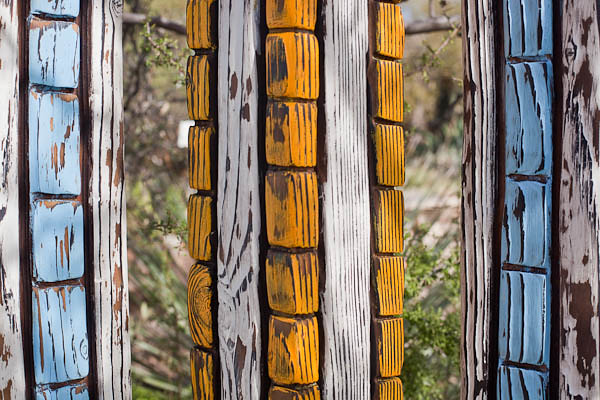
Sculptures for Bees?

Sculpture for Bees?

Sculpture for Bees? © 2011 Bo Mackison

As I was walking through the Arizona Sonora Desert Museum last week, I noticed a new sculpture exhibit. Attractive elongated wood sculptures in varying heights decorated the bee area. There was another matching piece that was an inviting bench for a resting place.
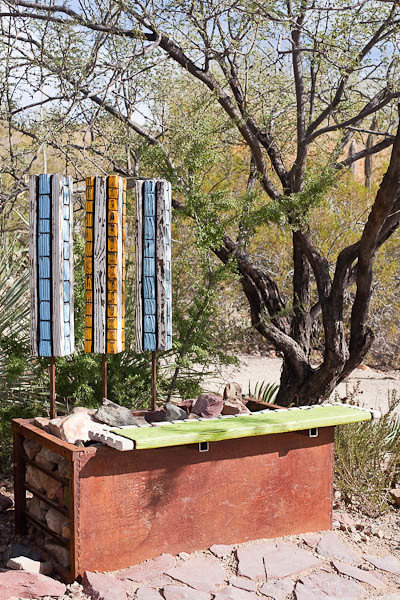
A Bench as Sculpture?

A Bench as Sculpture and More © 2011 Bo Mackison

When I investigated further, I learned that these wooden and steel sculptures are the art work of Tucson sculptor and artist Greg Corman, and were made from recycled materials.

This is one of the multipurpose pieces he designed for the Desert Museum. It is a bench for humans, a rock pile for lizards and a habitat for stingless, pollinating bees. (The elongated sculptures have tiny holes that aren’t visible in this photo.)

The artist notes that the front of the bench is enclosed so the lizards enter and exit from the rear space, safely away from feet and other potential hazards.
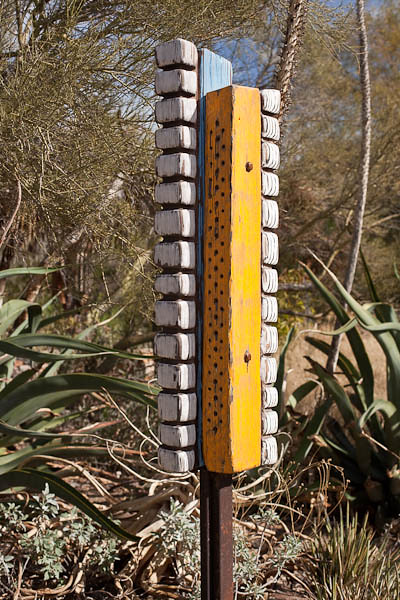
Sculpture Doubles as Bee Hive

Sculpture Doubles as Bee Habitat © 2011 Bo Mackison

In this photograph of a sculpture/habitat in the Pollinator Garden, the holes are easy to see in the yellow painted wood. The bees who use these nests are solitary bees, and are found throughout the US and in other countries.

They build their nests in dead wood, however this habitat is disappearing because much dead wood and limbs from gardens and parks are removed.
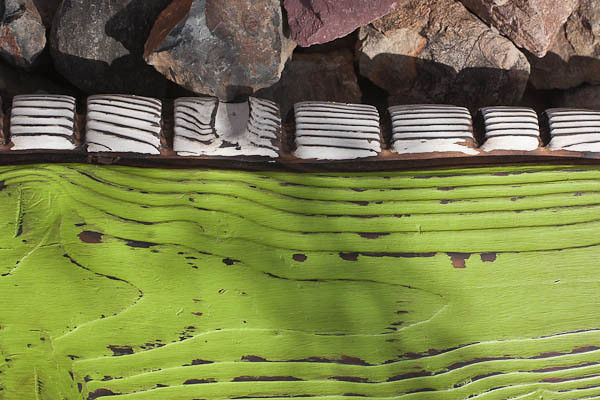
Rocks and Wood?

Rocks and Wood? © 2011 Bo Mackison

Corman’s colorful sculptures provide natural spaces for the bees to nest while adding eye-appealing art to the garden spaces.

A wonderful concept!

Corman’s blog at  Zen-Industrial is well worth a visit. According to his site, he specializes in creating sculptures, bee habitats,  garden furnishings, and functional wood pieces. His blog features plenty of photos of his recent works.

———————–

Bo Mackison is a photographer, owner of Seeded Earth Studio LLC. Even though Bo has never met Greg Corman, she has carefully explored his bee habitat sculptures and she is smitten with his functional art!
Senita – A Hairy Cactus

Whiskery Cactus?

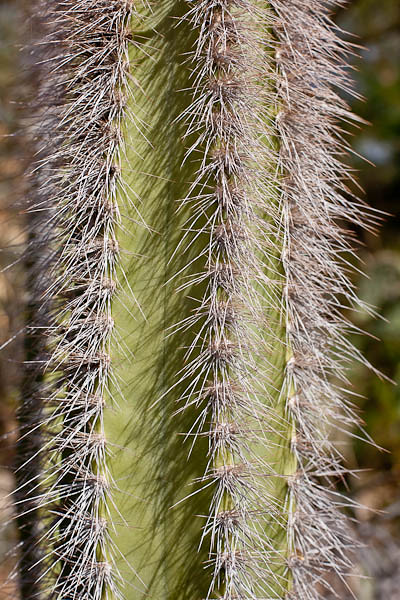
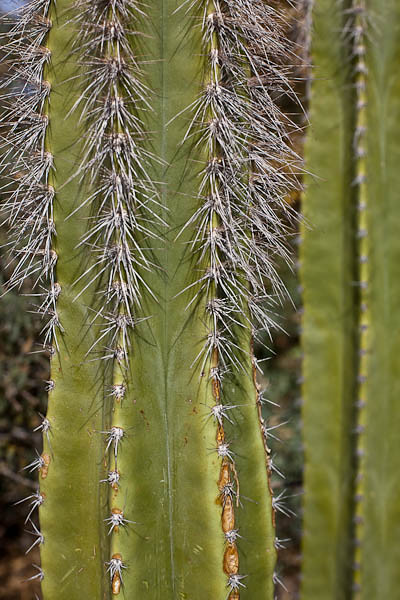
Whiskery Cactus? © 2011 Bo Mackison

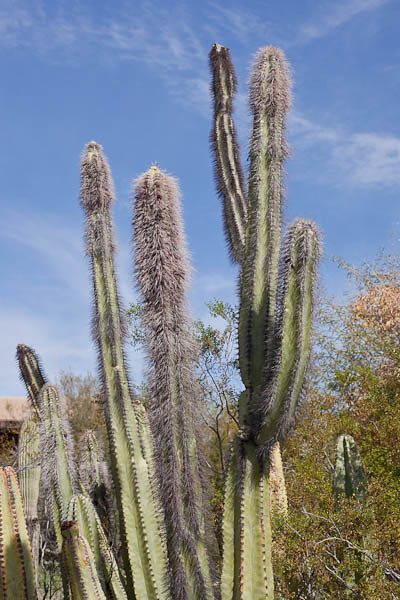
This is the Senita cactus, one of the three largest cactus species found in a few areas of the United States. The Organ Pipe Cactus and the Saguaro Cactus (third photo in linked post) are the other two specimens that are found in the southern Sonora Desert in the US. They are more abundant in Mexico.

Senita

Senita © 2011 Bo Mackison

Senita usually grow about 10 to 12 feet tall and it looks very similar to the Organ Pipe Cactus, except for the long and bristly gray spines which densely cover the top third or so of each mature cactus arm.

The word senita is derived from a Spanish root meaning “old” and could roughly be translated “little old woman,” which I suppose seems appropriately named.

One of the things I found most interesting when I was doing a little research on the senita — the senita is very long-lived. According to A Natural History of the Sonoran Desert, published by the Arizona – Sonora Desert Museum, “when sites in Baja California photographed in 1905 were revisited in the 1990s, nearly every senita was still present.” The book didn’t say, but I’d love to know how much these cacti grew in that nearly 100 year period.

Hairy Senita

Hairy Senita © 2011 Bo Mackison

I am more than careful when it comes to touching the plants in the desert. This is extremely hard for me to stop, because I learn best through the techniques of visual and tactile (or kinesthetic) learning.

I want to get as close as I can to see the tiniest visual detail AND I want to touch all the parts of the cactus, too. Not so wise, but I did touch the gray spines of the senita — very carefully, I assure you — and they were very bristly and sharp.

Not unlike Sherpa’s two-day growth of beard when he is roughing it and forgoing shaving. (Ouch!)

—————

Bo Mackison is a photographer and owner of Seeded Earth Studio LLC. Bringing you photographs and natural history notes from the Sonoran Desert, at least for a few more days.

Garden Gate

Garden Gate

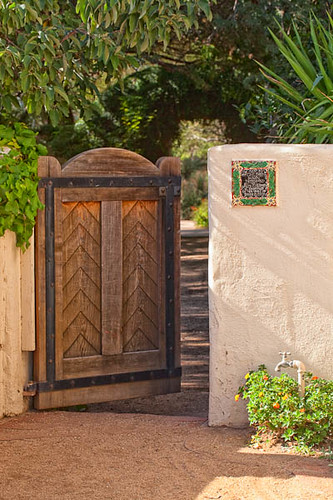
Garden Gate © 2011 Bo Mackison

My favorite thing is to go where I’ve never been.  ~ Diane Arbus

Travel and blogging – a difficult pair. I always have much I could write about when I am traveling. But I never have much free time. And when I have free time, I am at the end of my day and my motivation to ready a photo and write are struggling with my needs to relax a bit or go to sleep in order to be ready for the next day.

I’m not in my more accustomed Tucson mode. This is trip one of two trips to Tucson in the next few months. Sherpa and I decided November was a safer time to drive the art trailer to Arizona. Less weather drama. And after last February’s travels through rain, sleet, ice and snow, we decided “no more winter travels, not if we can avoid them.”

Sherpa hooked his remaining vacation days to the long Thanksgiving holiday and so, on this first trip to Tucson, we are officially on vacation. We’ll return to Wisconsin for most of December, and then I’ll return to Tucson in January and be here for a few months to do a few winter art shows in Arizona.

Today I am going to do one of my favorite things – go where I have never been. (Diane and I must have a lot in common!)

—————-

Bo Mackison is a photographer, owner of Seeded Earth Studio LLC.

Three Tops at a Mic

Three Tops at a Mic

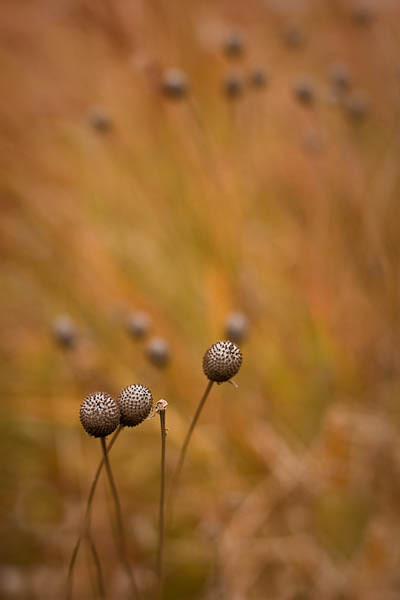
Three Tops at a Mic © 2011 Bo Mackison

I am imagination. I can see what the eyes cannot see. I can hear what the ears cannot hear. I can feel what the heart cannot feel. ~ Peter Nivio Zarlenga

Ever get carried away with your imagination as you look at the most ordinary of scenes?

This photograph of the prairie as it is breaking apart and shedding its finery in preparation for winter is straightforward. A few coneflower seed heads plus a stem in focus in the foreground, and more seed heads — out of focus — in the background.

And suddenly I no longer see the dying autumn prairie:

I see the “Three Tops,” a premier singing group in Prairie Land, at their microphone. Singing their hearts out as their fanatic audience sways to their rhythmic beat. Many in the audience are singing in their seats, but a few of the “Three Tops” most ardent fans are squealing and dancing at the bottom of the stage.

Hmm . . . Ursula Le Guin wrote, “I doubt that the imagination can be suppressed. If you truly eradicated it in a child, he would grow up to be an eggplant.”

—————–

Bo Mackison is a photographer, owner of Seeded Earth Studio LLC. She walks the prairie, thankful she did not grow up to be an eggplant.

Art at the Creek

Art at the Creek - October 2011

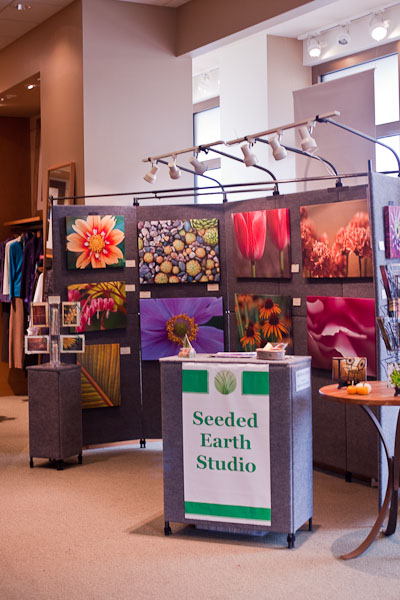
Art at the Creek © 2011 Bo Mackison

The Coldwater Creek Store at Greenway Station in Middleton, Wisconsin will be featuring Seeded Earth Studio in their inaugural Art at the Creek Show this Thursday, October 20 from 4:30 p.m. – 7 p.m. I’ll be exhibiting my most popular botanical photographs, as well as introducing a new series of photographs on mini-canvases. Each mini-canvas comes with its own easel, a great way to display these tiny treasures.

Coldwater Creek will be providing refreshments throughout the evening. The store is in Greenway Station, just three blocks west of the West Beltline (Highways 12 and 14) and the Greenway Blvd exit.

If you are in the Madison/Middleton area, I would love for you to stop and visit my photography gallery inside the store. You will think you are standing in the middle of a summer garden! Promise!

———————-

Bo Mackison is the photographer and owner of Seeded Earth Studio LLC.