Articles by Bo Mackison

Mission San Xavier del Bac

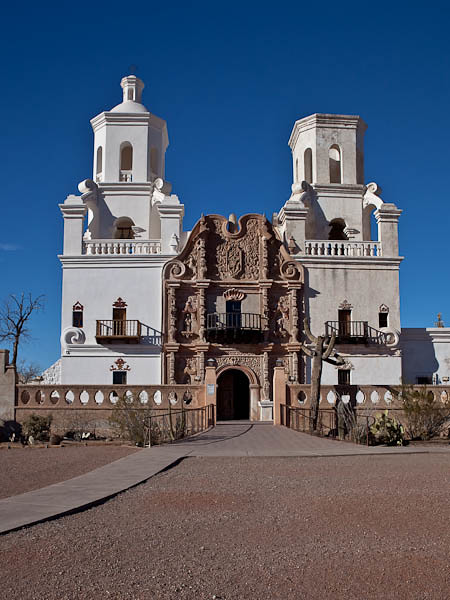
"White Dove of the Desert"

Order Zopiclone Online "White Dove of the Desert" © 2011 Bo Mackison

source url Mission San Xavier del Bac is located only a few minutes south of Tucson, Arizona, on the Tohono O’Odham Indian Reservation. The mission was founded by Father Eusebio Kino, a Franciscan missionary, in 1692. Father Kino also founded the mission at Tumacacori, located 20 miles south of San Xavier, and several other missions in southern Arizona and in Sonora, Mexico.

https://geneticsandfertility.com/patients/fees/ The church, which is a National Historic Landmark, was built in 1783-1797. It is the oldest European structure in the state of Arizona.
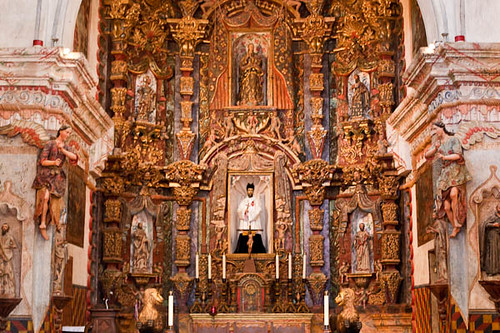
Sacristy,  Mission San Xavier del Bac

https://www.appliquecafeblog.com/tees/ Sacristy, Mission San Xavier del Bac © 2011 Bo Mackison

https://thelonelycreative.com/contact-us/ San Xavier’s interior is filled with many pieces of original statues and mural paintings, all dating from the 18th Century. The Baroque architecture has many dramatic features including painted faux doors, wood sculptures painted to resemble marble, and many niches that hold statues in curtained surroundings. It is all quite intricate and full of ingenious detailing.
https://www.grupoursa.com/prom/

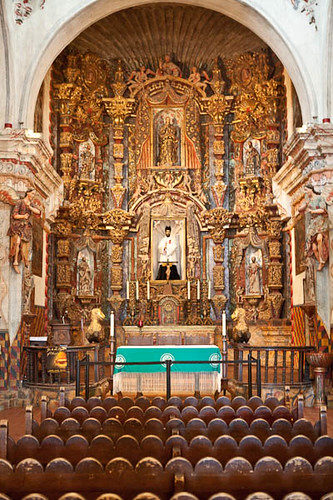
Mission San Xavier del Bac, Interior

https://www.thephysicaltherapyadvisor.com/mta/ Interior, Mission San Xavier del Bac © 2011 Bo Mackison

Order Soma 350Mg Online Once inside the church, one barely knows where to look first. There are more than 300 angels an over one hundred saints represented in paintings, sculptures or bas reliefs. Many of them are highlighted in gold leaf.

http://www.ztpackaging.com/art_requirements/ It is hard not to look in amazement at the decorative features that cover nearly every inch of this masterpiece. The church has undergone several restoration projects, and some of the nations’ most talented art conservators gave new life to much of the art a decade ago. It’s an amazing collection of church art, considering it was conceived and constructed over 200 years ago.

https://rmscherubimhealthcare.com/services/prescriptions-medical-refills/ ———–

https://www.wjsmithconstruction.com/deck-building/ Bo Mackison is a photographer and owner of Seeded Earth Studio LLC. She is living in Tucson for two months, exhibiting her photography in art shows, taking photographs, and blogging about photography, art fairs, and living life “solo.”  There are many gifts to find, here in the desert.
https://www.52editions.com/confirmations/

Cactus, Cactus, Everywhere – Exporing Organ Pipe Cactus National Monument

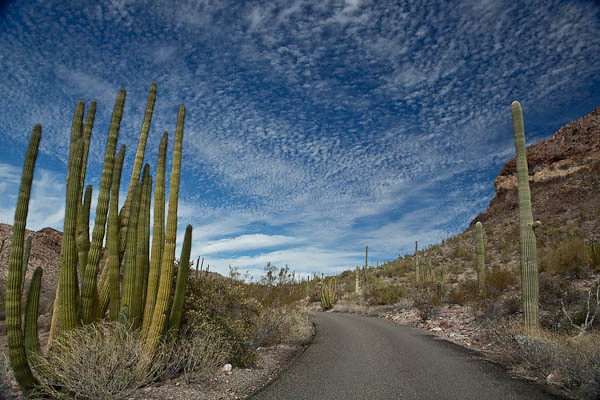
Ajo Mountain Scenic Road

Order Ultram Online Ajo Mountain Scenic Road @ 2011 Bo Mackison

see One of the best ways to explore a large portion of Organ Pipe Cactus National Monument is to do so on the loop road. Not usually my favorite way to see a national park, but in this case, it was certainly an efficient way to see various habitats of the park while taking advantage of the protection and speed of my car. Less wear and tear on my body, and I didn’t get lost once! Of course, it IS a loop…

https://anthonynewmancamps.com/education/ The 21 mile Ajo Mountain Scenic Road winds from desert floor, ascends through the Ajo Mountain Range, and then returns to the desert floor. The beginning is partly paved, but once it reaches higher elevations and tight passes, the road becomes rocky and bumpy, a bit of an adventure ride. And I have to say, I have seen National Parks and Monuments in the 48 lower states, and I think this 20 mile length of road rivals almost any other road, National Park or not, for its breathtaking beauty. I think it must be in my top five favorites.

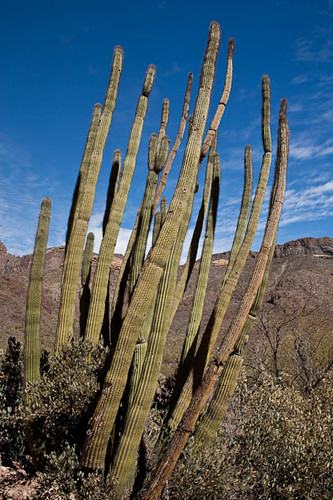
Organ Pipe and Palo Verde

https://geneticsandfertility.com/services/iui/ Organ Pipe and Palo Verde © 2011 Bo Mackison

source url The organ pipe cactus is much like it s cousin, the saguaro. Both large cacti grow near a nurse tree, often a palo verde, as shown in this photograph. A bird, while sitting in a tree, makes a deposit under the tree which includes the seeds of cactus. The tree provides protection from the harsh sun, carnivores and water from the nurse tree as it indirectly waters the seedling cactus. If it isn’t eaten, frost-bitten, or scorched to death, it may make it. Cacti have the best chance of making it past the first few years of growth if the weather is milder and wetter than average.

https://www.parolacce.org/vaffanculo/ These conditions happen only a few times in a century in the Arizona Uplands where Organ Pipe National Monument is located. That is why there are only a few sizes/ages of cactus in a any given area. The lucky cacti that make it to the height of three feet–40 years worth of growth–are quite resistant to weather extremes and animal damage, and have much lower mortality rates than the younger cacti.

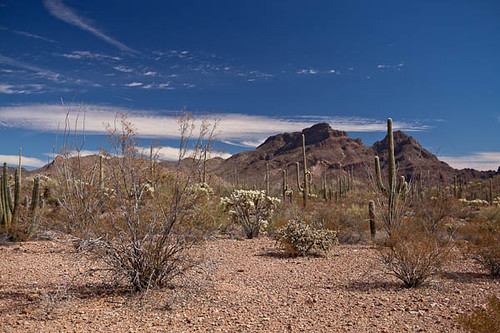
Organ Pipe NM

https://www.appliquecafeblog.com/ikea/ “Good Housekeeping” Desert © 2011 Bo Mackison

Buy Prednisone Online Without Prescription This region of the Sonoran Desert seems much less cluttered than the desert I hiked in a few days ago, the western unit of Saguaro National Park. There everything was a jumble of clutter. Here, it looks like the maids have come through, preparing for an inspection from the “Good Housekeeping” desert spirit.

Organ pipes are easily distinguished from the saguaro, and the other large, but less common cactus, the senita. (No photos of the senita yet, but I’ll keep looking.) Organ pipes have arms that rise from ground level, their stems are often thinner, and they do not sprout projecting arms.

They are uncommon in the United States–found only in Organ Pipe Cactus National Monument and the adjacent Tohono O’odham Indian Reservation located in south central Arizona. This is the most northern habitat for these plants. They are common in the Sonora, Mexico to the south. At that most southern part of the Sonoran desert, these cacti grow with such density, they appear as a sea of organ pipes. Now that is something I would love to see!

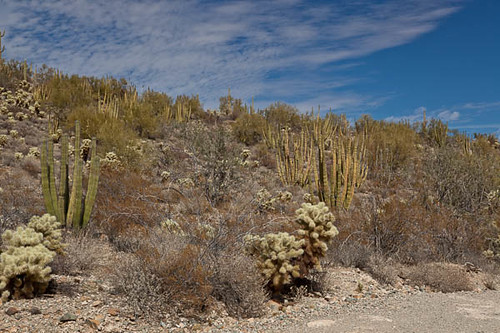
Southern Mountain Side--Cactus Habitat

Southern Mountain Side–Cactus Habitat © 2011 Bo Mackison

Organ pipes are usually found on south facing, rocky mountain sides. In Organ Pipe Cactus National Monument, the south exposures are one of the warmest micro-habitats in the United States. The cacti typically grow about 10 feet high, though occasionally they can be seen twice that height. Their flowers are white, and bloom at night from April through August. They open in the dark and close shortly after sunrise. That would be something to see, too.

In the photograph above, the organ pipes are joined by the fuzzy Teddy Bear Cholla, a few palo verde trees, and creosote bushes.

————————-

Bo Mackison is a photographer and owner of Seeded Earth Studio LLC. She is living in Tucson for two months, exhibiting her photography in art shows, taking photographs, and blogging about photography, art fairs, and living life “solo.”  She is finding the desert habitat more and more to her liking. She is also finding that a solitary life comes with unexpected gifts, too.

Organ Pipe Cactus National Monument

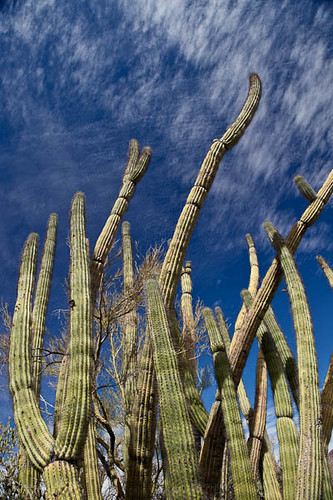
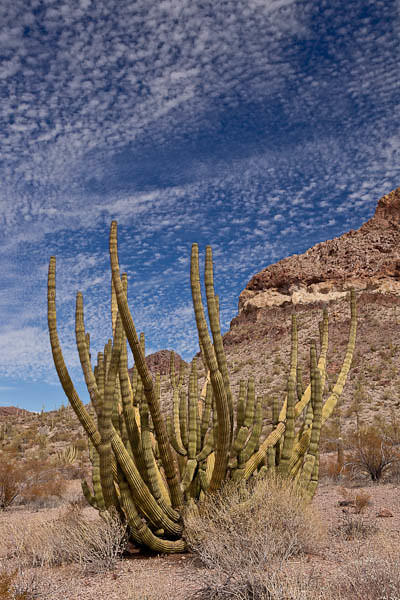
Squiggly Organ Pipe Cactus

Squiggly Organ Pipe Cactus © 2011 Bo Mackison

One of my goals during my time in Arizona was to take an all day trip to a place I’d never been, to a place that was at least 150 miles from home base in Tucson. I knew this would be a challenge when I added that goal to my list. At the time, I wasn’t fond of driving and I worried about getting lost.

In the three weeks I’ve been in Tucson, I’ve gotten much better at driving and I’ve been going to lots of new places. Today’s weather was perfect for a drive, so it seemed a good time to get on the road and visit a place I had on my list–Organ Pipe Cactus National Monument in southern Arizona.

Considering I left before sunrise this morning and I returned home just as the sun was setting — well, my brain is too tired to say all the spectacular things I’ll want to say when I am more awake. So I’ll post just one photograph for now — I promise there will be many more. I loved this park.

Isn’t this Organ Pipe Cactus against that cloud-streaked Arizona sky a thing of beauty?

(Though I might call this particular specimen an Octopus Cactus! The ones I’ll post tomorrow are better examples of why they are called Organ Pipes, but this one has a lot of character!)

———————-

Bo Mackison is a photographer and owner of Seeded Earth Studio LLC. She is living in Tucson for two months, exhibiting her photography in art shows, taking photographs, and blogging about photography, art fairs, and living life “solo.”  She spent the day driving and is going to bed early. More photographs from Organ Pipe NM tomorrow.

Hiking the Loma Verde Trail in Saguaro National Park

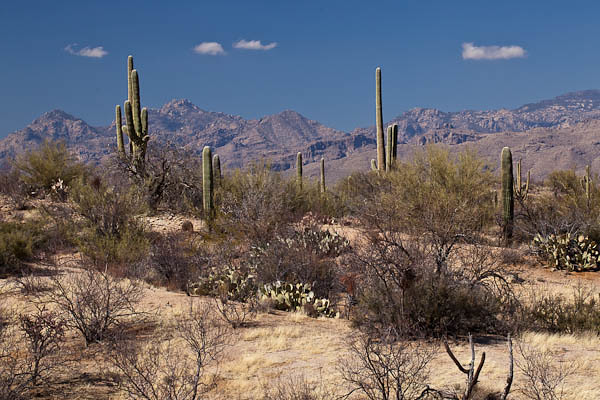
On Pink Hill Trail

On Pink Hill Trail © 2011 Bo Mackison

The day was a deep blue sky day in Tucson and I was primed for a desert hike. When I asked Mr. Friendly Park Ranger if he would recommend a hiking trail no longer than three miles, please, he smiled a convincing smile and replied, “Well, the best trail in the park is 3.6 miles long, only a half mile more. Wanna try that one?”

It didn’t seem that much longer, so I agreed. He pulled out a map with a few squiggly lines on it. “So,” he said, “if you take the Loma Verde trail head, follow Loma Verde, make a right at Squeeze Pen, a left at Pink Hill, follow the jog right on Loma Verde North and finally a left on Loma Verde South. You’ll be back at the trail head in two hours.”

Two hours? Knowing I had my camera along, I added another hour onto the estimated time. I could manage a three hour hike, out in the desert, by myself. Sure. Why not? It was 11 o’clock. I’d be back at the car by 2:00, 2:30 at the latest. No matter it was the warmest time of the day. The temperature wasn’t supposed to break 70˚ It was the perfect temperature for exploring the desert.

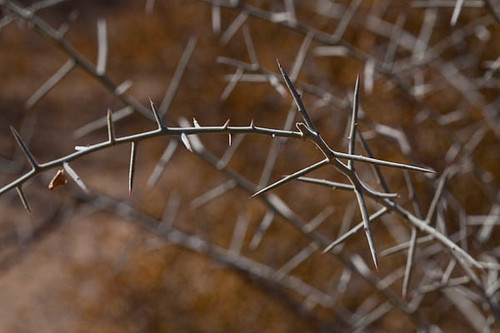
Tree of Thorns

Tree of Thorns © 2011 Bo Mackison

At the trail head, I emptied my camera backpack of all unessential equipment, then added two bottles of water and some trail bars. By the time I’d gathered my hat, hiking stick, and sun glasses, I was past eager, and ready to be on the trail. The sun was dodging in and out of cloud cover, and a mild breeze was blowing. Perfect hiking weather!

I had never hiked this part of Saguaro National Park, and so everything was new and exciting. There was plenty that needed photographing. There were thousands of saguaros begging to be photographed. And the mountains in the background. And the dancing clouds. Heck, I even took photos of the thorns and the bare branches. There is something about all of the elements of the desert that thrills me.

Cholla Forest

Cholla Forest © 2011 Bo Mackison

One of my favorite parts of the hike was when I entered this little cholla tree forest. Aren’t they cute? Well, they are cute–unless you get too close to one of them. If you brush against one, they “jump” on you. I carefully kept my distance.

Of course, I got lost. Several times. The trails looked well marked until I was out there with no one else in sight, and the name of the trail I was to follow wasn’t on the trail marker. I turned around more than once. And added another mile and a half to an already long-enough hike.

I wasn’t worried about the extra distance, but I did worry about the time. Rangers close the park gates at five. If they found my car on the Cactus Forest Loop after closing time, they would come looking for me. That wouldn’t do. The last mile and a half I put my camera away (sigh!) and hiked back to the car using fast feet.

It was a simply perfect hike (except for the back tracking parts) and I pulled my car out of the park at 4:30. Plenty of time to spare. Next time, I’ll start earlier and take fewer photographs.

Well, I’ll start earlier. I’ll have to re-think that fewer photographs part!

———————-

Bo Mackison is a photographer and owner of Seeded Earth Studio LLC. She is living in Tucson for two months, exhibiting her photography in art shows, taking photographs, and blogging about photography, art fairs, and living life “solo.”  She is discovering much more than she ever had anticipated.

Making of an (Art Show) Artist: Part IV – More On the Job Training

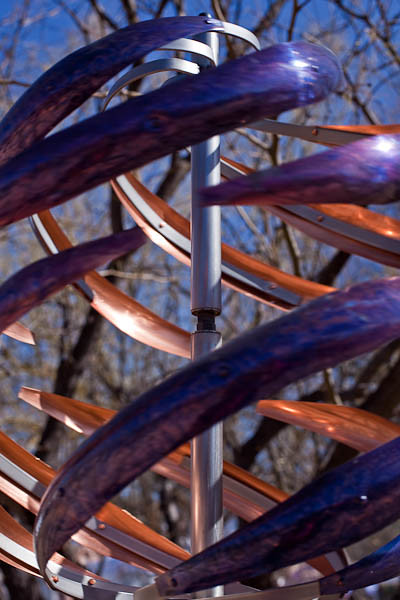
Spinning

Spinning © 2011 Bo Mackison

Welcome to my 5 part series on the making of an art show artist!

Part I described my initial questioning about whether or not I could be an art show artist. In Part II, the answer was “yes, do it, but how do I start up?” Part III included a few of the lessons learned from “on the job” training, the real learning is in the doing.

Part IV continues with more lessons learned from the first year’s art shows, learning by doing MORE and MORE art fairs.

A breakthrough happened during our fourth show of the summer. I discovered the magic that happened when Sherpa and I each had our own jobs to do. There isn’t much space to maneuver in a 10′ by 10′ art show tent, and we were forever stepping on each others’ toes. I’d start to do a task and get interrupted. He’d try to finish the task, but it didn’t work as intended. I finally realized that if we each did specific jobs, there would be less confusion with better results.

Sherpa began going for the truck and trailer at closing time, leaving me to pack everything in an organized fashion, and life on the art fair circuit became more peaceful. We were able to get the work done in less time. And with more calm. Division of labor–a good thing to learn.

Our first large show (in Chicago) taught us a different kind of lesson. It’s an easy one to do. Take advantage of the amenities offered by the organizers of the shows. These added benefits may include booth sitters, free breakfasts, and delivered-to-your-booth bottled water for hot, humid summer days in the Midwest.

But the best amenity, and one that quite a few artists ignored, was the artists’ reception held the night before the festival opening. I’m not a party goer, but this is the kind of party I make sure I attend. These receptions are an excellent time not only to meet other artists who will often share their experiences, but it is also a prime time to meet the art patrons in the community.

These are the people who give their time and effort to make art happen. They are knowledgeable, friendly, and they love art! Definitely, they are people worth getting to know. Plus, it was a party! After setting up the booth in the mid-summer heat, food and drink was a great reward.

After a season of art festivals, we had the organization down. We were meeting other artists. And finally, I was getting more comfortable talking to the public. Sherpa is a natural at small talk; he could chat with a cement statue if given the chance. Me? Not so much. I made excuses for my shyness, listing plenty of reasons why I needed time to warm up to conversations. Or why I should avoid a conversation altogether.

Well, warm up time or avoidance are parts of my past. There isn’t enough time for warm-up exercises when customers are in your booth looking at your art. I had to carry on an intelligent conversation with my potential clients, or they would leave the booth, never knowing what they were missing.

It is up to the artist to educate the public about all aspects of your art, and you can’t do much educating by remaining silent, or ducking in the back of the booth. Or even worse, by reading a book or simply ignoring people and not engaging.

Neither Sherpa nor I read or ignore our visitors, but I saw quite a few artists sitting in the back of their booths, half hidden from sight, reading or working crossword puzzles, and never giving their customers even a hello. I also saw those same customers, feeling unwelcome, leave those booths quickly.

It took me quite a few shows before I did much more than smile and offer a friendly “hello” to people who came and looked at my art. A few more shows and I was doing so comfortably, and carrying on conversations. Now I feel confident approaching any visitor in my booth, and talking to them about my art. After all, photography is my passion, and who doesn’t love to talk about their passion with willing listeners!

You can teach an old dog new tricks! Or learn how it is possible for an introvert to be an artist on the art festival circuit!

Part 5–the wrap up.

If you have any questions about showing art at art festivals, or would like to know about a different aspect of art fair circuit routine, feel free to contact me. Use the contact form in the menu.