Sunflower © 2008
My garden looks a little bedraggled – except for the glorious sunflowers. Hoping I can watch them dance until frost comes to visit.
Sunflower © 2008
My garden looks a little bedraggled – except for the glorious sunflowers. Hoping I can watch them dance until frost comes to visit.
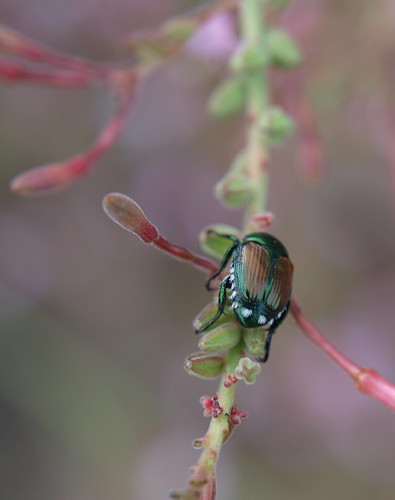
Japanese Beetle © 2008
The Japanese beetle has invaded my gardens and yard. They have been voracious this summer and really inflicted a great amount of damage. The beetles eat the surfaces of the leaves, but avoid the vein which remains intact, and therefore the foliage looks lacy. However, it is not a pretty sight to any gardener.
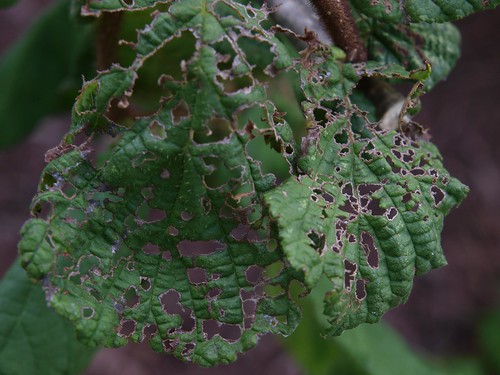
Lacy Leaf Damage on Filbert Tree © 2008
The beetle was first discovered in the United States in 1916, and it is thought it was accidentally introduced in New Jersey in imported Japanese iris. The beetles are controlled in Japan by natural predators, but are unchecked in the US. They are found in every state east of the Mississippi River, except for Florida.
The best defense in my smallish garden is removal by hand – yuk! There are traps using pheromones, but some studies show the traps can actually attract more beetles than they catch. I’m not one to use much in the way of chemical control if possible, but I”ve been using Bonide from Garden Naturals in the worst areas and that seems to have helped.
Anyone else fighting these pests successfully with other means?
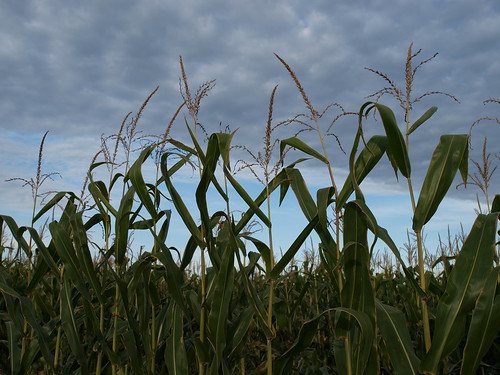
Next to a Cornfield © 2008
Not all of my hiking has me wandering through prairie land. Today’s hike started in prairie and ended up with me coming face to face with an endless expanse of cornfield. This Midwestern corn is tall stuff when you get up close. And surprisingly noisy. Lots of insects buzzing and crickets cricketing and birds swooshing. Critters scooting between the rows of corn. It’s rather a mini eco-system in it’s own way.
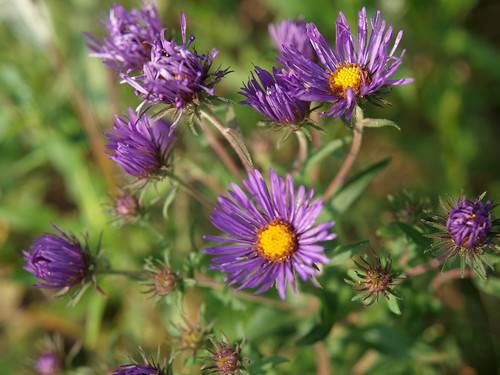
New England Asters © 2008
The last show of wildflowers in the prairies are in bloom. The prairies are full and thick, now beginning to yellow a bit. The New England Asters are easily cultivated, and found in many gardens, but they are especially handsome in the thickets of grasses on the prairie.

Rosin Weed © 2008
What a name for one of the most perfect prairie wildflowers I’ve seen in a long time! Rosin Weed is an excellent flower for the prairie, and used extensively in prairie restorations as it is attractive to bees, butterflies and birds. Its sap contains resin which was once used as a chewing gum. (Ick – I’d rather have peppermint myself.)
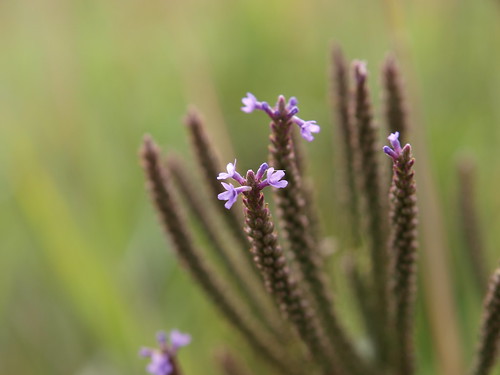
Blue Vervain © 2008
This would be an easy flower to miss, except it grows so tall the flowers tend to stick out over many of the shorter grasses. The Blue Vervain flowers themselves are tiny – less than 1/4″ wide – but the plant stands up to 6 feet tall.
Vervain was a popular plant, well-known for its many medicinal uses – made into a brew and used as a tonic, an aphrodisiac, and a sedative. Centuries ago it was hung on European peasants’ doorways to ward off the devil and other evildoers, and it was worn as an amulet to bring good luck.
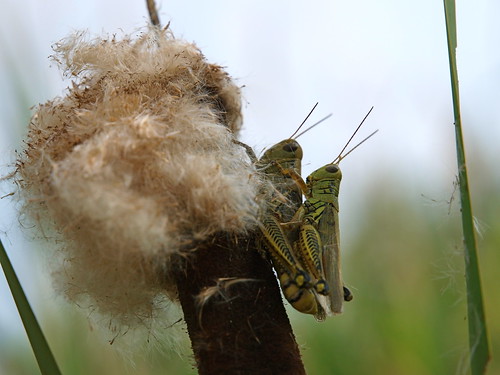
Differential Grasshoppers on Cattail © 2008
While hiking in the prairie just north of Madison, I noticed a cattail that had exploded with seeds. Upon further examination, I discovered two grasshoppers partially hiding in all the fluff. They seemed quite preoccupied and didn’t appear to mind my camera lens pointing within inches of them.
I think this may be my first ‘insect’ shot. I usually am too impatient to wait for insects, but this was a ready to take photo.
When I went to do some research on these complicated looking creatures, I found hundreds of pages of information on grasshoppers. I had no idea there were so many different grasshoppers. I concluded that these were a pair of Differential Grasshoppers – what an odd name! – by the unmistakable black chevron pattern on their hind legs. Pretty cool pattern.