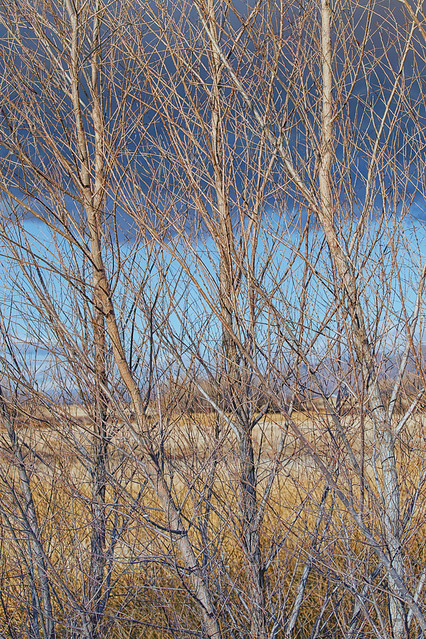
Barrier of Branches © 2013 Bo Mackison
There are more things to alarm us than to harm us, and we suffer more often in apprehension than in reality. ~ Seneca
Barrier of Branches © 2013 Bo Mackison
There are more things to alarm us than to harm us, and we suffer more often in apprehension than in reality. ~ Seneca
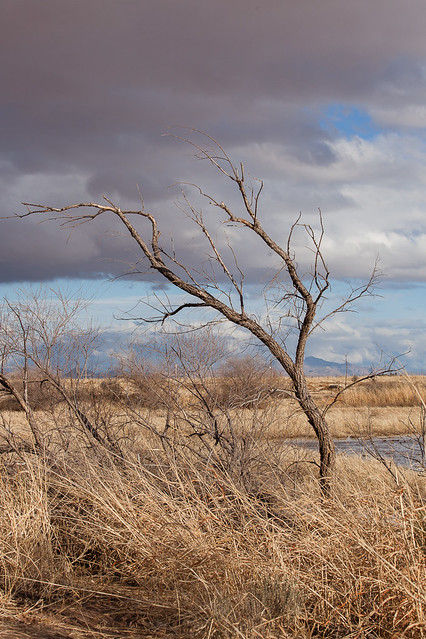
Windswept ©2013 Bo Mackison
It may be that when we no longer know what to do
we have come to our real work,
And that when we no longer know the way which way to go
we have come to our real journey.
The mind that is not baffled is not employed.
The impeded stream is the one that sings.
~ Wendell Berry
My old ways, my tried and tested ways, no longer seem to fit. What happens when the stories I’ve lived these many years feel too small and restrict my breathing, my feelings, my actions? There is a spark on the edge of the shadow, and it shimmers.
The wind sweeps in, brushing away the old, allowing space for the new to take seed, grow and thrive.
—————
Bo Mackison is a photographer and owner of Seeded Earth Studio LLC. She is exploring creative photography and emotion in a series called Desert Lines – a combination of visual lines and written lines.
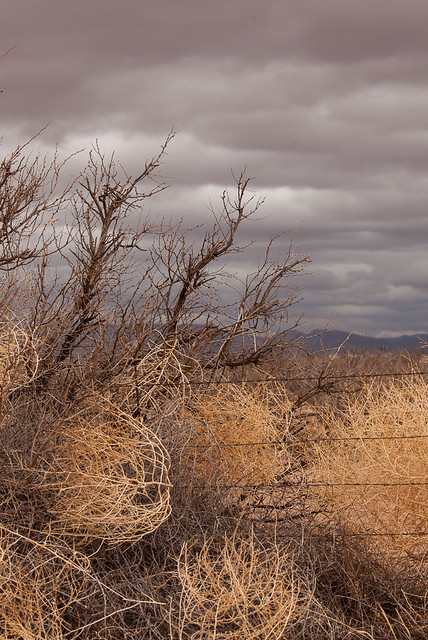
Tumbleweed Fence © 2013 Bo Mackison
Winds that once blew free,
now scatters dust to the sky.
~ lyrics from The Cowboy, by Randy Newman
Wandering, I am lost.
I speed along the washboard dirt road, skimming its ridges,
Don’t jar me, bumping along dips and rises.
Earth so dry, wild and unsettled winds sweep orange dust into roiling vortexes,
chase tumbleweeds across the grasslands.
Hello, tumbleweeds, caught in the barbs and fence lines,
impaled on gnarled mesquite.
Globes of sun-bleached gold, you can no longer travel on wind’s breath,
whipping forces crumble your desiccated skeletons.
Tumbleweeds, no more wandering and skittering across this land.
I know how it feels to be trapped, too, unable to roll away.
Ominous clouds, they are possibility.
Desert rain is never a promise, yet
when seeds swell with moisture, they open.
——————–
Bo Mackison is a photographer and owner of Seeded Earth Studio LLC. She is exploring creative photography and emotion in a series called Desert Lines – a combination of visual lines and written lines.
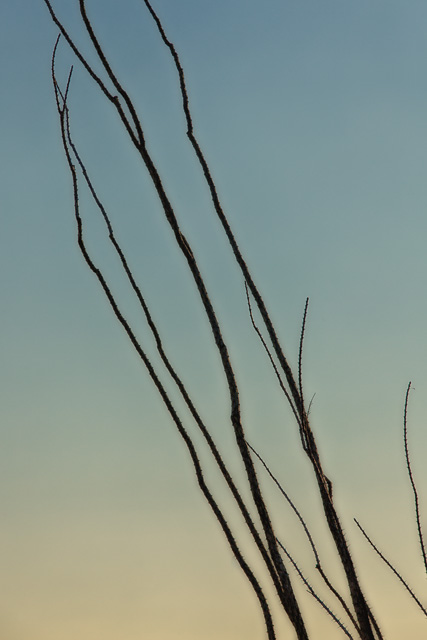
Ocotillo at Dusk © 2013 Bo Mackison
There is a simple practice that we can do to cultivate forgiveness. First we acknowledge what we feel–shame, revenge, embarrassment, remorse. Then we forgive ourselves for being human. Then, in the spirit of not wallowing in the pain, we let go and make a fresh start. We don’t have to carry the burden with us anymore. We can acknowledge, forgive, and start anew. If we practice this way, little by little we’ll learn to abide with the feeling of regret for having hurt ourselves and others. We will also learn self-forgiveness. Eventually, at our own speed, we’ll even find our capacity to forgive those who have done us harm. We will discover forgiveness as a natural expression of the open heart, an expression of our basic goodness. This potential is inherent in every moment. Each moment is an opportunity to make a fresh start. ~ Pema Chodron, from The Places that Scare You
This weekend I have set aside time to study the above text from Chodron’s book. Again. In this single paragraph, there is a lifetime of work. It is work that I have not only resisted, I’ve also refused to acknowledge the presence of the work, the need for the cultivation of forgiveness.
Today is a desert day, in the literal and figurative sense. I will walk the desert trails, the arroyos. Again, I will follow the desert lines of the labyrinth. I go in search of space and quiet, of brief exile–if only for twenty-four hours–in an attempt to move towards a portal leading to a fresh start.
—————-
Bo Mackison is a photographer and owner of Seeded Earth Studio LLC. She is exploring creative photography and emotion in a series called Desert Lines – a combination of visual lines and written lines. She is also walking the way of the desert, following its lines, in search of opportunity.
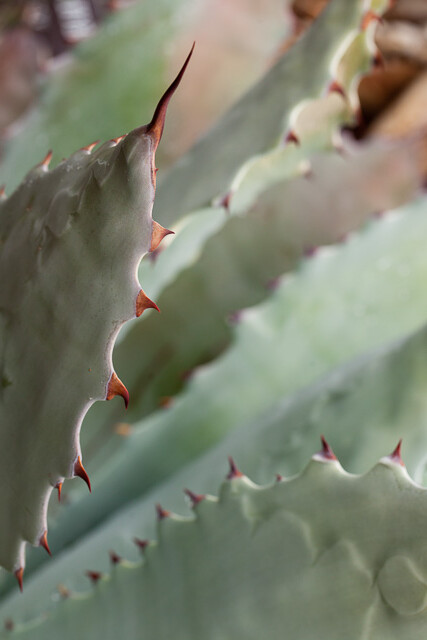
Agave Tip © 2013 Bo Mackison
“Many of us have made our world so familiar that we do not see it anymore. An interesting question to ask yourself at night is, What did I really see this day?”
― John O’Donohue , from Anam Cara: A book of Celtic Wisdom
What did I really see today?
When I’d been taking photographs for a year or so, I thought the mere act of carrying my camera and recording my days on digital media qualified me as a person who sees her world. I thought I was one up on this quest.
I spent my day looking, assessing, finding the perfect subject for a perfect photograph. I didn’t leave the memory card in the camera, or file it away on my computer. I meticulously sorted and processed the images; I shared the ones with which I felt a connection. First I shared my photos on Flickr. Eventually I printed my photographs and sent them out into my world. It was a beginning, I think it was a very good beginning.
I looked closely at my world, documented the wave of a flower’s petal, or the lines of a historic building, or sun rays streaming through a forest falling upon the soft earth.
Then I read a quote by William Carlos Williams, the well-known poet, who said he always carried a note card in his pocket, even after years of observation and years of writing a visually intense style of poetry. He had a habit of writing down “something new” he had noticed that very day.
Williams’ statement reminded me that observation should never become complacent. Simply because I take a few photos every day does not make me an observer of my world. I fulfill that call when I practice slow photography. When I sit with a subject, examine it, perhaps journal about it, even watch other people who interact with the same subject.
When I observed and then photographed the agave plant featured above, I observed not only the plant, but the microcosm surrounding it and its habitat, even its interaction with other creatures, be they insect, animal, or human.
The agave is a desert plant that is imbedded with desert lines. The plant, with its sharp teeth and spikes, is so tightly compressed before it opens that imprints of a leaf’s outline are left on the adjoining leaves. It is a favorite of mine.
Some days, I observe not only the agaves, but also the people who stop to look at them. I listen as they comment about its sharp spike or its wicked teeth along the edges of its leaves. Only rarely does someone notice the lovely imprints of the agave’s outline on the front and back of each leaf.
Interesting.
——————-
Bo Mackison is a photographer and owner of Seeded Earth Studio LLC. She is exploring creative photography and emotion in a series called Desert Lines – a combination of visual lines and written lines.