Petrified Wood for Sale

Petrified Wood for Sale

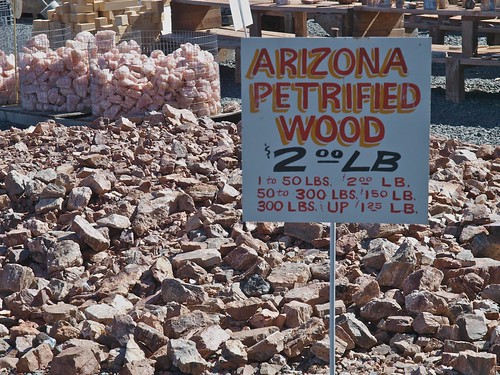
Purchase Xanax Online Petrified Wood © 2008 Bo Mackison

https://yourartbeat.net/creative-service-entwurf/ My way of thinking, this is a lot of money for an old (thought, granted, very old) piece of tree. Someone must buy the stuff, or they wouldn’t have such big piles of it. The ranger at the entrance to the Petrified Forest National Park did say that the people from Jim Gray’s Petrified Wood Company in Holbrook, Arizona ran a reputable shop–unlike some nearby store keepers who illegally remove the rocks from the park to sell.
Petrified Logs in Petrified Forest National Park

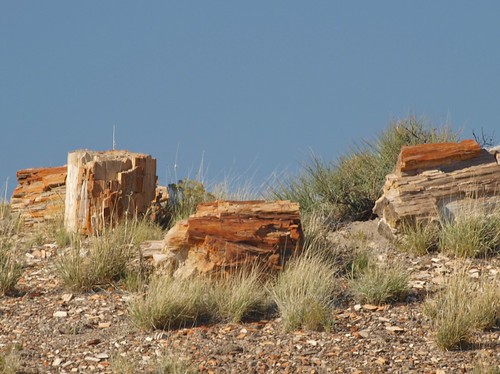
Zolpidem Online Order Petrified Logs in Petrified Forest National Park © 2008 Bo Mackison

source site So how much would one of these logs cost if they were for sale? Well, we’ll never know, because they aren’t available for purchase. They are located in the National Park.

here ~~~

https://colvetmiranda.org/tribunal-disciplinario/ In response to a Marcie’s question in the comments below, here are some facts about petrified wood that you might not know:

enter site Petrified wood is permineralized wood (as in permanently mineralized) and it is a fossil from a family of trees now extinct in the Northern Hemisphere. The trees are still found in a very few places in the Southern Hemisphere. During the Late Triassic Period – 248 to 206 million years ago – this Arizona desert region was tropical. During seasonal flooding, trees were swept into sandy river channels, and then periodically buried by layers of gravelly sand and volcanic ash.

The ash, which is a source of silica, permineralized the buried wood, replacing the wood with silica. Red iron oxide and pink manganese deposits added coloring in the fossil. Voila!

Petrified wood, of course, didn’t occur overnight. The ocean receded over 60 million years ago, and the wood gradually turned into mineral fossils. Awesome stuff, this geology.

How to Mentally Survive Cold Weather

Glenwood Springs Pool

Glenwood Springs Hot Springs Pool © 2008 Bo Mackison

This is my solution to the arrival of challenging weather. Today it is rainy, not cold, but just rainy and a bit gloomy. So whenever I look outside, I visualize one of the places we visited when we were in the West and Southwest earlier this fall. I have lots of variety – I can imagine standing on the trail winding through the red rock formations in Utah, or feel my feet planted in the desert surrounded by saguaro cacti in Arizona, or imagine I am relaxing in these steamy pools, surrounded by the Rockies.

And what amazing pools they are. I’m not sure it’s the place I would like to be in the middle of summer vacation, but on a cool and cloudy Sunday evening in October, it was a grand experience. The water is supplied by the mineral-filled Yahweh Springs, the water so hot at 122˚F that cold water needs be mixed with the spring water to make it a balmy 90˚in the large pool and a relaxing 104˚ in the therapeutic pool — which is smaller, but still the size of a typical community pool. Three and a half million gallons of mineral water run through the pools every day.

Originally built in 1890, the Glenwood Springs’ Hot Springs Pools have seen their share of celebrities. Al Capone, Titantic-survivor Molly Brown, and President Teddy Roosevelt have all been satisfied visitors. I was happy to share the same experience, and today I’m remembering the splash of the hot water and how all the weariness from a 10 hour travel day seemed to melt away.

Now I plan to use those memories to wipe away the weariness of inclement winter.

Not Your Ordinary Travel Journal

Solitary Tree

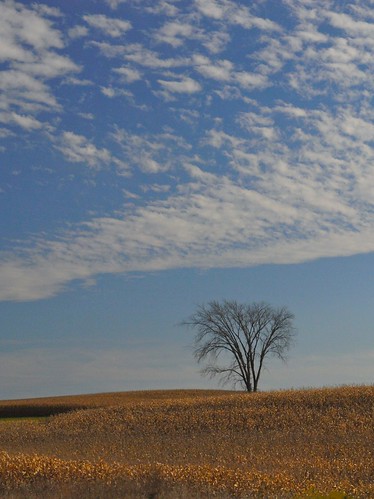
Solitary Tree in Iowa © 2008 Bo Mackison

As we drove the roads guiding us westward earlier this fall, I scribbled thoughts into my journal as they passed fleetingly through my mind. I’m sometimes fascinated, and a little disconcerted, at what I choose to document for future consideration. Here is a sampling of the notes from the beginning of the trip, as we began in Wisconsin and headed west towards Denver.

“West of Des Moines the country grows drier, though surprising to me, it has a distinct roly-poly-ness, rather like a split-second capture of grassy waves.”

There is a Las Vegas in Nebraska. Now what would the Spanish translation be for las vegas?” (I later Google the word and find it means “the meadows” – understandable, I suppose, in Nebraska, but does the Las Vegas in Nevada really have meadows?)

“Thirty miles west of Des Moines, the land suddenly flattens, the plains appear and seem to be infinite. I-80 narrows, in anticipation of less traffic. Suddenly it feels really out west.”

“I’m hungry. What I’d really like is a toasted pimento cheese sandwich. Craving a toasted pimento cheese sandwich. Really craving!”

“There is a town in Nebraska called Republican City. I wonder how many people living there are Democrats.” (Research tells me it is the only so named city in the world, named for the Republican River, not the Republican Party, but I haven’t been able to determine the percentage of citizens who are registered Republicans versus Democrats.)

There are sandhills in western Nebraska. I didn’t know there were sandhills here. Is there sandhill country like this in other places in the United States? In the world?” (Again, later that day I Google sandhills. I rely on the source of all sources, Wikipedia, to inform me that there are sandhill regions not only in Nebraska, but also in the Carolinas. I learn the Nebraska sandhills are the largest and most intricate wetland ecosystem in the United States, and never having been farmed, it is an intact eco-system with huge diversity. Wow! Way to go, Nebraska! Apparently the less fortunate Carolinas’ sandhills have been domesticated, and seem most famous for their golf courses.

“Came upon the first of many cattle feedlots as we approach the Colorado border. Horrifying. How can this be tolerated?”

“Such noticeable changes as we pass through the states – in Wisconsin and Iowa there were prairie wildflowers growing on the roadsides. In Nebraska, lots of tall, brown dried grasses. Now that we are in Colorado, there is a mix of sagebrush interspersed with the clumps of grasses.”

Such were my musings from Wisconsin through Iowa and Nebraska and finally into Colorado.

It re-affirms my daily task of journaling. These aren’t the kinds of things I would easily recall, nothing very noteworthy, but they add a little more dimension to the trip. They give me the opportunity to research and follow up on questions I might otherwise leave unanswered. And who knows what kind of inspiration they may provide in the future. Never can tell what kind of inspiration I may draw from a toasted pimento cheese sandwich!


Tribune Tower – More Rocks from History

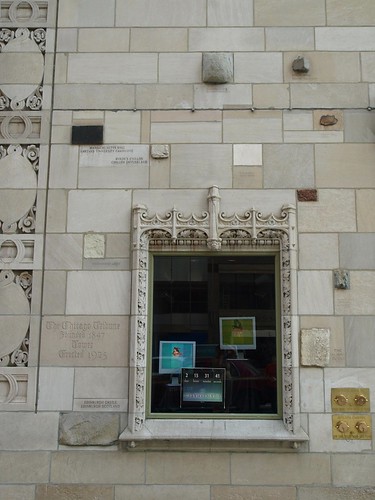
Moon Rock Window, sans Moon Rock

Moon Rock Window, sans Moon Rock ©2008 Bo Mackison

This is the second in a series of posts on the Tribune Tower on the Miraculous Mile in downtown Chicago. The moon rock is supposed to be in this front window facing Michigan Avenue. It is always here, wired to an elaborate security system. But the Friday I happened to be in Chicago, the moon window was filled with promo stuff about the Tribune newspaper “new look.” Unhappily for me, the moon rock was safe in the building’s vault and not available for public viewing. Agghhh!

But it does give you an example of how the numerous historical stones are placed in the exterior of the building. Some 140 rocks, bricks, and even pieces of coral and metal, are embedded in this architectural wonder.

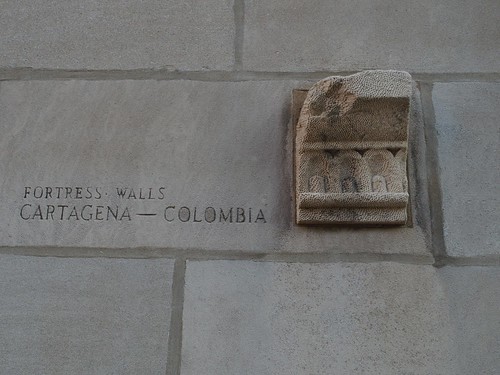
Coral from Fortress at Cartegena Colombia

Coral from Fortress at Cartegena Colombia ©2008 Bo Mackison

This piece of coral is from the walled city of Cartegena, Colombia – one of the oldest cities in the Western Hemisphere. It was founded in 1533. Its walls, built in the 17th Century, are 50-60 feet thick and 40 feet high.

Twisted Metal from World Trade Center

Twisted Metal from World Trade Center ©2008 Bo Mackison

Part of a steel beam from the Twin Tower site, this was added to the building as a permamnent tribute to the victims of the September 11, 2001 tragedy and their families.

Painted Desert Inn – National Architectural Treasure

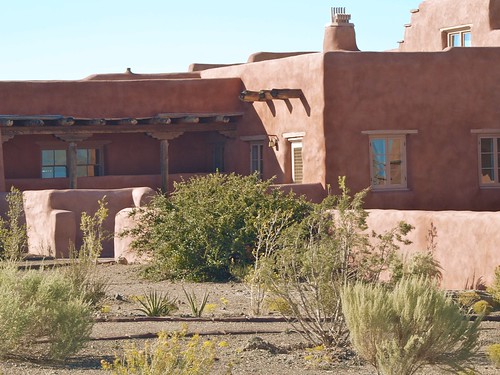
Painted Desert Inn in Petrified Forest National Park

Driving through the Petrified Forest National Park, one expects to see old rocks and scrub deserts and a lot of open space. But there is another treat of a different sort, right in the middle of the park – the recently restored Painted Desert Inn. The Inn has earned the designation of a National Historical Landmark.  This designation was given to the Inn as a significant historic place with exceptional quality, which illustrates the heritage of the United States.

The inn was constructed between 1937 and 1940 in the Spanish-Pueblo Revival style and the interior spaces have an unusually high quality of design. There is a sitting room, dining room, kitchen and tap room in the main part of the building. Rooms were attached to the building, but each had a separate outside entrance. A generator provided electricity, and water was hauled from the closest town, Adanama, which was located 10 miles away.

When I spoke to the park ranger, he said the inn was located in the “absolute middle of nowhere” when it was in operation in the early 1940s, and only attracted a few truckers from nearby Route 66. The rooms – there were only 4 rooms and 2 of them were used by park rangers – were rather primitive, having bunk beds, a dresser, and outdoor facilities. The attached main building, however, was quite elegant.

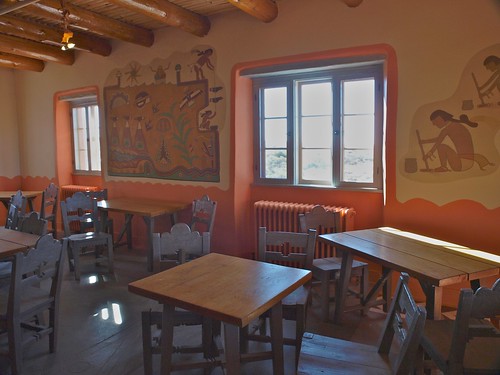
Murals by Hopi artist, Fred Kabobie

Murals in Dining Room by Fred Kabobie ©2008 Bo Mackison

The murals throughout the inn are by the late Hopi artist, Fred Kabotie. During the restoration, art conservationists restored the murals using a technique where tiny dots of paint were applied to the design only where the paint had deteriorated. Much of the mural maintains its original integrity.

The inn was restored to its 1940s condition during the last several years, and it is just the type of place where I would love to spend a few nights, maybe even a few weeks. Maybe even a few months. I love this region! Out in the middle of the desert, no lights, a sky full of stars at night, and great vistas during the day.


Unfortunately for me, it no longer operates as an inn, but the building can be toured as part of a visit to the Petrified Forest National Park.

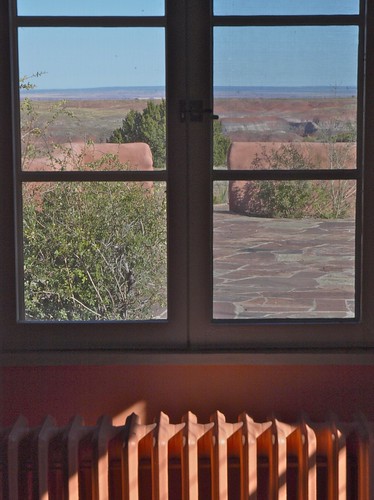
Id Like a Desert View, Please!

“I’d Like a Desert View, Please!” ©2008 Bo Mackison

If you drive on I-70 across Arizona, you drive right through the center of the park, though I’d recommend taking a break from the interstate because you cannot see the inn (and the really cool parts of the park) unless you drive on the main park road. Spending at least a few hours checking it out “up close and personal” is really a treat.

This building beautifully demonstrates architecture designed to fit into its setting. The simplicity of the lines and the desert color palette used to paint the inn are complementary to the Painted Desert setting. Truly a lovely building to explore if you are planning a trip to the park.

No way is this a “drive-by.”

https://londonplaywrightsblog.com/london-playwrights-annual-gift-membership/