Brown or Yellow?

https://londonplaywrightsblog.com/subscribe/ As a first or second grader, I would have been highly concerned that some adult made a serious mistake when painting the sign on the school bus. Surely big people who can spell all those hard words and then paint them on buses know the difference between the colors brown and yellow?

go to link Life is not always as it seems – especially when you are six.

Ambien 10 Mg Price But even when you are a big people, too!
Finding Jewels Along the Way

go site On our recent travels to the Southwest, we spent two days driving west from Wisconsin to our first destination, and then two days driving east from our last destination back to the Midwest. We had much ground to cover–over 2200 miles–on those four days, and we were traveling on Interstates, something that neither of us particularly enjoy.

Order Pregabalin Online We didn’t want to squander four days of our two week vacation doing nothing but driving, so I researched our route before we left our home. Perhaps Iowa, Nebraska, and Kansas don’t have a lot of well-known places to visit, but there is always something interesting to see if you are willing to look. And I found quite a few treasures that gave us an hour’s diversion from the monotony of the road.

Jewel Box Bank

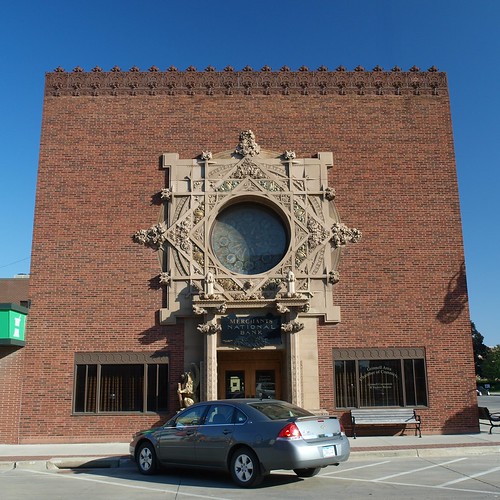
https://musicboxcle.com/vip/ Jewel Box Bank © 2008 Bo Mackison

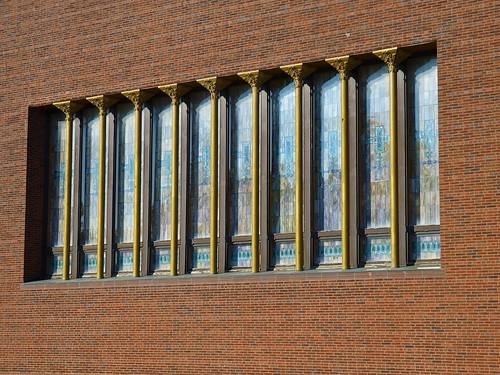
enter site Our first treasure literally was a jewel. We stopped at Grinnell, Iowa, which was just a few miles off I-80, to see the Merchant’s Bank, one in a series of architect Louis Sullivan’s Jewel Box Banks. Though Sullivan is most famously known as the “Father of skyscrapers”, he also left a legacy of these small banks, eight in all, dotting the Midwest.

Drat that car, but I wanted a photo of the front exterior showcasing the rose window medallion, and the car came with the exterior shot.

The window is designed with overlapping circles and squares that are in encased in terracotta ornamentation.

Terracotta Griffin

Terracotta Griffin © 2008 Bo Mackison

Griffins originally flanked both sides of the bank’s entrance, built vandals destroyed the East Griffin in 2006.  The terracotta and stained glass were a significant part of Sullivan’s designs.

Terracotta Griffin

Terracotta Griffin © 2008 Bo Mackison

When the bank opened on January 1, 1915, the townspeople of Grinnell were nearly unanimous in their approval. One citizen observed, “It sure looks nothing like Grinnell.”

Although that’s not entirely true. Grinnell, a small farming community, has an astounding number of buildings designed by well-known architects.

I think the building is best summed up by a newspaper journalist who wrote for the Grinnell Herald and was allowed a sneak preview prior to the grand opening for his article. He wrote:

“Go back to the north end and turn around to the south.  Raise the eyes above the partitions and brickwork and catch the massive simplicity of the long beams along the ceiling: study the windowed colored by Millet and its mosaic replica below which surrounds the clock with face of gold.  Raise the eyes still higher to the skylight…  If you are in just the right mood in time you can hear the dash of the waters over Niagara Falls, listen to the winds that sweep across the prairies of the West, see the blue that hovers over the land of the azure sky and understand something of what Sullivan meant when he talked about the genius of America.”

Cliff Hangers

Cliff Hangers

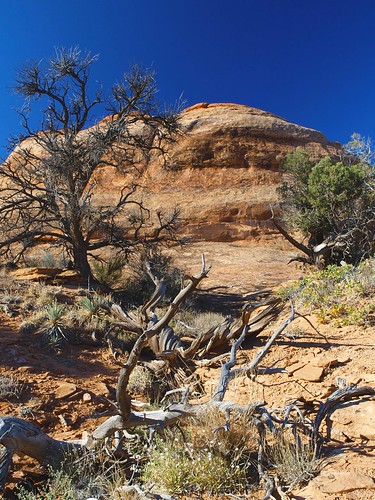
Determined Juniper Trees © 2008 Bo Mackison

These scraggly trees are common on rocky ridges. Where there is a fracture in the rock, the roots of the trees will reach deep enough to access just enough water to survive. One-seed junipers have the capacity to speed up or slow down their growth depending on water availability. It is also common for part of a tree to die back, allowing the rest of the tree to survive. Though their growth is slow, sometimes only 4 to 6 inches in a decade, they may live for hundreds of years.

Native Americans used the juniper for medicine, gum, dye, food (the berries) and fuel. They also made shoes from the woody fibers. Herbalists still use the plant for a variety of remedies.

These trees are hanging off the rocky top of Walnut Canyon in northern Arizona.

Wilderness Exposure

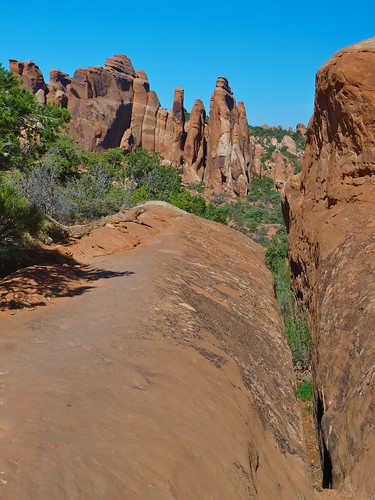
Devil’s Garden Trail explores some of the Utah back country in Arches National Park. Your reward for scrambling over rocky surfaces, navigating the narrow tops of exposed sandstone fins, and then climbing up and down short, steep crevices is a view not many people see – eight spectacular arches, and back-country worthy of many oohs and ahs, and a few comments, such as “I can’t walk on that #%*& ledge!”

Creative Cairn

Creative Cairn © 2008 Bo Mackison

Though most cairns (markers that let you know – really – you are still on the trail) are rocks stacked up in a pile, a previous hiker took the time to re-arrange this cairn into replicas of two hikers. So by looking at this photo, you can see we are precisely where we are supposed to be, even though we are vaguely lost.

This is the Trail? Are you Sure?

This is the Trail? Are you Sure? © 2008 Bo Mackison

At this spot, our choices were to scramble over the dome in front of us, or deal with the tangle of dead wood around the side. We scrambled up the rock, which thankfully was not slippery, and then slid down the other side. No sweat! (Yeah, right!)

The Worn Part iS the Trail

The WORN Part is the Trail © 2008 Bo Mackison

As was most evident to us, the trail was the worn path on the rocks. I kept my sights on the spectacular stand of fins ahead, and kept taking deep breaths. The trail marker at the beginning said the hike was not appropriate for people who suffer from extreme agoraphobia (fear of heights) – what about those of us who only have a minor case?

But I exaggerate! I loved this hike. We started at dawn and returned to the trailhead about 2 in the afternoon. I’ve seldom seen such magnificence. Worth all the bits of anxiety and lack of oxygen. (We were at a high elevation for Wisconsin folk!)

Then we went out for beer and pizza. It seemed the only reasonable thing to do.

What’s a Wupatki?

Box Canyon Pueblo

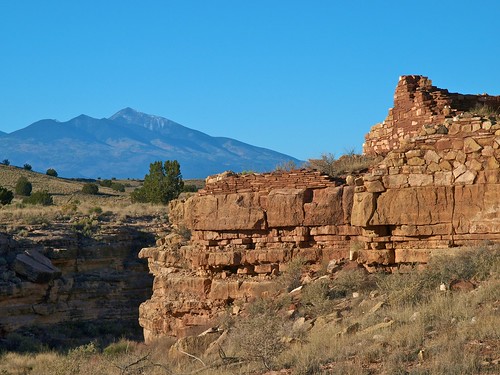
Box Canyon Dwellings © 2008 Bo Mackison

Wupatki isn’t a what, it’s a where. It is one of the five National Monuments we visited in Arizona when we were traveling the Southwest in October.

Wupatki National Monument is a high desert country that is 15 miles north of Flagstaff, Arizona. The region is extremely dry and supports a few stunted juniper trees and desert creatures. It seems like a rather inhospitable place to settle and farm, but that is exactly what an early group of Native Americans did. As early as 500 AD, people we refer to as the Sinagua (“without water”) built homes and farmed small plots of land. They took advantage of water run-offs collected in a variety of pottery vessels to irrigate their corn, gathered edible plants, and hunted in the nearby mountains and desert grasslands where a larger variety of animals lived.

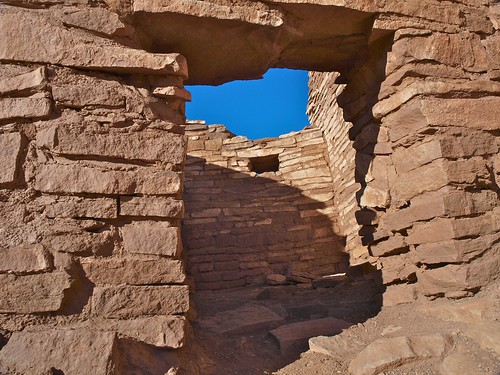
Doorway to the Bluest of Skies

Lomaki Pueblo – Doorway to the Bluest of Skies © 2008 Bo Mackison

The National Monument contains more than 2,700 ruins, the remains of structures that were inhabited until about 1400 AD. They constructed villages of multilevel, masonry pueblos. The Sinagua used red sandstone outcrops to act as a backbone for the bricks of fractured rock to make walls. To the north and west, the walls were built high to give protection against the winds; the walls to the south and east were terraced to take advantage of the winter’s sun. A water collection system was built into their flat roofs, and rain water was directed into storage pots.

These photographs are of Box Canyon dwellings, including Lomaki Pueblo, one of the smaller settlements in Wupatki. (Lomaki is the Hopi word for “beautiful house.”) Only a few of the pueblos are open for viewing. Most are protected against disturbance, but the buildings and area are not forgotten or abandoned. The Hopi and Zuni peoples believe their ancestors who lived and died here remain as their spiritual guides. They occasionally come to the grounds to enrich their personal histories and understanding of their clan.