Arizona Report – Life in the Southwest

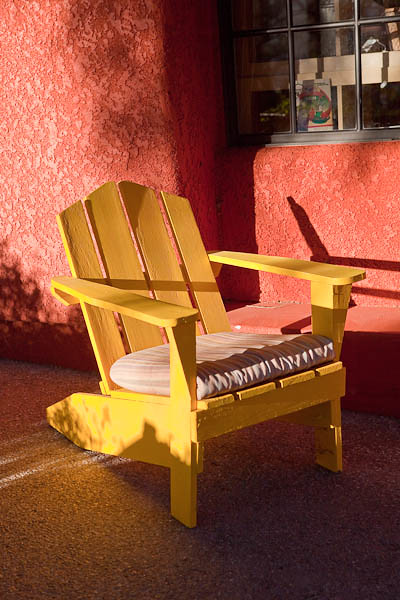
Sun Seat

In the Sun Seat © 2011 Bo Mackison

I’ve been in Arizona for a week. The weather has lived up to its promises, and then outdone itself on a few occasions. Except for one windy day, it has been calm and sunny. I’ve basked in the first 80 degree days I’ve seen since last August. I’m 1888 miles from my home, and sometimes it feels like that distance is half way around the world. Life, for sure, is different in the Southwest.

A few observations from the first week:

  • The critters I see still surprise me. A road runner “ran” across my back yard the first morning I was in my new place. I’ve seen it a couple times since, but that old cartoon didn’t lie. “Beep, beep” and it’s outta here, way faster than I can grab my camera.
  • The birds are simply amazing. As soon as the art show was over, and I had time to slow down, I bought a book on Southeast Arizona birds. Sherpa and I spent our only free day together exploring a canyon world famous for its birding populations. I’ve never been a birder. Except for the few birds that are easily identifiable, I refer to the whole of the avian population as “bird.” I am going to learn to identify some of the birds while I am here, though I don’t think I will ever be a bird photographer. I don’t have a lens capable of capturing most birds, although I’m told the hummingbirds are quite tolerant. At least they hover, almost long enough to get their photographs taken. Maybe I’ll get a photo of a hummer or two.
  • My washer and dryer are outside in a utility shed. I haven’t quite gotten used to this. Yesterday, I returned home from an “explore” and headed for the laundry to get my clothes. I nearly came face to face with a javelina. At first I thought it was a large, gray dog, but when it turned around to gaze at me with its beady eyes, its snout was no dog snout. I don’t much like the idea of sharing my laundry room with the javelinas, but they are crepuscular – they visit at dawn and dusk – so I’ll just do my laundry at other times.
  • Early this morning, I threw my arm over the pillow that is sleeping next to me in this king size bed. At first I thought it was Sherpa. But no, it was only a pile of pillows. That moment gave me my first taste of “alone”.  A sudden heave in my chest and a better realization of what I have taken on, and then the moment was over.  But I was shaken enough by my solitary feeling that I got up and made coffee. Every morning, so far, I’ve watched the sun rise from the porch, a cup of coffee in hand. I figure each day deserves a great start.

It’s time to start my day–I can smell the coffee–and give thanks that I am here, living my dream, and that I have this gift of a new day, full of possibilities.

——————-

Bo Mackison is a photographer and owner of Seeded Earth Studio LLC. She is living in Tucson for the next eight seven weeks, exhibiting her photography in art fairs, taking photographs in deserts and desert gardens, and blogging about photography, art fairs, and learning to live on her own. Her mantra is “Bo goes solo!”
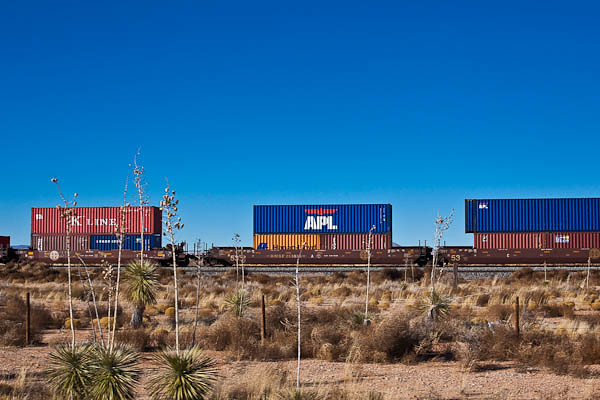
Three Cars and Yucca

Three Cars and Yucca

Three Cars and Yucca © 2011 Bo Mackison

I’m barely into my Grand Adventure and I already ran into a snafu. Not a bad snafu, just a time sucking one. And there are times when you can’t do much of anything about time drains, except admit you aren’t going to get everything done you’d planned to get done.

One can only go so fast hauling a trailer, and we lost travel time due to traveling in storms, so we drove fifteen hours straight to get to Tucson as scheduled.

The place I’ve rented for a couple of months is perfect for what I need – small, but not too small; in a quiet area, but not too quiet; plenty of open space and desert surroundings. Unfortunately, the promised computer hook-up was not available, so I couldn’t download any of the travel photographs or do much computer work last night or most of today.

Today was set-up day for the Tubac Festival of the Arts which runs from Wednesday through Sunday. (More info in tomorrow’s post.) I managed to set up part of my art booth, but then the Spring winds kicked in. And they packed a mighty wallop. I was just too darn exhausted to wrestle together my art booth while being battered by high, gusty winds. I’ll return early tomorrow morning to finish the booth and hang my photography canvases and prints. The show starts at 10, so I’ll have a little extra time if I get an early start.

I do want to mention the very best part of my day however. (Even days that aren’t going as planned can have great, unexpected moments!)

I was sitting on my patio this morning, only a few minutes after the sun rose into view above the mountains, sipping a cup of coffee. And a road runner strutted right through my back yard.

Now that may not be too exciting for anyone who has lived in the West, but I have to tell you, I have never seen a road runner close up – cartoon “beep-beep” road runners do not count. And I have surely never, ever visited with a road runner over early morning coffee – until today!

———–

Bo Mackison is a photographer and owner of Seeded Earth Studio LLC. She is living in Tucson for the next eight weeks, exhibiting her photography in art fairs, taking photographs in deserts and desert gardens, and blogging about learning to live on her own. Visit as she writes about living and working in Tucson. Her mantra is “Bo goes solo!”
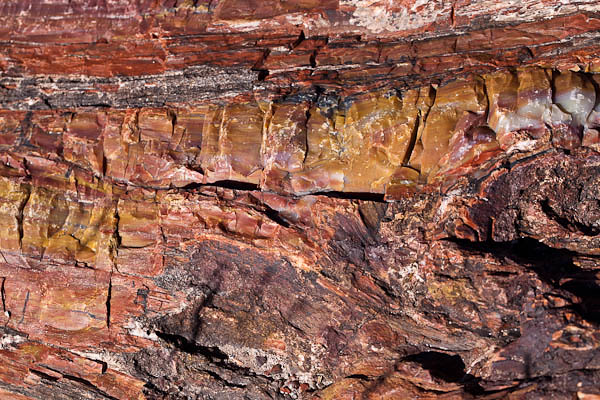
Petrified Wood in the Petrified Forest National Park

Petrified Wood III
Multi-colored Petrified Wood

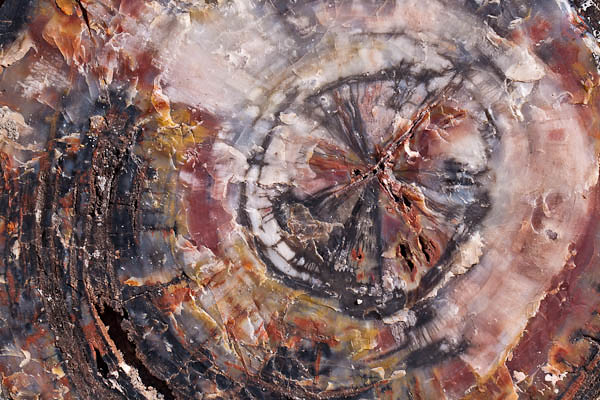
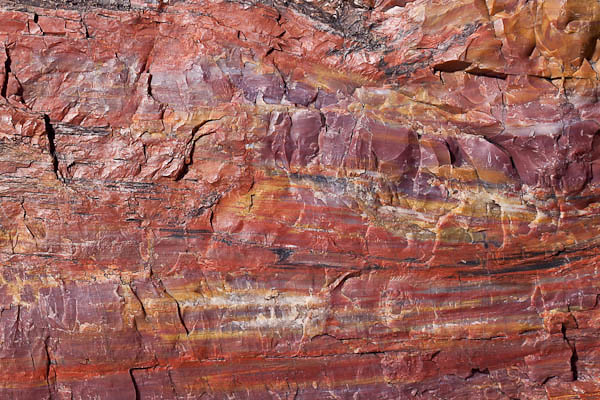
“An enchanted spot…to stand on the glass of a gigantic kaleidoscope, over whose sparkling surface the sun breaks in infinite rainbows.” ~~Charles F. Lummis, Some Strange Corners of Our Country – A Forest of Agate, 1891.

Petrified Forest National Park

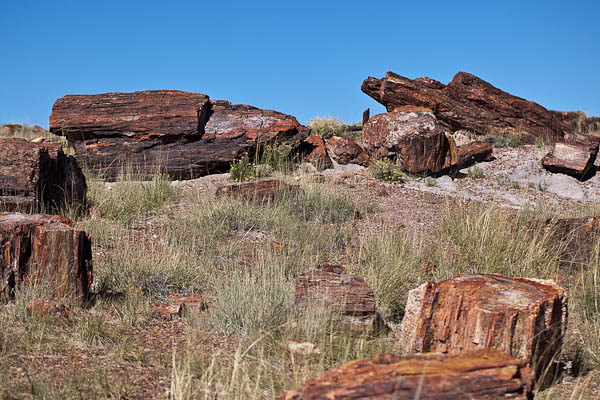
The Petrified Forest National Park is home to a large region of the Colorado Plateau filled with shards and fallen logs of petrified wood. The fossils have been dated to the Late Triassic period, approximately 225 million years ago.

Petrified Wood VI
Annular Petrified Wood

In the National Park, most of the logs in the park have retained their original form as they petrified, but internal structure was worn away by the elements. A few of the logs and some of the collection of petrified animal bones have cells that retained their original organic structure even though the structures were mineralized.

Petrified Wood
Red Petrified Wood

Much of the park’s petrified wood is from Araucarioxylon arizonicum trees, though at least nine species of fossilized trees have been identified in this petrified forest. All of these species are now extinct.

The International School of Gemology presents an informative and in depth explanation of how wood becomes petrified.

Historic Art in the Painted Desert Inn

Trading Room Glass Art Panels

Trading Room Glass Art © 2010 Bo Mackison

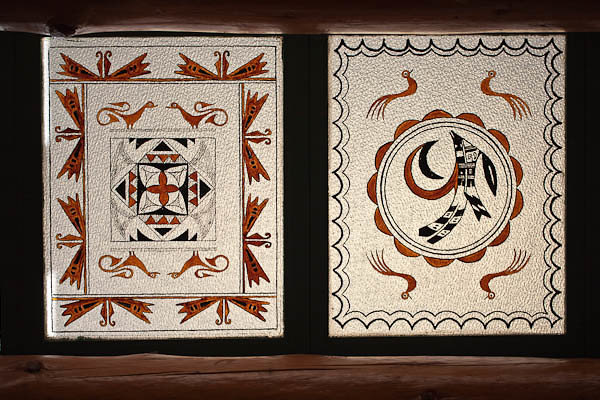
During the rehabbing of the Painted Desert Inn in the 1930s under the Civilian Conservation Corps (CCC), the architect, Lyle Bennett, was in charge of the Painted Desert Inn project. Though Bennett joined the park service as a ranger, his expertise about the fine arts (he had a degree in fine arts) made him sought after for many Park Service architectural projects. Under his guidance, the CCC crew designed and built tables and chairs based on Native American designs. Two CCC workers hand-painted these lovely skylights in the Trading Room with designs based on prehistoric art found in Southwestern archeological sites. Even the concrete floors were painted with patterns based on Navajo blankets.

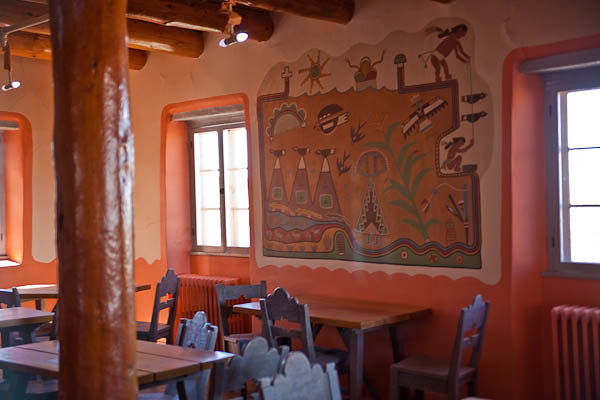
Painted Desert Inn Mural by Fred Kapotie

Mural by Fred Kapotie © 2010 Bo Mackison

In 1947, the Painted Desert Inn changed ownership and was purchased by the Fred Harvey Company. The company placed their architect, Mary Elizabeth Jane Colter, in charge of again renovating and repairing the buildings. She added a new color scheme to harmonize with the Inn’s surroundings, and also hired Fred Kobotie, a famous Hopi artist, to paint blanket sized murals on the walls of the diningroom and lunchroom. Kapotie’s murals depicted his culture in these paintings and provide glimpses into Hopi culture. Included subjects were the Buffalo Dance, a journey to a sacred place, spring planting time, and a sun face. The sun face also became the logo of the Fred Harvey Company.

Even though the Painted Desert and the Painted Desert Inn (Museum) are in the Petrified Forest National Park, I haven’t posted any photographs of the actual prehistoric wood yet. I promise, the next posts will contain the namesakes of the National Park.

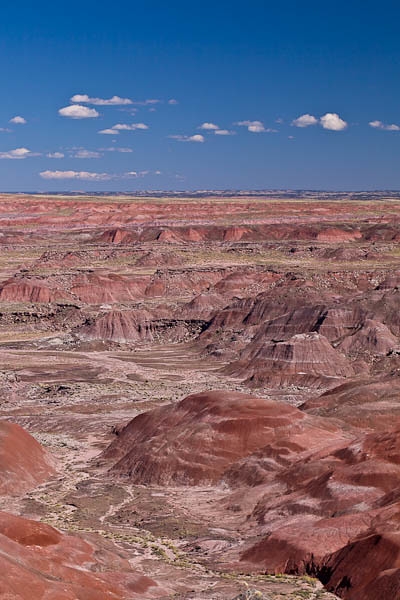
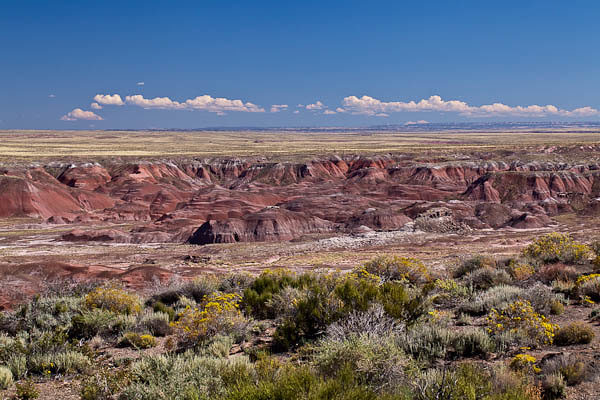
Harsh, But Beautiful – Painted Desert

Harsh Beauty in the Painted Desert

Harsh Beauty of the Painted Desert © 2010 Bo Mackison

A portion of the Painted Desert is located within the boundaries of Petrified Forest National Park located near the eastern border of Arizona. The  Painted Desert gets its name from the amazing, varied colors of rock – reds, oranges, pinks, lavenders, grays. This photograph was taken in October, and rain had recently passed through the region. The badlands I remembered from an earlier August visit were no longer brown and lifeless, but popping with a multitude of green plants and yellow flowers.

View from Painted Desert Inn

Painted Desert © 2010 Bo Mackison

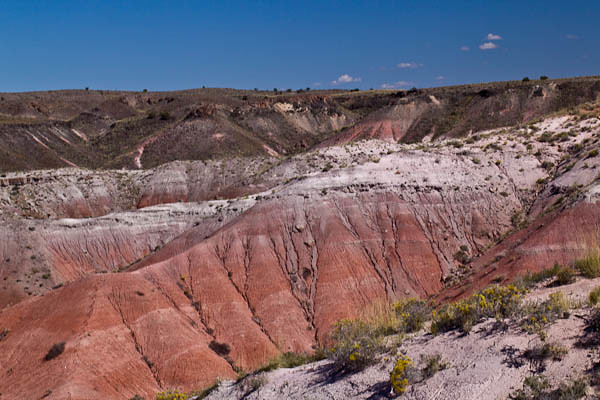
The area is covered by the geological Chinle formation which is a soft layer of earth consisting mainly of mud, sandstone, and volcanic ash. The texture of the soft rock is easily eroded and staining by water flows and mineral deposits leaves remarkable colors.

Painted Desert VII

Painted Desert VII © 2010 Bo Mackison

This is a designated wilderness area — hiking only a few hundred yards away from the main road provides for feelings of both exhilaration and desolation.