What’s a Wupatki?

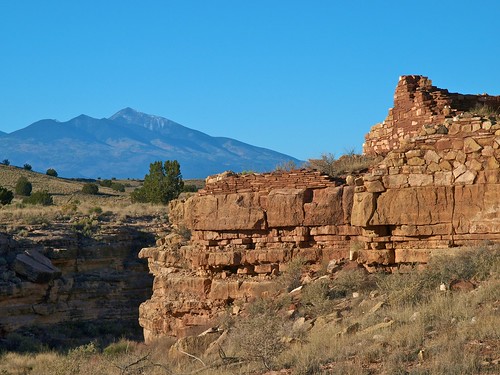
Box Canyon Pueblo

Box Canyon Dwellings © 2008 Bo Mackison

Wupatki isn’t a what, it’s a where. It is one of the five National Monuments we visited in Arizona when we were traveling the Southwest in October.

Wupatki National Monument is a high desert country that is 15 miles north of Flagstaff, Arizona. The region is extremely dry and supports a few stunted juniper trees and desert creatures. It seems like a rather inhospitable place to settle and farm, but that is exactly what an early group of Native Americans did. As early as 500 AD, people we refer to as the Sinagua (“without water”) built homes and farmed small plots of land. They took advantage of water run-offs collected in a variety of pottery vessels to irrigate their corn, gathered edible plants, and hunted in the nearby mountains and desert grasslands where a larger variety of animals lived.
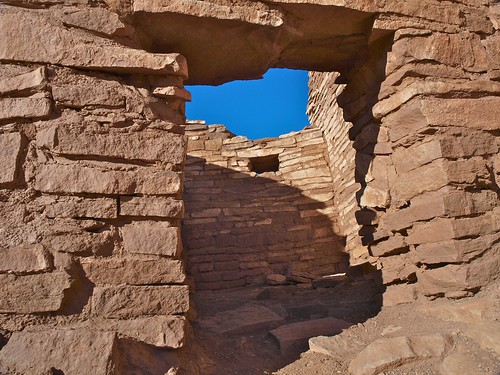
Doorway to the Bluest of Skies

Lomaki Pueblo – Doorway to the Bluest of Skies © 2008 Bo Mackison

The National Monument contains more than 2,700 ruins, the remains of structures that were inhabited until about 1400 AD. They constructed villages of multilevel, masonry pueblos. The Sinagua used red sandstone outcrops to act as a backbone for the bricks of fractured rock to make walls. To the north and west, the walls were built high to give protection against the winds; the walls to the south and east were terraced to take advantage of the winter’s sun. A water collection system was built into their flat roofs, and rain water was directed into storage pots.

These photographs are of Box Canyon dwellings, including Lomaki Pueblo, one of the smaller settlements in Wupatki. (Lomaki is the Hopi word for “beautiful house.”) Only a few of the pueblos are open for viewing. Most are protected against disturbance, but the buildings and area are not forgotten or abandoned. The Hopi and Zuni peoples believe their ancestors who lived and died here remain as their spiritual guides. They occasionally come to the grounds to enrich their personal histories and understanding of their clan.
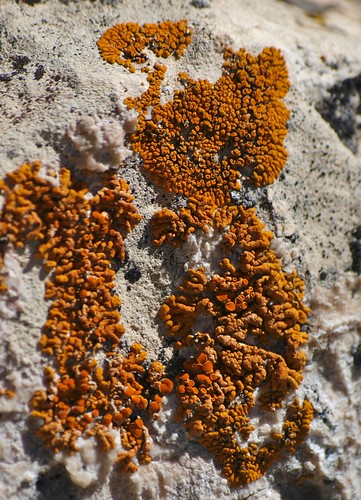
Oran’ga Likin’ Orange Lichen

Orange Lichen © 2008 Bo Mackison

These splotches, formally known as lichens, grow on rocks. They can be any number of colors – yellow, orange, gray, green, blue, black. And they can grow in the most inhospitable places in the world. This colony of orange lichen is from Walnut Canyon National Park in northern Arizona.

Lichens are actually colonies of two different organisms co-existing and working together: algae which lives in filaments built by fungi. They use photosynthesis for nourishment.

Some lichen grow only a few millimeters in a century, so these lichens may be thousands and thousands of years old.

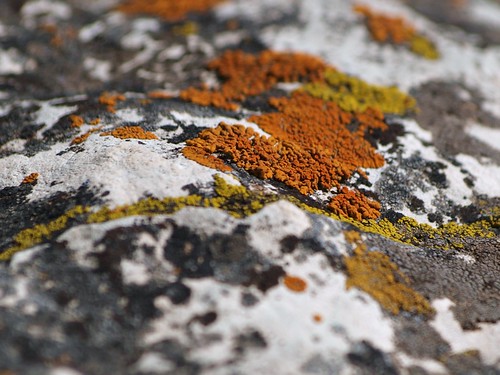
Yellow, Orange and Gray Lichen

Yellow, Orange and Gray Lichen © 2008 Bo Mackison

For me, lichens are the kind of thing that brings out experimentation when I’m photographing. Do I capture the texture, the design, the mix of colors?  Well, having fun is a big part of taking photos for me. And this stuff was amazingly fun to shoot. I like lichen.

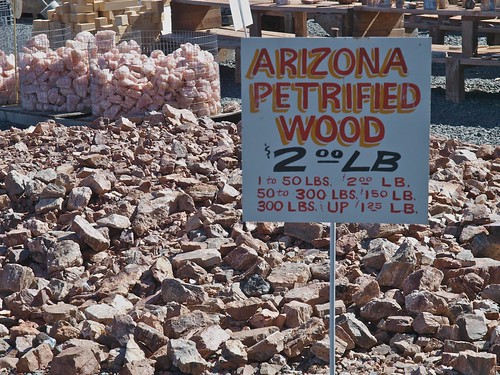
Petrified Wood for Sale

Petrified Wood for Sale

Petrified Wood © 2008 Bo Mackison

My way of thinking, this is a lot of money for an old (thought, granted, very old) piece of tree. Someone must buy the stuff, or they wouldn’t have such big piles of it. The ranger at the entrance to the Petrified Forest National Park did say that the people from Jim Gray’s Petrified Wood Company in Holbrook, Arizona ran a reputable shop–unlike some nearby store keepers who illegally remove the rocks from the park to sell.

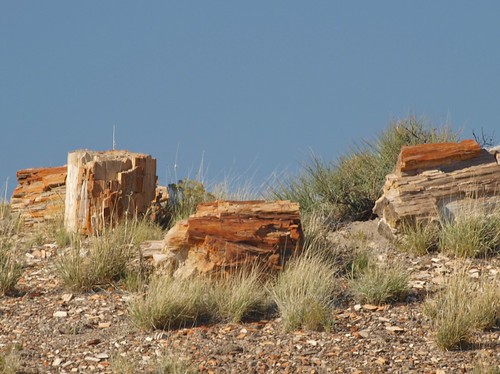
Petrified Logs in Petrified Forest National Park

Petrified Logs in Petrified Forest National Park © 2008 Bo Mackison

So how much would one of these logs cost if they were for sale? Well, we’ll never know, because they aren’t available for purchase. They are located in the National Park.

~~~

In response to a Marcie’s question in the comments below, here are some facts about petrified wood that you might not know:

Petrified wood is permineralized wood (as in permanently mineralized) and it is a fossil from a family of trees now extinct in the Northern Hemisphere. The trees are still found in a very few places in the Southern Hemisphere. During the Late Triassic Period – 248 to 206 million years ago – this Arizona desert region was tropical. During seasonal flooding, trees were swept into sandy river channels, and then periodically buried by layers of gravelly sand and volcanic ash.

The ash, which is a source of silica, permineralized the buried wood, replacing the wood with silica. Red iron oxide and pink manganese deposits added coloring in the fossil. Voila!

Petrified wood, of course, didn’t occur overnight. The ocean receded over 60 million years ago, and the wood gradually turned into mineral fossils. Awesome stuff, this geology.

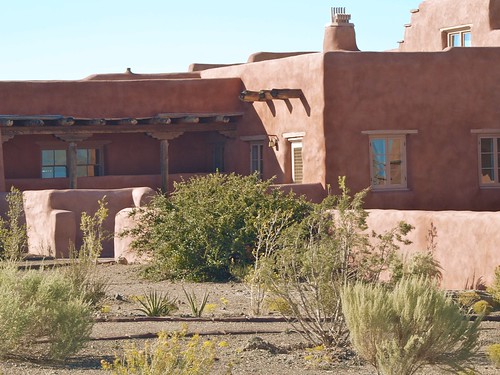
Painted Desert Inn – National Architectural Treasure

Painted Desert Inn in Petrified Forest National Park

Driving through the Petrified Forest National Park, one expects to see old rocks and scrub deserts and a lot of open space. But there is another treat of a different sort, right in the middle of the park – the recently restored Painted Desert Inn. The Inn has earned the designation of a National Historical Landmark.  This designation was given to the Inn as a significant historic place with exceptional quality, which illustrates the heritage of the United States.

The inn was constructed between 1937 and 1940 in the Spanish-Pueblo Revival style and the interior spaces have an unusually high quality of design. There is a sitting room, dining room, kitchen and tap room in the main part of the building. Rooms were attached to the building, but each had a separate outside entrance. A generator provided electricity, and water was hauled from the closest town, Adanama, which was located 10 miles away.

When I spoke to the park ranger, he said the inn was located in the “absolute middle of nowhere” when it was in operation in the early 1940s, and only attracted a few truckers from nearby Route 66. The rooms – there were only 4 rooms and 2 of them were used by park rangers – were rather primitive, having bunk beds, a dresser, and outdoor facilities. The attached main building, however, was quite elegant.

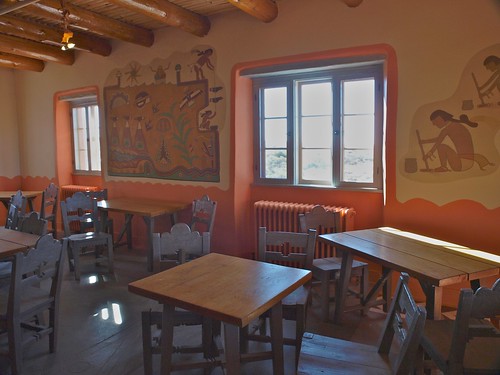
Murals by Hopi artist, Fred Kabobie

Murals in Dining Room by Fred Kabobie ©2008 Bo Mackison

The murals throughout the inn are by the late Hopi artist, Fred Kabotie. During the restoration, art conservationists restored the murals using a technique where tiny dots of paint were applied to the design only where the paint had deteriorated. Much of the mural maintains its original integrity.

The inn was restored to its 1940s condition during the last several years, and it is just the type of place where I would love to spend a few nights, maybe even a few weeks. Maybe even a few months. I love this region! Out in the middle of the desert, no lights, a sky full of stars at night, and great vistas during the day.


Unfortunately for me, it no longer operates as an inn, but the building can be toured as part of a visit to the Petrified Forest National Park.

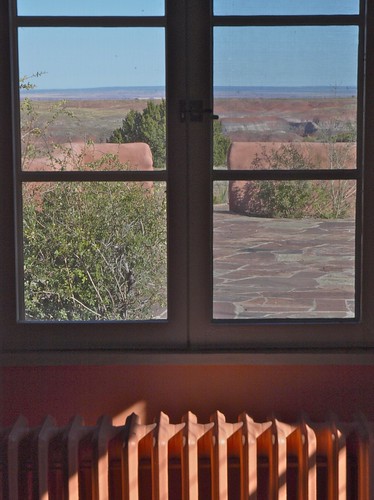
Id Like a Desert View, Please!

“I’d Like a Desert View, Please!” ©2008 Bo Mackison

If you drive on I-70 across Arizona, you drive right through the center of the park, though I’d recommend taking a break from the interstate because you cannot see the inn (and the really cool parts of the park) unless you drive on the main park road. Spending at least a few hours checking it out “up close and personal” is really a treat.

This building beautifully demonstrates architecture designed to fit into its setting. The simplicity of the lines and the desert color palette used to paint the inn are complementary to the Painted Desert setting. Truly a lovely building to explore if you are planning a trip to the park.

No way is this a “drive-by.”


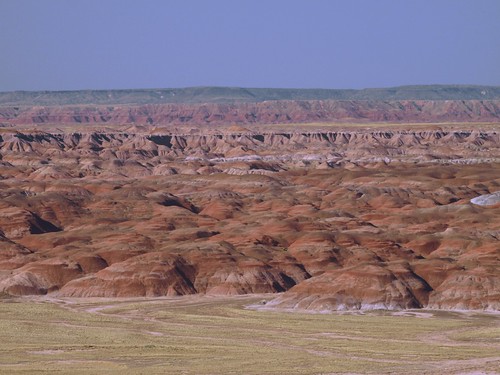
The Painted Desert – Not Quite What You Expected?

Painted Desert in Petrified Forest National Park

Painted Desert in Petrified Forest National Park ©2008 Bo Mackison

No saguaro or organ pipe cacti or other familiar succulents in this desert. The Painted Desert in northeastern Arizona really isn’t a desert at all – you need to go further west and south for real desert – but is located near short grass plains or desert grasslands. The Painted Desert is barren red Chinle mudstone. Various combinations of minerals provide the different coloration – red is iron oxide and the white is gypsum.

These formations were formed 220 to 225 millions of years ago, and though the rocks are not high, they are approximately 800 feet thick. No drilling for water through this stuff.

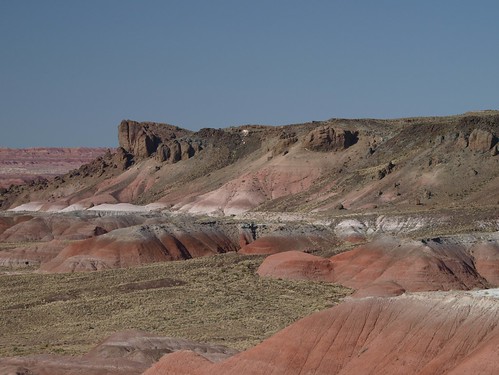
Badlands in Painted Desert

Badlands in Painted Desert ©2008 Bo Mackison

Unfortunately, we were traveling through the area in early afternoon. I would have liked to have captured the colors nearer sunset when the reds would reflect deeper colors. It is still an amazing drive, though, through an ancient world that is well preserved. An incredible number of fossils and archeological ruins are found throughout the park.