Desert Agave in Bloom

Agave with Yellow Blooms

Agave with Yellow Blooms


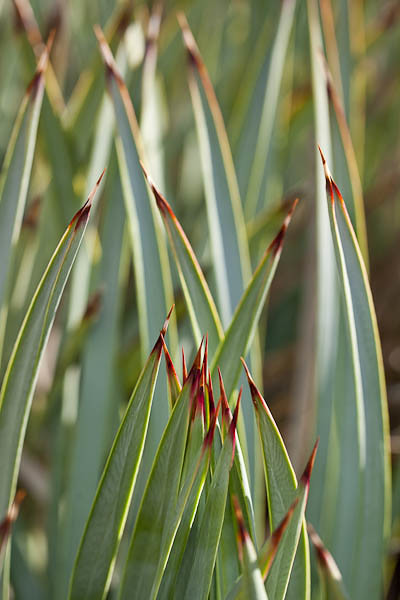
This lovely agave, known as the Desert Agave, is also sometimes called the “century plant”. It may have seemed like a century between flowerings to the ones who originally named it, but in practice it flowers after 8 – 20 years. Although all the flowering plants die, the plants also send out offshoots of non-flowering rosettes that remain alive, ready to flower in another year. The leaves of the rosettes are armed with stiff terminal spines, not to be fooled with, though hummingbirds seem quite attracted to the flowers.

The Desert Agave is one of the more drought-tolerant of the more than 130 species of agave found in north America. It typically grows on gravely earth from south-eastern California and south-western Arizona to Baja, California and northern regions of the state of Sonora, Mexico.

The core of the plant was baked in rock-lined pits by desert-dwelling Indians to form a nutritious energy-rich staple food. Baked agave is still available in Mexican markets. I’d love to taste it.

—————

Bo Mackison is a photographer and owner of Seeded Earth Studio LLC, living and photographing in southern Arizona. She is grateful for the opportunity to see the diversity and beauty of the Sonoran Desert and its amazing plants.
Return to the Chiricachuas

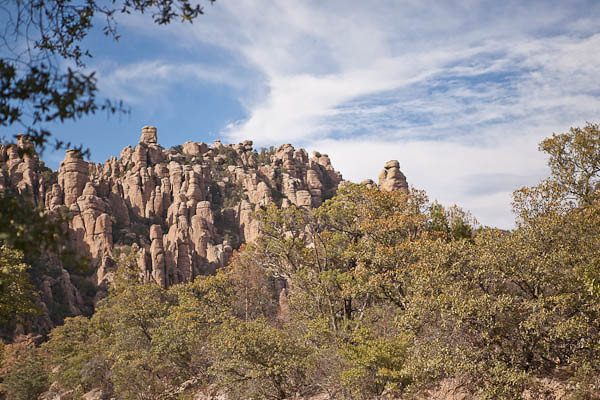
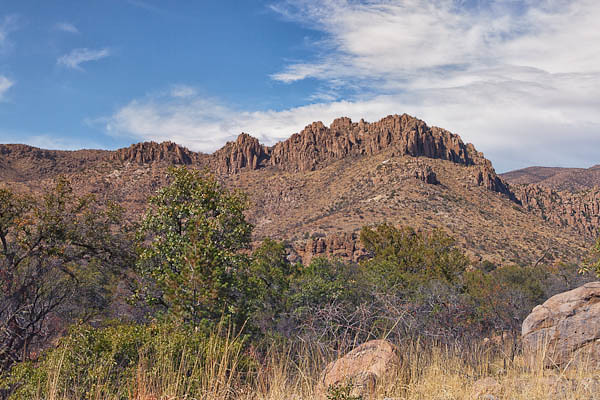
The first time I visited Chiricahua National Monument in southeastern Arizona, on my first visit to Arizona in 2008, I was in awe of the vast mountain spires, the chimneys and balanced rocks and imposing towers of stone. Interspersed within this wonderland of rock was a forest of many shades of green, and an immense variety of vegetation caused by the interconnection of four major habitats – the Chihuahuan Desert from the east, the Sonoran Desert from the west, the Rocky Mountains from the north and the Sierra Madre Mountains from the south.

All come together in Chiricahua, a sky island, and the combined diversity in nature was almost unimaginable. A drive from northern Canada, through the United States, and ending in northern Mexico would give you a similar experience, but add 2,000 miles to your drive.

Chiricahua

Chiricahua National Monument © 2012 Bo Mackison

When I was in Arizona last winter, I had hoped to visit the Monument again, but I ran out of time. No problem, I thought. I’ll go see the Chiricahuas when I come back. They’ll still be there. I’ll have more time to explore, and I can camp again in the delightful Bonita Springs Campground.

I returned to Chiricahua National Monument a few days ago. And I was partly wrong in my assumptions. Yes, the Chiricahuas are still there, the mountains as vast and intricate as always. But no, they are not the same. Last May, 2011, only a few weeks after my return to the Midwest, a human-caused fire started in the drought-dry Coronado National Forest many miles south of the park.

A deep freeze the February before had killed much of the annual and perennial vegetation in the area. And a regional drought had made the whole of southeastern Arizona like a tinder box. One carelessly watched campfire was all it took. Six weeks after the initial blaze, almost 223,000 acres in the Chiracahua Mountains, and 100% of Chiricahua National Monument, had burned. Buildings were saved, a few hundred acres of trees in the lower elevations and near the campground had been protected, but everything else had been damaged to some extent by the wildfire.

Last week, I finally had the chance for a proper visit. I set up my campsite, and then took the last tour of the day of the Faraway Ranch,the historical ranch that was instrumental in establishing this part of the Chiricahuas as a National Monument back in the 1920s. Then I headed up into the mountains on the eight mile long road to see the summit and assess the damage I had only heard about.

The rocks were there, but the trees I remember were burnt tree matchsticks. Entire mountains had been denuded. Here and there a few survivors showed green against the pale rock, but the damage was — perhaps I am being dramatic here, but the only word I can think of is — heartbreaking.

As I walked around I still admired the rocks. They are still spectacular. But I wondered what had happened to all the species of mammals and bats, hummingbirds and insects, the trees and the flowers, that had flourished here in such unprecedented numbers. Where had everything gone?

I saw a few birds soaring between the rocks and one lizard. I saw a few wildflowers, hugging the road. A few bushes, some scarred. A few trees.

I left my camera in the car. Even though it was late afternoon, and the time was approaching the golden hour, my enthusiasm for photography was at a low. I drove back to the campground, packed up the few things I’d piled on the picnic table, and drove back to Tucson.

Before I left, I took a couple of photographs near the Faraway Ranch where the trees were saved.

Chiricahua National Monument

Spared Chiricahuas © 2012 Bo Mackison

The monument won’t be the monument I remember falling in love with until my grandchildren’s children are old enough to hike the trails. I’ll be back before then, ready to find the beauty I know is still there, ready to take photographs of Chiricahua.

I need a little time to adjust to Chiricahua as it is now. But I’ll be back.

——————-

Bo Mackison is a photographer and owner of Seeded Earth Studio LLC, living and photographing in southern Arizona.


In All Things of Nature

The Spanish Bayonet agave is a wicked sounding plant, and no doubt if you bump into it or step upon a fallen spike, it gives a wicked stab, too. But just as you can’t accurately judge a person by his or her name, or a new food by its appearance, you cannot know a plant by its name, nor a casual glance.

It usually takes time to get to know a plant, or a person for that matter.

Sotolillo

Sotolillo © 2012 Bo Mackison

When I first saw the Spanish Bayonet agave, it was a mass of red tinged, spiky green stabbing sticks. Those who knew the desert well called that bundle of danger an agave plant, or according to some botanists, a very close relative of the agave. I thought perhaps they were being generous.

Spanish Bayonet in Bloom

Spanish Bayonet in Bloom © 2012 Bo Mackison

In all things of nature, there is something of the marvelous. ~ Aristotle

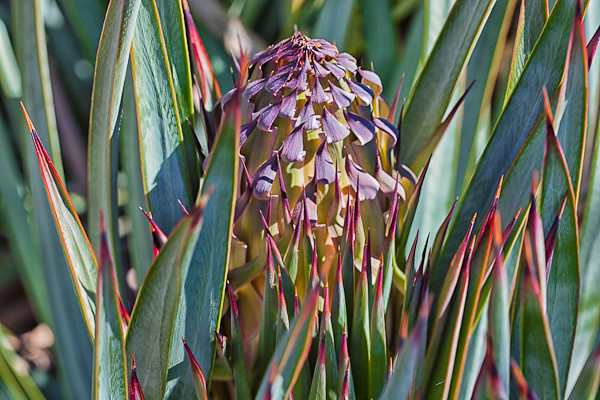
Then one day when I was out and about in the Sonoran desert, I saw the Spanish bayonet, but it was no longer simply a spiky plant. Its center had opened, the heart of the plant, and bursting forth was a mass of purple florets. This spiky plant, this plant which has red-tinged tips and a vague look of battle, had always had this beauty in its heart.

It was unknown to me, a newcomer to the desert. But what a wonderful gift for me – a surprise bouquet!

Spanish Bayonet

Flower Spike © 2012 Bo Mackison

One looks, looks long, and the world comes in. ~ Joseph Campbell

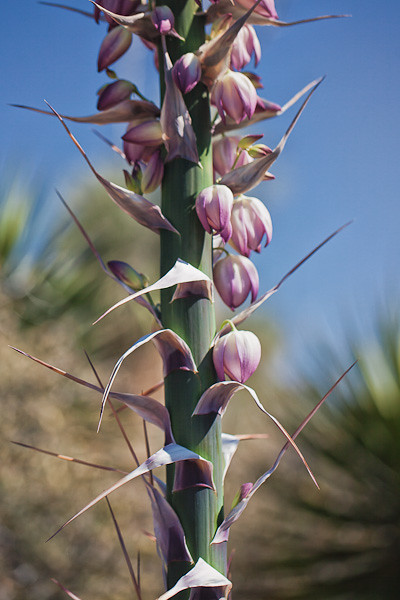
The sotolillo – the name I have since learned is the Mexican name of the plant, and one that I quite prefer – offered even more delight at my next visit, a week or so later. The bouquet in the middle of the spikes had stretched – like, I imagine, Jack’s beanstalk grew – and it   stretched towards the sky, a full ten feet high. Lovely!

There is one last photograph of the sotolillo blossom that I will save for Sunday’s post. It is a beauty, perfect for Part II.

——————–

Bo Mackison is a photographer and owner of Seeded Earth Studio LLC, living and photographing in southern Arizona. She remains amazed and grateful for the opportunity to see the diversity and beauty of the Sonoran Desert.

Imagining the Past – Teatro Carmen

I love the desert Southwest, wandering through the saguaro forests and the hidden canyons west of Tucson, but occasionally I feel the need for solid pavement under my feet, and that is when I go searching for the region’s historical buildings. Though Tucson is not considered an old city compared to most other cities, it is a city proud of its history.

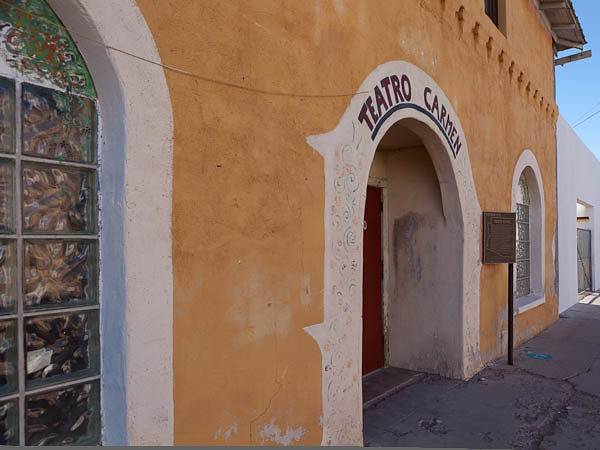
Teatro Carmen - Street View

Teatro Carmen - Street View © 2012 Bo Mackison

In researching historical buildings in downtown Tucson, I found two resources of interest. First, there is a well established historical walk through the heart of downtown known as the Presidio Trail – also called the Turquoise Trail because one follows a turquoise painted line on the sidewalk to easily go from site to site. The brochure has information about each of the 23 sites and an easily followed map for when the turquoise line on the pavement goes in several directions, leaving trail followers too many choices.

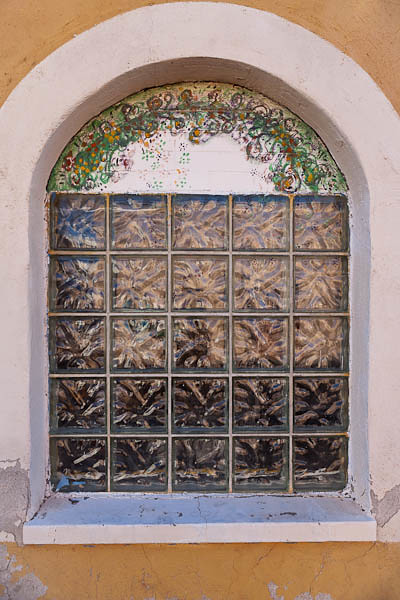
Teatro Carmen - Decorative Painted Window

Teatro Carmen - Decorative Painted Window © 2012 Bo Mackison

One of the sites that is on both the Presidio and the Arizona Women’s walking tours is the Teatro Carmen. This was one of the first theaters in Tucson built to showcase Spanish language dramatic arts. It is named for its founder, Carmen Soto de Vasquez, a businesswomen and cultural leader in Tucson in the early 1900s.

She commissioned a prominent architect/builder, Manuel Flores, to build the theater. The building was designed in the Sonoran Mission style and in the heart of what is now Tucson’s historic district and had its first opening performance in 1915. Carmen Vasquez had the theater built to provide a place for Spanish literary productions as well as operas, musicals and melodramas.

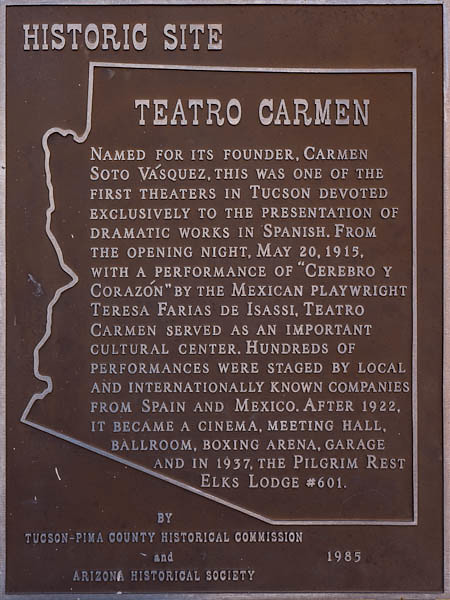
Teatro Carmen - Historic Sign

Teatro Carmen - Historic Sign © 2012 Bo Mackison

Many of the sites along the Presidio Trail are marked with historical signs that provide additional information.

The second reference I used is a fairly new brochure, compiled by a coalition of women’s organizations and historical groups, called the Arizona Women’s Heritage Trail. It was designated a legacy program by the Arizona State Centennial Commission and has twelve sites that highlight a few of the women in early Tucson and their history.

Seven of the sites are on both walking tours, but each map has its own perspective, and so both are useful. There are also many restaurants, outdoor plazas with benches and drinking fountains, and many places you can duck inside for a respite from the Arizona sun if, like me, you choose a 90˚day to re-visit the past with a walk through history.

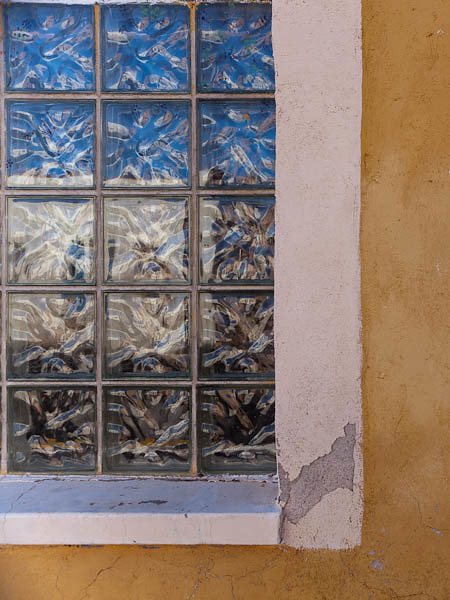
Teatro Carmen - Window and Reflection

Teatro Carmen - Window and Reflection © 2012 Bo Mackison

Although the building is in a state of partial disrepair, there are still hints of its fine construction and quiet beauty in the remaining details. I love the arches over the pressed window blocks and the brightly painted floral decoration. The painting is not only above the window, but remnants of painted flowers still can be seen on the window glass.

It is amazing to think that through this woman’s efforts a desert town became a cultural center for the arts and brought internationally acclaimed theater to Tucson. She was one of the original arts-instigators in Tucson.

—————-

Bo Mackison is a photographer and owner of Seeded Earth Studio LLC, living and photographing in southern Arizona.

Color in the Desert

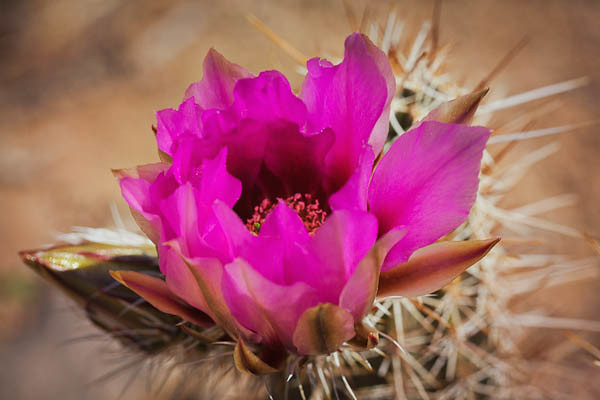
Hedgehog Cactus Blossom

Hedgehog Cactus Blossom © 2012 Bo Mackison

Our difficult and very urgent task is to accept that nature is not primarily a property to be possessed, but a gift to be received with admiration and gratitude. ~ Henri J. M. Nouwen

I have taken many photographs of many cactus blossoms. But this bright offering of the desert, this magenta blossom perched on the very tip of one of the many stems of this cactus, is my first cactus blossom taken in the natural desert.

Last year the desert was dry, very dry, and the flowers I did see were in botanical gardens where sufficient care was provided to keep the plants satisfied and blooming. But in the desert, along the trails wandering miles from the nearest building, the cactus were late bloomers and I had returned to Wisconsin before there was any blossoms of color in the desert.

But this year? This year I feel as if it is my birthday ever time I hike in the desert, and the desert is intent on giving me daily surprises, gifts of nature that I can only accept with my awakened senses, and then document with my camera and notebook.

It is impossible for me to explain how thrilling it is to be walking along a trail, weaving in and out, and up and down along mountain trails, studying the saguaro cacti forests one mountain over, the saguaros on the southern face of a mountain, as common as pine trees in a Northern forest. And I spot the first blooming cactus I’ve ever seen in the desert – a hedgehog cactus. And it sports one perfectly formed magenta blossom from one stem.

And suddenly, as I walk along, everywhere I look there are magenta flowers popping off the tips of the hedgehog stems. The Sonoran Desert is blooming in bright color as I watch. Occasionally I see a few yellow buds on other hedgehogs, and as I survey the mighty saguaro, I notice a few that have flower buds at their highest tip.

Saguaros typically bloom in mid-May through mid-June in the Tucson region of the Sonoran, but it has been an early blooming season, and the cacti are proving no exception. This year I purposely stayed in Arizona through April, hoping to see the cactus bloom, and I am  quite ecstatic that the desert is showing me her colors.

—————–

Bo Mackison is a photographer and owner of Seeded Earth Studio LLC, living and photographing in southern Arizona until the end of April. She is thrilled that the cactus in the Sonoran desert are beginning to blossom.