Articles by Bo Mackison

Writing Your Life Story Part 3: How to Create A Photo Keepsake Booklet

https://www.jacobysaustin.com/press/ Grandma and Brother © 2010 Bo Mackison

Order Ambien Online This is the third post in the Memoir Project, a series on documenting your life story. The first two projects in the Memoir Project were writing projects. Now is a good time to branch out and add a multimedia touch.

Let’s add an easy photography project.

click here No need to have an expensive camera or a camera with fancy settings unless that is the kind of camera you love to use. A basic camera is fine. Or a phone camera. Or a three dollar disposable camera from the corner store.

We often annotate our photographs when we organize them.

https://geneticsandfertility.com/patients/fees/ We take photos. Then we add information on the back — date, place, names. Important information. However in this project, the photographs are not the only part of the project. The writing is just as important.

My photo booklet — in the photograph below — focuses on an important person in my life.

https://gritandgracefamilyfarm.com/the-barnyard/ You may want to do a similar project with the focus on a person, or you may want to feature your favorite books, art, foods. You can photograph the place where you live, including details that make your house a special place. You can do a photo shoot documenting your typical activities on a typical day. You are limited in subject matter only by your imagination!
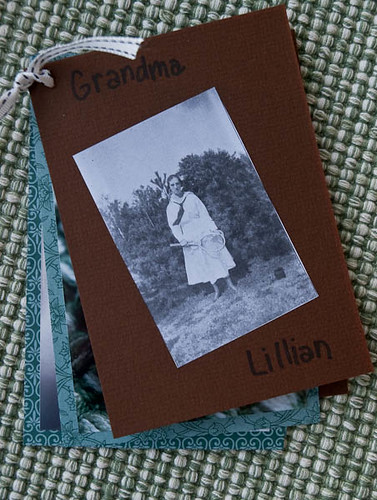
http://www.ztpackaging.com/laminated-bags/ Grandma Lillian © 2010 Bo Mackison

https://thelonelycreative.com/photography-gallery/ I chose to write about my grandmother, one of the more influential women in my life, who lived to be 91 years old. I have many fond memories of my grandmother — I lived with her until I left home to attend college — but I wanted to write about her using a multifaceted approach.

go I chose to do a project about objects and mementos she had given me, both as a child and as an adult. I photographed these items and included them in a booklet, using each photo as an evocative prompt for writing. Here are the directions for making a similar booklet. You can adapt the directions to your own project.

https://www.beyondagencyprofits.com/loom-videos/ How-To Directions for Turning a Photo Booklet into a Memoir Keepsake:

1. I only have a few things from my grandmother. I went through my home collecting those items. In ten minutes, I’d found several pieces of jewelry, a collectible miniature shoe, a lucky buckeye, and my most beloved treasure, a gravy bowl that my grandparents had received as a wedding gift.

2. I took photos of each object. Again, nothing fancy. Try to use natural lighting if possible–set the items up on a table near a window, or even outside, but don’t photograph items in direct sunlight. A shaded area is fine. It is also better to avoid flash if you shoot indoors, but don’t get hung up on the photography. Just take the photos. Take several photos of each item, so you can choose the best photo of each item.

3. Make prints of a photograph of each object.

4. Mount the photographs on a backing paper. You can use a variety of papers, a heavy weight paper works best. I used a decorative paper from a local arts and crafts store.
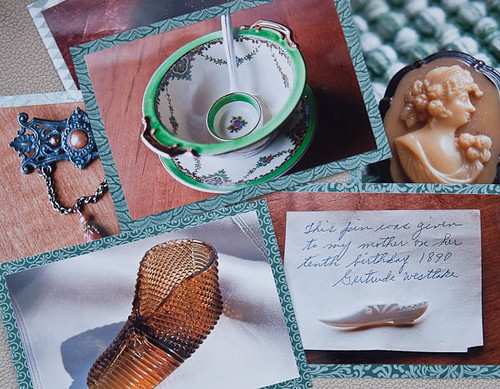
Remembering GrandmaSentimental Objects © 2010 Bo Mackison

5. I created a front and back page for the booklet. I photocopied a vintage photo of my grandmother — don’t use an original! — and glued it to the front of the booklet. Use any photograph, drawing, or title that captures the focus and spirit of your book.

6. Punch a hole in the top left corner of each photo and the cover pages.

7. Tie the two covers and all the photographs together with a ribbon or use a metal binder ring (can be purchased at an office store.)

8. Once you complete your booklet, the writing begins. (Or sooner, if you are inspired.) When using photographs of special objects, thinking about the memorabilia will bring back many memories. Write whatever comes to mind on the back of each photograph. No over-thinking, just a quick written sketch will do.

9. Keep the booklet handy. You can add information as you recall more details. Once in a while I find another item from my grandmother. (Just last week, I realized my rolling-pin had come from her kitchen.) Take photographs and update the booklet as needed.

Here is a sample of the quick writing I did on the back of the photograph of the gravy boat.

This is my favorite object I have from Grandma. It’s a Noritake china gravy bowl with a matching saucer.  My favorite part is the elegant but tiny matching ladle. She and Grandpa Harry received it from his great-aunt when they married in 1919. I remember using it on special occasions such as Thanksgiving dinner. I always loved it, and Grandma gave it to Robert and me the summer we planned our own wedding.

In our family we used the gravy bowl frequently while the kids were growing up. I think whenever we had gravy with a meal, one of the children would ask if we could “please use Great Grandma’s bowl.” The kids used the bowl and tiny ladle while I cautioned them to be careful–I couldn’t help but utter words of warning!–but all three kids, from the time they were barely in school, ladled their own gravy onto their mashed potatoes from the precious china bowl.

We use it to this day, and everyone thinks of it as one of our more valuable family heirlooms.

In the next project, we’ll explore another quick writing prompt and discuss methods for storing your growing memoir stash!
Next: Part 4, Why Write Your Life Story?

Desert Art – Chihuly’s Cattails in the Garden

Chihuly Cattails

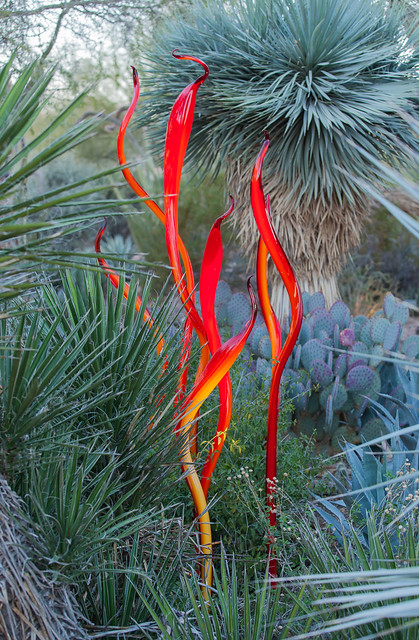
Chihuly Cattails in the Desert Garden © 2104 Bo Mackison

I never met a color I didn’t like. ~ Dale Chihuly

Another stroll through the Desert Botanical Garden in Phoenix, Arizona.

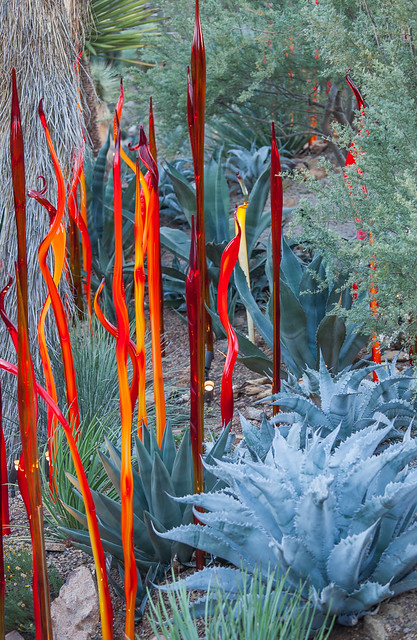
This time focusing on these stunning red and orange cattails – swirling, curving, shimmering in the sunlight. The individual pieces are set amongst the succulents and desert trees .

Chihuly Cattails

Curving Cattails © 2104 Bo Mackison

[I want the glass] “to appear like it came from nature—so that if someone found it on a beach or in the forest, they might think it belonged there.” ~ Dale Chihuly

Chihuly Cattails

Red Cattails, Blue Agave

As an artist, Chihuly has always been a scavenger of images and ideas. He’s known for translating forms and patterns from nature and other media into glass: the designs of Native American blankets, the undulating shapes of sea creatures, the orbs of Japanese glass floats. ~ Sheila Farr, Seattle Times

This installation of cattails inspired by the plant world are interspersed with blue agave and yucca.

The blue-green plants provide a stunning background for the brightly colored, complementary glass art. The color play is striking, and as the sun lowers in the sky, and first twilight, and finally dark appear, the gardens and art take on new expressions.

Chihuly Cattails

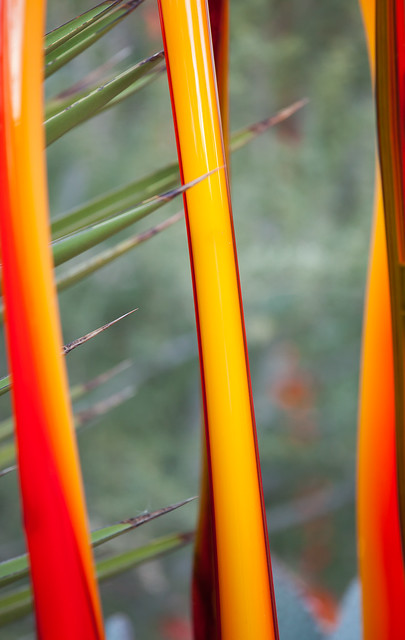
Chihuly Close Up © 2104 Bo Mackison

A close up of the glass show the many color varieties, even in the simplest of pieces.

Though Chihuly no longer blows his own glass — he suffered a vision loss in an accident, and then a subsequent shoulder injury in the 1970s — he closely supervises his team of nearly 100 glass blowers. When one looks at the enormity of the show, it is understandable that one man could not produce all the blown glass pieces, though it is evident that Chihuly’s artistic vision is the cohesion in the show.

The exhibit is stunning placed amidst the desert habitations. It is a place I will visit repeatedly — the show is open daily through mid-May — and I’m sure to see a different perspective with every visit.

More Chihuly: Blue Fiori Sun

Writing Your Life Story Part 2: Using a Search Engine As Your Muse

Chihuly's Blue Star

Chihuly’s Blue Sapphire Star © 2014 Bo Mackison

This Memoir Project, the second project in a series of twelve, uses popular research tools to prompt your life story writing.

Using the internet for fact-finding can help recall information that jogs your memories.

Here is a simple technique for turning a search engine such as Google into your own personal muse.

  • Pick a memorable year in your life. Choose a significant birthday – maybe the year you turned Sweet 16, or the year you reached adulthood. Or choose a notable year – the year you married, moved across town, or across the country.
  • Pick one category or several. Research the best fiction and non-fiction books for that year. Also try the award-winning movies, the best albums or singles, and the most popular television shows.
  • Look at sites where you not only can find top 10 lists, but also a summary of the year’s news highlights, sports winners, and popular culture.
  • Researching the decade can make it easier to find information in one place. Here are a few links to get you started:

1960s: collection of music, books, movies and more from the 60s

1970s: the super seventies in music, literature, popular culture

1980s: an encyclopedia of music, cinema, and news for the 80s

1990s: nifty nineties’ top books, movies, happenings

  • What jogs your memory? Write what you remember. You aren’t creating a history book. You are recalling your memories the way you–and only you–remember them.

I chose 1976 as my memorable year.

It was the year I graduated from college, started my first job as a physical therapist, moved into my first apartment, and got married, all in 6 months time.

Since I have always been an inveterate reader, I checked out the top books in fiction and non-fiction. No memory jogs there.

I looked at the list of the top 10 TV shows. A few of the them are now classics–Happy Days, Laverne and Shirley, M*A*S*H– but I wasn’t inspired to write.

However, my muse did awaken as I read over the list of popular music for 1976. Most of the singles were familiar. I played a few of the songs on YouTube and memories came flooding back.

One of the more popular songs of the year, Can’t Take My Eyes off of You by Frankie Valli, was the first song played at our wedding reception, our first dance. Suddenly I had a story I wanted to remember.

Here is an excerpt from “The First Dance”:

Bob and I met when we worked together at the university cafeteria. He worked so he could earn beer money. I worked so I could eat. When we decided to get married, there was the typical planning. My mother offered to help.

“What kind of band do you want? We have friends who have a band. They play anything. Waltzes, polkas, even your kind of music.”

I was wondering exactly what kind of music my kind of music was, but she didn’t wait for an answer.

“He can dance, can’t he?”

It was a question I had considered. I also tabled the discussion before I had it. Why ask the question? I already knew the answer. No, he couldn’t dance. To keep wedding plans from getting overwhelming, I took evasive tactics.

“No problem, Mom. We’re both rusty, so we signed up for dance lessons.”

I had seen the sign on the bulletin board at the hospital where I worked. Six classes – six different dances. The city college was offering classes and the classes were cheap – a buck a class a person. It sounded like a great solution.

Our enthusiasm was high as Bob and I attended the first class. But after an hour practicing “1-2-3, turn, 1-2-3, turn, guy-smash-girl’s-foot, 1-2-3, turn” we’d both said things we wished we hadn’t, and three of my toes were throbbing and bruised.

Even so, we were young and optimistic. Surely the second class would be better. Not really. We were young and inexperienced, and we knew nothing about the connection between dancing and natural ability. I would have had better luck dancing the cha-cha with a chihuahua, but there wasn’t one available.

Neither of us were naturals on the dance floor, but we weren’t stupid. In fact, we had a lot of smarts. And as a dear mentor once told me, part of being smart is knowing what you are not good at – and not doing it.

We nixed the cha-cha and the waltz, and decided we could fake the polka with enthusiastic lunges. As for the traditional first dance, we wimped out, much to the chagrin of our mothers. No waltzing around the dance floor.

We chose a song that had a slow beat, and did the slow dance reminiscent of those self-consciously done during high school dances in a decorated gym. Bride and groom in each others arms, gazing into each others eyes, swaying to the music, and shuffling in a circle while never lifting our feet from the floor.

When the music stopped, everyone applauded. We sighed. And smiled.

That slow dance has served us well for more than 35 years.

Here are a few tips for giving search engine research a try.

  • Pick a year. Research the Top 10s. Look at the popular culture or a price list of basic needs–a loaf of bread, milk, a first class stamp, a new auto or home.
  • Consider printing the lists to keep in your memoir stash for future reference.
  • Read through your research lists until an item triggers a memory. If necessary, play a few songs on YouTube or watch a few clips from movies or television shows.
  • Write down at least one memory. Don’t worry about perfect sentences or how the words flow at the beginning. Just get the memory down on paper. You can always rewrite later.

In the next part, I’ll introduce a photography project for collecting memories. It’s quick, easy, and you’ll love the keepsake results.

Next: Part 3, Keepsake Photo Booklet

Desert Art – Chihuly’s Neodymium Reeds and Black Niijima Floats

Chihuly's Neodymium Reeds 2013

Chihuly’s Neodymium Reeds © 2014 Bo Mackison

I love botanical gardens, I love the desert, and I love Dale Chihuly’s huge glass art installations.

When I discovered that the Desert Botanical Gardens in Phoenix was hosting another Chihuly exhibition I made plans to attend. As members of the Gardens, we made advance reservations for the 4 pm to 8 pm slot on a recent Friday evening. Choosing the later hours gave me opportunity to photograph the many exhibits during daylight, at dusk, and in the dark when the sculptures were illuminated.

Chihuly's Neodymium Reeds 2013

Chihuly’s Neodymium Reeds © 2014 Bo Mackison

In Finland we started making these long, cylindrical pieces that looked like spears. This was an exciting new form. It was the first time we ever made anything like that. Sometimes I call them spears and sometimes I call them reeds. They can be taken anywhere—they can go outside. They are very strong pieces, and they are very dramatic. ~ Dale Chihuly

There were at least a dozen installations, large installations featuring intricately shaped glass art.

Since I had the luxury of time, and perfect weather, I studied each installation from several different perspectives. I tried to see each installation as a whole, from a distant path or in the desert setting amidst saguaro and organ pipe cacti. Then I experimented, moving closer and closer until I could take a close up of a part of each installation.

Chihuly's Neodymium Reeds 2013

Black Niijima Float © 2014 Bo Mackison

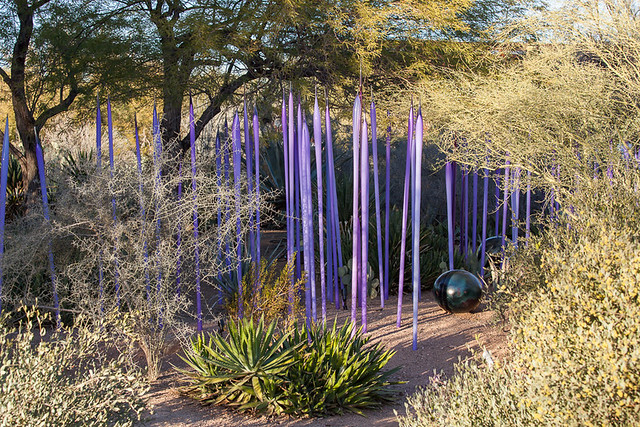
This particular installation featured reeds and floats.

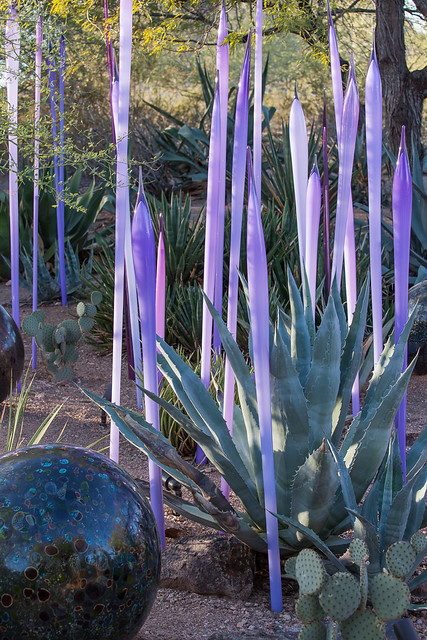
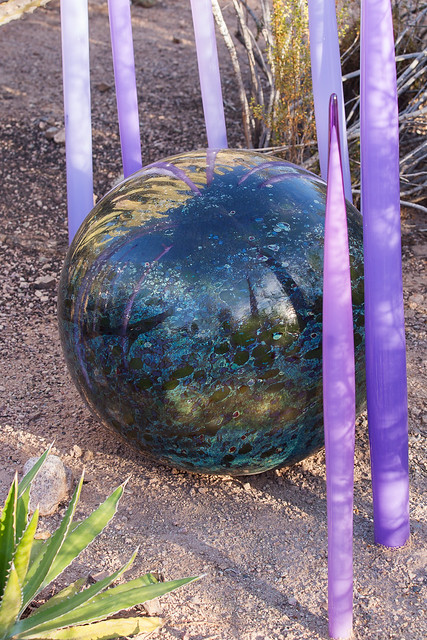
There were nearly a hundred glass reeds in varying hues of purple, and in opalescent, dotted, and clear glass. There were several globes, Black Niijima Floats, set among the reeds.

Half Globe

Half Globe © 2014 Bo Mackison

The black floats were among my favorites.

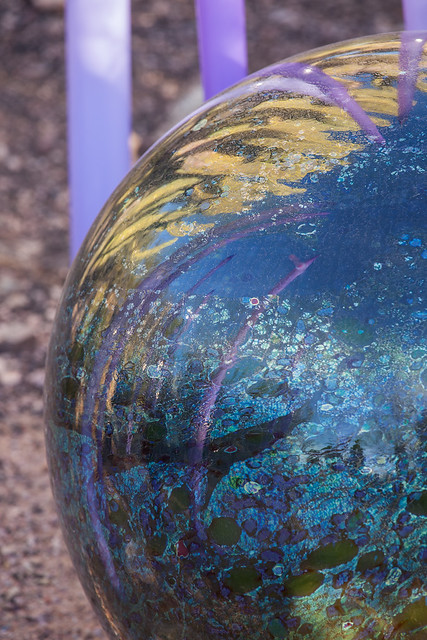
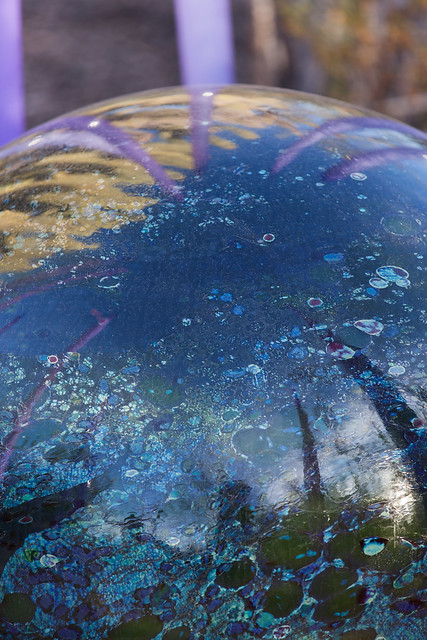
I loved how the globes captured the reflections of the adjacent purple reeds, the overhanging palo verde, and the cacti.

Chihuly Globe

Chihuly Globe © 2014 Bo Mackison

I’ve never done anything like the Floats. They are probably the most monumental-looking, since there’s no reminiscence of a container shape. Just because they are so big, the Floats are technically, or let’s say physically, the most difficult things that we have ever done. Even though a sphere or a ball is about the easiest form you can make in glass, when you get to this scale, up to forty inches in diameter, it becomes extremely difficult. ~ Dale Chihuly

It is an amazing concept, studying these black floats, these perfect globes shimmering with gold and silver leaf, and visualizing their creation as blown glass.

More  Chihuly: Cattails in the Garden

Writing Your Life Story Part 1: Introduction to Writing


Driving Home © 2009 Bo Mackison

Have you thought about writing your life story?

“Nope, way too hard,” you think.

That is exactly what I thought, too, until my 88-year-old mother unintentionally gave me the nudge I needed.

My mother has always been quite secretive about her life, never one to share stories.

On a recent visit, she mentioned running into an old friend. I didn’t recognize the man’s name. Finally, my mother divulged that he had been an old beau whom she had known for years before she met and married my father. I remarked that I knew little from that time of her life and she announced that she could list all of the boyfriends she had ever dated. As she started reciting names and memories, I grabbed a nearby notebook and jotted down her list. In ten minutes I learned more about her late adolescence and early adulthood than I had learned in the previous five decades. And it was effortless.

Later I prompted her on other topics. “What trips did you take before you married?” “Who are the five most famous people you’ve met in your life?” Each time I asked a question, she responded with a list full of quirky details. By the end of the weekend, I had several pages of stories featuring my mother.

I also had the opportunity to try the listing method for retrieving my own memories.

My younger daughter worked at a movie theater for many years, and she had unlimited access to movies. One evening, as she was going to another show, her third that week, I remarked I’d seen perhaps a half-dozen movies before high school graduation.

“Really? You only went to six movies as a kid?” She was shocked by the thought. “What did you see?”

It only took me a minute to recall the movie titles. They were highlights of a childhood when movies were a huge treat. Amanda sat down in amazement and asked me about my movie experiences. As she listened, her eyes widened in surprise at the differences between the movie experiences in the 1960s versus today.

After I recalled my memories about movies seen in my youth, I wrote a list and added details.

Here is an example from the list “Movies I Saw in A Theater as a Kid”

Movie Memories © 2010 Bo Mackison

. . . when my friends and I were just sixteen, and beginning to accrue driving privileges, the movie Romeo and Juliet was released with much hype. To our dismay, it was not playing at the local movie theater. No, it was at the off-limits drive-in theater on the edge of town! I had never been to a drive-in movie and doubted I’d get permission to go.

But my girlfriends and I were determined to see this movie. Perhaps it helped that Romeo and Juliet was a Shakespearean classic. Perhaps it helped that I planned to go with five other girls crammed into one father’s trusted Oldsmobile. And I’m sure it helped that my friend’s parents agreed to also attend the show and park their car next to ours.  They kept a watchful eye on us the entire evening. Jan’s dad brought his pipe, her mother brought her knitting, and I don’t think they looked towards the big screen even once . . .

I was surprised at the memories I thought I’d long forgotten. Not only was list making an effective aid for recalling details, it was easy and fun, too.

You can use the same technique to jump-start your writing. List making leads to memory making.

Here is how to start:

  • Think of a topic. Use the movie prompt or one of your own. It is easier to write if you initially give yourself guidelines. For example, instead of listing all of your favorite books, list five books you read as high school requirements. Instead of writing about a summer vacation, list the highlights of your first weekend trip to the big city. Remember, it is easy to expand a narrow topic if you are so inclined, but not nearly as easy to pick a huge topic and find the thread of the beginning.
  • Once you have a list of a few items, fill in the details. The list acts as a prompt for retrieving memories you didn’t know you remembered.
  • Be alert for ideas for new lists. Record them in a notebook as they come to you. Topics may come from family conversations, newspaper or magazine articles, radio or television programs, or your daily activities.
  • Don’t over-think this project. Keep several small notebooks or index cards in your home, car, and purse. As you recall details, jot down key words.

Are you thinking of reasons why you can’t write your life story?

Here are three things that may help you get started:

  • You are creative. Though you may fear you are not creative enough to write your memoir, you are the only person who can write about your life from your point of view.
  • You are writing for yourself. Maybe you will share it with family members or friends, maybe you won’t, but the person you are ultimately writing your memoir for is yourself.
  • Writing is a way to explore and connect with your past, perhaps even resolve issues. Your writing is what you make it. The simple act of putting down the words of your story, or doing the coming memoir projects, provides you with an opportunity to make meaning in your life.
  • This can be a big project, or as small as you wish. You do not have to write chronologically. You do not have to record every experience, every detail. Write bits and pieces, collect them in one place, and you will have a start to writing memoir. Write your life story in whatever way works for you. It is your memoir project.

In this series, I offer a dozen writing techniques and creative projects to encourage you on your memoir journey.

Klonopin For Sale Online Writing Your Life Story is a multimedia project that will inspire you to create/write/photograph your memoir in fun, easy, and interesting bits. I hope you’ll be inspired to try the various projects. We will be writing unique exercises to flesh out your memories, shoot a few photography projects (with any camera – cell phone camera, point and shoot, digital SLR is fine) and explore other multimedia ideas in the quest to “collect your memoir”.

There are writing prompts, simple photography projects, ideas for inventive interviews, creative research techniques, suggestions on how to physically contain your memoir stash, and much more. Twice a week I will post a new memoir project. Imagine how quickly your memoir will grow, a bit at a time.

I invite you to join me in this multimedia memoir project. After all . . . if you don’t write your life story, who will?

Next: Part 2, Search Engine as Muse