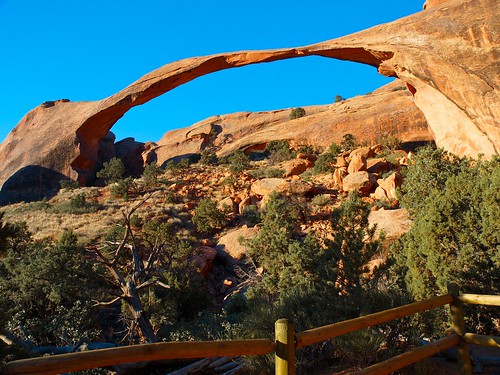
The Grand-Daddy of All Arches
No, I am not talking about McDonald’s Arches.
There are arches other than those golden ones which have become an American icon.
These natural beauties are the arches that should be one of our icons. Landscape Arch is surely one of the world’s greatest natural wonders.
It has the greatest span of any natural arch documented, over 290 feet long. At its narrowest, the rock is only 6 feet wide. This is an arc natural arch, a geological specimen very old and near the end of its life cycle. The arch could collapse any day or it could last another century. You have to remember we’re talking about arches made from eroded sandstone here – they have an incredibly long life span, but can collapse without warning.
In the last 17 years, sizable chunks have fallen from Landscape Arch.
In September of 1991, a 73-foot slab of rock crashed to the earth from underneath the narrowest part. This rock fall may have actually prolonged the life of the rest of the arch, as the piece was considered structurally unimportant and it reduced the weight of the suspended rock. In June of 1995, a 47-foot mass fell from the front of the thinnest section , soon to be followed by a third rock 2 weeks later. Since then, the trail that once wound beneath the arch has been closed by the Park Service. Smart move!
Landscape Arch is in Devil’s Garden in Arches National Park, a few miles north of Moab Utah.
The hike to see this arch is just over a mile, but it really is an easy hike to this point on extremely maintained paths. If you can walk 2 miles in your mall, you can walk the 2 miles in and out to see this giant arch. If you are ever in this area, consider getting out of your car and really look at the rocks. This is a must see, and the Park Service has made it as easy as possible to see Landscape Arch. I saw toddlers carried on their parents’ backs and I saw octogenarians walking with canes, all checking out the magnificent view.
There are other arches in Devils’ Garden – it has the largest number of significant natural arches in the world.
However, once past this landmark, it gets a mite more rugged (ha!) and it is almost easy to feel that you are an intrepid explorer in the wilderness if you are visiting at an off-peak time. Next post, I’ll share with you the other arches in the area – the ones I had to crawl up and down rocks to see. Ah, but they are so awesome. Such a wonderful experience to have filed away in my brain for further consideration.