Mountain Bluebird

Bluebird on the Grasslands

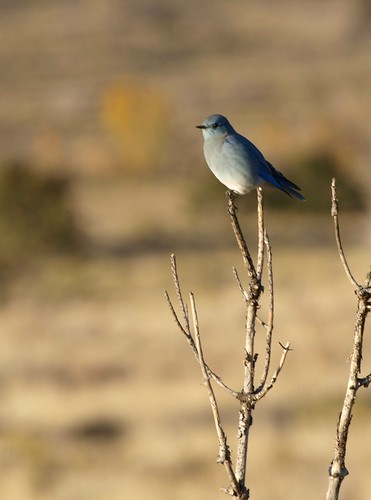
Mountain Bluebird in Great Sand Dunes National Pk ©2008 Bo Mackison

This male Mountain Bluebird seemed to be admiring the setting sun as it dropped below the Great Sand Dunes in Colorado in mid-October. The mountain bluebird is one of three bluebird species in the United States–the other two are the Eastern Bluebird and the Western Bluebird–but the only one to be all blue instead of having a brownish underbelly.  The females of all the species are more difficult to identify, as they lack the blue intensity of the male, and tend to be an overall grayish-blue.

The Mountain Bluebird is found throughout the western parts of the States, usually west of the Rockies. This guy was perched only a few hundred yards from the nearest peaks, the Sangre de Cristo Range.

Pretty little guy, isn’t he? He’s the first Mountain Bluebird I’ve ever seen.

Cliff Hangers

Cliff Hangers

Determined Juniper Trees © 2008 Bo Mackison

These scraggly trees are common on rocky ridges. Where there is a fracture in the rock, the roots of the trees will reach deep enough to access just enough water to survive. One-seed junipers have the capacity to speed up or slow down their growth depending on water availability. It is also common for part of a tree to die back, allowing the rest of the tree to survive. Though their growth is slow, sometimes only 4 to 6 inches in a decade, they may live for hundreds of years.

Native Americans used the juniper for medicine, gum, dye, food (the berries) and fuel. They also made shoes from the woody fibers. Herbalists still use the plant for a variety of remedies.

These trees are hanging off the rocky top of Walnut Canyon in northern Arizona.

Wilderness Exposure

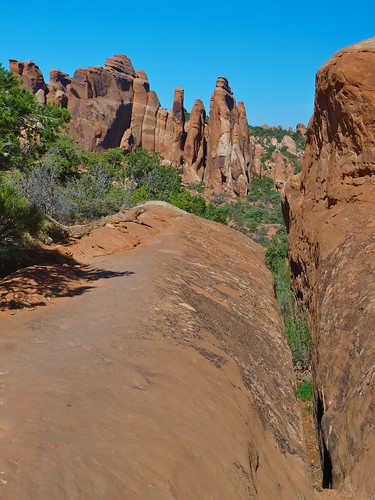
Devil’s Garden Trail explores some of the Utah back country in Arches National Park. Your reward for scrambling over rocky surfaces, navigating the narrow tops of exposed sandstone fins, and then climbing up and down short, steep crevices is a view not many people see – eight spectacular arches, and back-country worthy of many oohs and ahs, and a few comments, such as “I can’t walk on that #%*& ledge!”

Creative Cairn

Creative Cairn © 2008 Bo Mackison

Though most cairns (markers that let you know – really – you are still on the trail) are rocks stacked up in a pile, a previous hiker took the time to re-arrange this cairn into replicas of two hikers. So by looking at this photo, you can see we are precisely where we are supposed to be, even though we are vaguely lost.

This is the Trail? Are you Sure?

This is the Trail? Are you Sure? © 2008 Bo Mackison

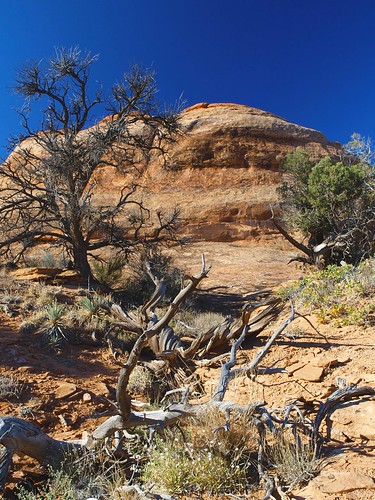
At this spot, our choices were to scramble over the dome in front of us, or deal with the tangle of dead wood around the side. We scrambled up the rock, which thankfully was not slippery, and then slid down the other side. No sweat! (Yeah, right!)

The Worn Part iS the Trail

The WORN Part is the Trail © 2008 Bo Mackison

As was most evident to us, the trail was the worn path on the rocks. I kept my sights on the spectacular stand of fins ahead, and kept taking deep breaths. The trail marker at the beginning said the hike was not appropriate for people who suffer from extreme agoraphobia (fear of heights) – what about those of us who only have a minor case?

But I exaggerate! I loved this hike. We started at dawn and returned to the trailhead about 2 in the afternoon. I’ve seldom seen such magnificence. Worth all the bits of anxiety and lack of oxygen. (We were at a high elevation for Wisconsin folk!)

Then we went out for beer and pizza. It seemed the only reasonable thing to do.

Oran’ga Likin’ Orange Lichen

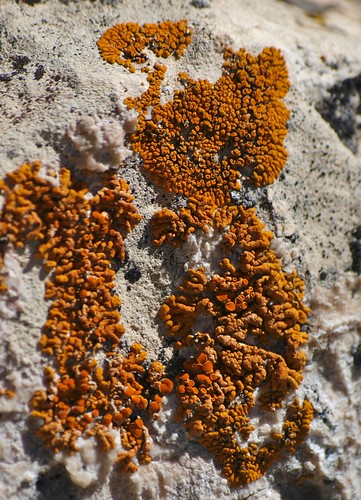
Orange Lichen © 2008 Bo Mackison

These splotches, formally known as lichens, grow on rocks. They can be any number of colors – yellow, orange, gray, green, blue, black. And they can grow in the most inhospitable places in the world. This colony of orange lichen is from Walnut Canyon National Park in northern Arizona.

Lichens are actually colonies of two different organisms co-existing and working together: algae which lives in filaments built by fungi. They use photosynthesis for nourishment.

Some lichen grow only a few millimeters in a century, so these lichens may be thousands and thousands of years old.

Yellow, Orange and Gray Lichen

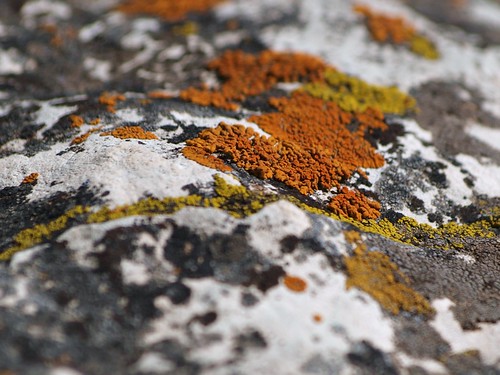
Yellow, Orange and Gray Lichen © 2008 Bo Mackison

For me, lichens are the kind of thing that brings out experimentation when I’m photographing. Do I capture the texture, the design, the mix of colors?  Well, having fun is a big part of taking photos for me. And this stuff was amazingly fun to shoot. I like lichen.

Spirit of the Tree

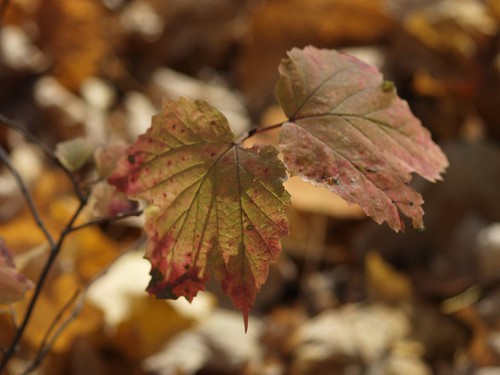
The Last Hurrah

Last Hurrah © 2008 Bo Mackison

When you can see each leaf as a separate thing, you can see the tree, you can feel the spirit of the tree, you can talk to it, and maybe you can begin to learn something.
~ William J Bausch

I guess if I’m going to learn anything, I’d better be quick about it. I think perhaps these are the only two leaves left in my neck of the woods. Wonder if I can study the snowflakes that are falling today instead. Not much accumulation though.

Does anyone remember catching snowflakes on black construction paper and looking at them with a magnifying glass. I think my Grandpa took me out snowflake spying when I was about six years old.

Do kids do still do that kind of thing?