Impressionist Autumn

Impressionist Autumn

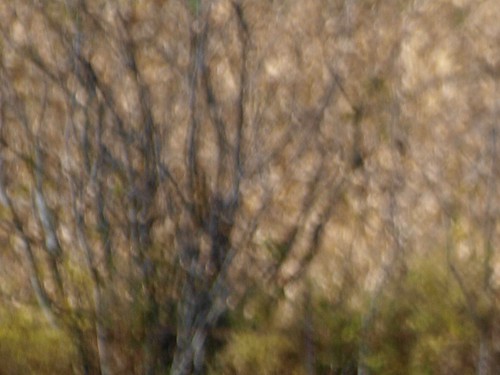
Impression of Autumn © 2008 Bo Mackison

I spend much of my photography time working to get detail-sharp photographs. But Saturday we were driving in the country when we came upon eight sandhill cranes strutting about in a just-harvested cornfield, feeding on the leftovers. I had my camera in my lap, but wasn’t planning on taking any shots, so though I clicked away, I didn’t have enough time to change the manual settings.

When I checked the photos, sure enough, all the cranes were a bit out of focus. Even though I had focused on the birds, they weren’t exactly posing still for me. They were busy fluttering, and pecking corn from the ground, and nudging each other. But I noticed the trees in the background and was drawn to their impressionist style. So I did a rather drastic crop.

Couldn’t pass up the opportunity to share, even though my husband, now a Photo Sherpa with a year of experience behind him, informed me that the photo wasn’t in focus.

I know.

I still like it.
Beauty of the Earth

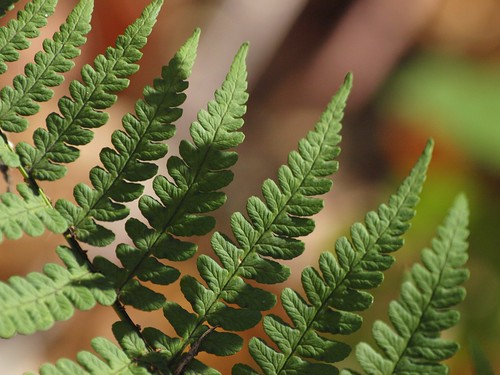
Fern © 2008 Bo Mackison

Those who contemplate the beauty of the earth find reserves of strength that will endure as long as life lasts. There is something infinitely healing in the repeated refrains of nature – the assurance that dawn comes after night, and spring after winter. 
~ Rachel Carson


Wupatki National Monument

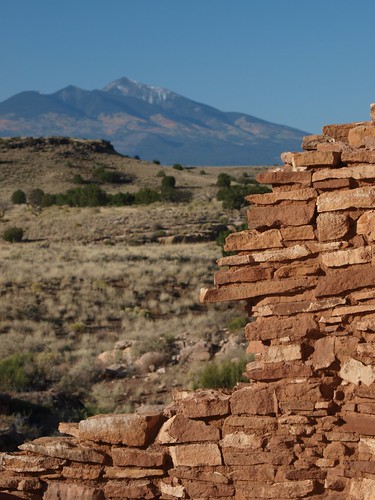
Pueblo Ruins

Pueblo Ruins © 2007

Wupatki National Monument, just twenty minute drive north of Flagstaff, Arizona, was established by the National Park system to preserve Native American archeological sites dating from the 1200s and the surrounding lands.

The area has geological formations and abrupt elevation changes that, within only a few miles, provide six different eco-systems, and a wide variety of habitats for plants and animals.The effects of elevation are visible along the 36 mile loop road connecting Wupatki with Sunset Crater Volcano National Monument to the south.

Desert in Bloom

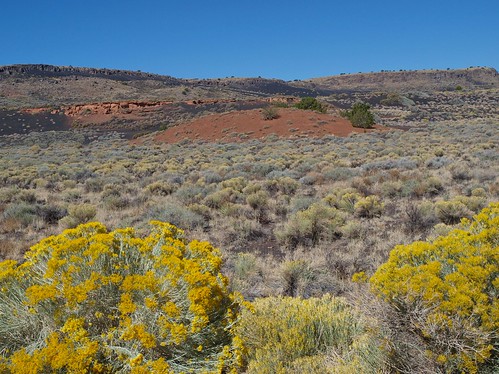
High Desert Grasslands in Bloom

A drive along this road isa journey from desert grasslands (at less than 5,000’ elevation) to Ponderosa pine forest (near 7,000’). In October, the desert floor springs to life with flowers and new growth. Rabbitbrush glows bright yellow against the black cinders, remains from the nearby volcanic eruption, the red rock in the distance, and the blue sky.

Red Sumac

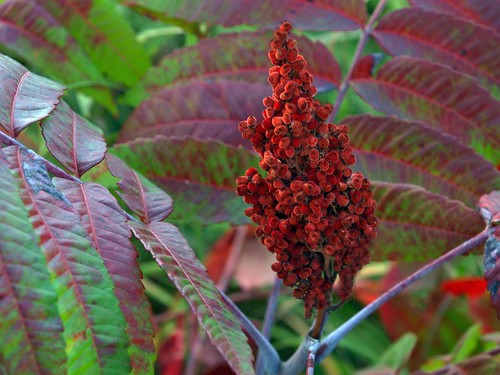
Smooth Sumac

Smooth Sumac © 2008

Sumacs are famous for their red foliage and fruits throughout much of autumn.  The fruits remain over winter and even throughout the following spring, providing much needed winter food for birds. It’s not that the birds are particularly fond of the berries (the berries are really drupes as they have a pit, not a seed), but that it is one of the few available foods. Moose and deer, however, are more than happy to chomp on the foliage and fruits, and often crop the bushes quite close to the ground.

I think the sumac is at its most attractive when the fruits are bright red, and the red berries are surrounded by foliage that is just turning from greens to blue/purples to reds.

Milkweed Fluff

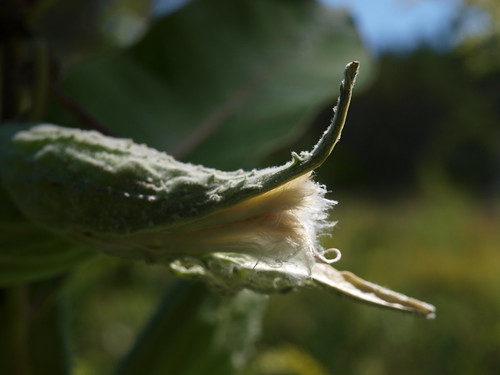
Milkweed in Autumn

Milkweed in Autumn © 2008

The Common Milkweed, a native plant in Wisconsin, has rough textured pods that contain thousands of seeds attached to strands of silky down. As the pods split in autumn, the seeds open like tiny parachutes and travel on wind currents to a new site to seed.

This silky stuff has been used creatively throughout the years. Settlers in the 1700s and early 1800s used the fluff to fill their pillows and mattresses. In the 1860s, thread from the down was made into socks and purses. During World War II, schoolchildren collected milkweed pods and the pods were sent to central processing locations. The down was used to fill life preservers and to line the uniforms of the United States Air Force. Milkweed down is extremely bouyant and a few pounds of this spinnery stuff can keep a 150 pound person afloat in water.