Lemonade and Izze – Living in the Moment

Lemonade and Izze

Lemonade and Izze © 2012 Bo Mackison

A glass of lemonade and a cold bottle of Pomegranate Izze. Living in the moment — ahhh!

So this photograph of two beverages is the perfect reminder to live in the moment. It’s not every day I get to spend a couple of hours with my younger daughter – the youngest of my three kids – sitting in an outdoor cafe in Bisbee, Arizona, sipping freshly squeezed lemonade – the puckery kind – and a Pomegranate Izze. Munching on chorizo and cabbage burritos. Laughing and telling snippets of life stories – some recent, some a decade old, some two decades old. Walking along the up and down sidewalks of Bisbee Arizona, peering at the window displays of the shops and galleries, occasionally wandering through a gallery, oohing and aahing over a painting or a sculpture. So much talent! Admiring the many buildings – schools, homes, businesses – many perched in precarious positions against the mountains.

At one point our conversation drifted to Manda’s propensity for conversation when she was a toddler and preschooler. She loved nothing more than to carry on a  lengthy conversation about any topic. She was, and still is, one of the most inquisitive people I know. We played a game for several years, one I devised so that I could get some work done while still entertaining my young conversationalist. When we were talking about it the other day, we both wondered how much this game influenced Manda’s education and the way she thinks and comes up with answers.

We played our game throughout the day. It would start simply enough.

I would make an observation. “Look, the first robin of the season. The robins are back.”

My then three-year-old would say, “Where do they come back from?”

I would offer a simple explanation. “They don’t like the cold weather and snow, so they go to a warmer place during winter.”

Manda would look at me as if I had just told her the biggest whopper ever heard by a three-year old.

So I would counter offer. “Well, what do you think happens to the robins?”

And this is where the fun would begin. Looking back, I wish I had written more of her answers in my journal. Only a few were documented.  Some of her conclusions were hysterical, some were thoughtful, some were fanciful, but they all displayed a certain ability to think and be creative. What an amazing thing, yes?

Here are a few lines I once wrote about the return of the robins. After I gave her the straight answer, I would ask Manda is she could think of any other answers. She would give me one and then another, and another. The game continued until she ran out of answers or lost interest.All answers were acceptable.

“The robins go down in the holes with the rabbits.”

‘The robins fly to Grandma’s ( 300 miles south and considerably warmer) and live in her attic.”

“The robins sleep under my bed and they are very, very quiet. I only hear them when they fight.”

“The robins play hide and seek and you don’t see them. I know where they hide.”

And on and on.

Then she would go off and play. That is, until we began the next question and answer game.

——————–

Bo Mackison is a photographer and owner of Seeded Earth Studio LLC, living and photographing in southern Arizona. Visits from her family are always appreciated. 🙂

Lessons from Desert Flowers

Rock Gilia

Rock Gilia © 2012 Bo Mackison

       The desert’s beauty suggests patience and struggle and endurance. Even in the brightest colors of its brief spring flowers, there is something austere. ~ from The Desert Year by Joseph Wood Krutch

Most of the desert flowers are mere specks on the ground. If there are dozens of them, the color is fairly noticeable, but if there are only two or three quarter-inch blossoms sprawling against a bit of green leaf and a lot of gravelly desert floor, it takes some careful observations to see those pretty little things. Of course, in the desert, the smaller, the better chance at survival. A flower, or leaf on a shrub for that matter, that is minute requires considerably less moisture for survival than a flower or leaf a hundred times that size. Adaptation of the species, as we know it.

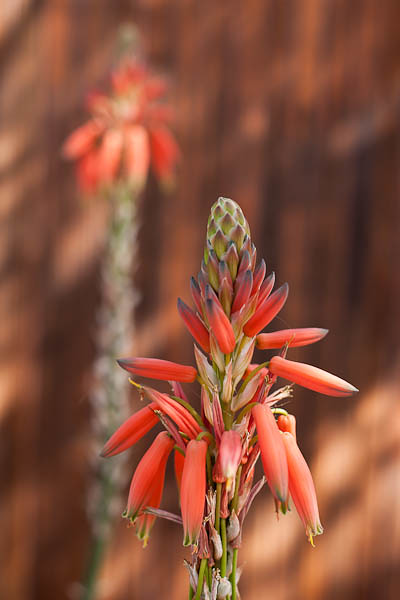
Blooming Aloe

Blooming Aloe © 2012 Bo Mackison

Notice how present a flower is, how it has surrendered to life. ~ Eckhart Tolle

Of course, the cacti and the succulents found in the desert have a totally different way to guarantee a flowering season, necessary for the continuation of the species. (No flowers, no seeds. No seed, no new flower).

This aloe is a succulent and has adaptive measures for desert survival. Succulents (and cacti, too) have the ability to suck up water when it does rain and then store it in large quantities. These plants send shallow roots in a wide circumference around the plant, and so the root absorbs the water before it evaporates. And when a succulent, like this bright-orange, flowering aloe, traps water in its system, its waxy surface helps keep the water in the plant and reduces water lost to evaporation.

We humans could learn much by consulting with nature and her ways:

  • Assess our weaknesses and strengths – bolster our weaknesses and play to our strengths.
  • Be resourceful and use our resources wisely. Do not use more natural resources than we need. Consider needs vs. wants.
  • Share your beauty, whether it be small and hidden, delicate and ethereal, or bright and showy.


Trees are Sanctuaries

Looking at the Past

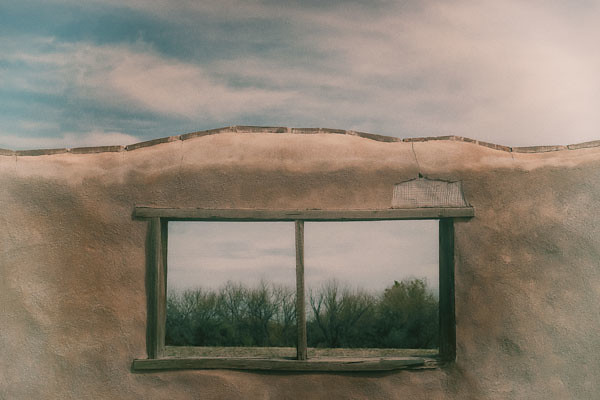
Trees are Sanctuaries © 2012 Bo Mackison

Trees are sanctuaries. Whoever knows how to speak to them, whoever knows how to listen to them, can learn the truth. They do not preach learning and precepts, they preach undeterred by particulars, the ancient law of life. ~ Herman Hesse

Trees Are Sanctuaries

1806, The People Build the Church

They make the brick, kiln the lime, raise the walls, lay the roof,
paint murals and sacristy ornamentation, build niches for the statues of the Saints.
They clear the land, build the fences, plant corn and wheat,
and from the priests’ cache of pods and seeds, they plant and then tend
fruit orchards, nut trees, and olive trees.
They learn the ways of the missionaries,
they marry, raise children, care for their sick, weep for their dying, bury their dead.

1827, Weary, Ill, and Wary of Raiding Enemies

Many of the People wrap the statuary in leathery strips of yucca,
the bundled saints cradled like newborn babes
protected from summer’s heat, shifting winds, monsoon thunderstorms,
from damage to their wooden limbs or chipped painted robes or eyes of porcelain marbles.
They walk north, leave the Tumacacori Mountains,
settle in another valley with another priest and another church.

1848, Tumacacori Mission, Deserted in the Desert.

No missionary priest leads his people, crucifix in hand,
his carved cross held high, a silhouette in the blue bowl of sky.
No one gives signal to the last few of the Desert People
who now abandon their homes, possessions, crops;
abandon their church, stacked bricks of adobe, and
precious, the limestone wash, white like angels’ wings;
now the church is an apparition towering amidst the desert grasses, agave, mesquite,
standing in the foreground of the mountains.

2012, A View through the Window

Open to the cool desert nights,
no roof for protection, no doors.
Only the ruins remain,  maintained as ruins.
But the window opening frames the cottonwoods, green and tall,
lining the Santa Cruz River, growing.
They hold my fascination. When I walk to the river,
they form the arched roof over my head,
provide a spongy carpet of decaying leaves under my feet.
Wisps of white cottony fluff, seeds for the future, drift on the southwest breeze.

The trees are the sanctuaries.

——————–

Bo Mackison is a photographer and owner of Seeded Earth Studio LLC, living and photographing in southern Arizona. There are also days Bo wanders through Mission ruins, thinks of days long past, and writes poetry.

Yucca Candelabra

Yucca Candalabria

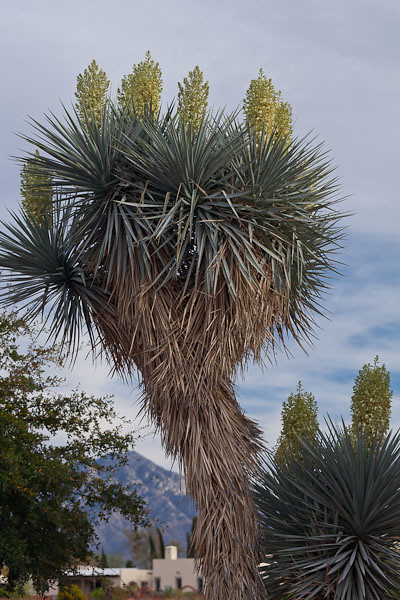
Yucca candelabra © 2012 Bo Mackison

Knowledge was inherent in all things. The world was a library and its books were the stones, leaves, grasses, brooks . . . We learned to do what only the students of nature ever learn, and that was to feel beauty.    ~ Luther Standing Bear

Yuccas are a common plant in the United States Southwest, so common that it is the state flower of New Mexico.

The leaves of the Yucca are long, narrow, and come to a sharp point. (I have proof – deep scratches on my arms. When will I learn!!)

Fibers of the yucca can be used to make rope and loosely woven textiles. The thick root can be beaten into a lathery pulp which is then used for soap and shampoo. It was a plant that was frequently planted near homesteads and encampments for its usefulness.

When the yucca blossoms, creamy-colored, bell shaped flowers hang in loosely arranged clusters. If the flowers are pollinated, seed-filled capsules develop. The yucca then dies after flowering and fruiting, but produces offshoots that spread out from the mother plant and develop into new plants.

The yuccas only known pollinator is the yucca moth. The female yucca moth has a specialized mouth to collect the pollen.  She lays her eggs in the yucca flower and covers the eggs with a ball of pollen. The pollen fertilizes the seeds which then begin to develop. The moth’s larvae require the yucca seeds for growth and development. Both species, the yucca and the yucca moth, benefit from the exchange. This inter-dependence on each other for survival is termed mutualism.

It is quite a lovely thing, to walk or drive down nearly any street and see the yucca blossoms swinging high in the air, atop the yucca stalk.

————–

Bo Mackison is a photographer and owner of Seeded Earth Studio LLC, living and photographing in southern Arizona. She is happy to see  so many plants in bloom.

Hiking Sabino Canyon

Yipes Stripes

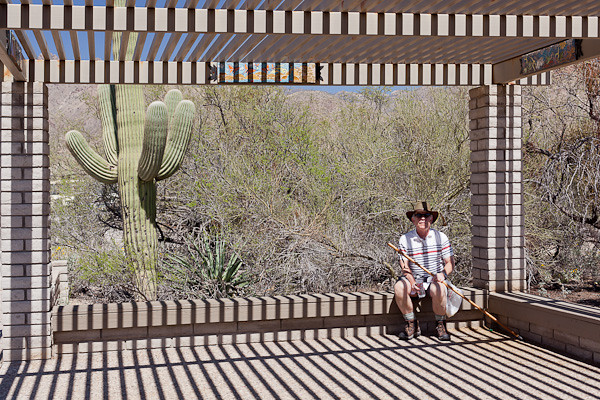
Yipes Stripes © 2012 Bo Mackison

On a sunny, 80˚ day in March, Sherpa and I agreed it was a great day for a hike, especially a hike that had a bit of a cheat to it. We hiked the Phoneline Trail in Sabino Canyon, a gorgeous canyon in the Santa Catalina Mountains bordering Tucson. Our cheat was this — we paid a few bucks each for a ride on the shuttle which comfortably took us from the Sabino Canyon Visitor Center to the top of the line, stop #9. We figured once we were up on the mountain, it would be an easy hike down.

I love this photo of Sherpa with the many variations of stripes. Stripe shadows, stripes from the ramada on Sherpa’s shirt, and he’s even wearing a shirt with horizontal stripes. “Yipes, stripes” is right. I was seeing stripes for most of the shuttle ride.

End of the Shuttle Run

End of the Shuttle Run © 2012 Bo Mackison

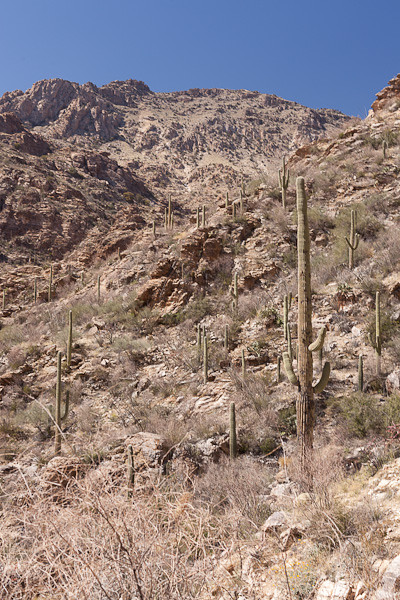
As the tram takes you deeper and deeper into the canyon, the world of natural beauty feels immense. Towering mountains, rocky ledges, saguaro reaching up. This is another sky island, once of several dozen in southern Arizona and northern Sonora, Mexico. Desert at the lowest levels, a juniper, pine, and rocky habitat at the top.

The Hike Begins

The Hike Begins © 2012 Bo Mackison

This trail starts at the end of the paved road. A half mile climb of ever-upward-reaching switchbacks takes us to the main Phoneline Trail. Once there, the trail follows the road, only several hundred feet higher. It isn’t a hard hike, but there are gentle ups and downs throughout the “descent” and several hundred boulders to help you climb up or climb down.

The Peak

The Peak © 2012 Bo Mackison

Once we climbed high enough, we could look to the north and see Mount Lemmon, the highest mountain peak in the Tucson area. If we had been really ambitious — and 30 years younger — perhaps we would have climbed up and over. But since neither the ambition or the age was happening, we took a lot of long looks from the trail we were on.

Eye Level with a 40 Foot Tall Saguaro

Eye Level with a 40 Foot Tall Saguaro © 2012 Bo Mackison

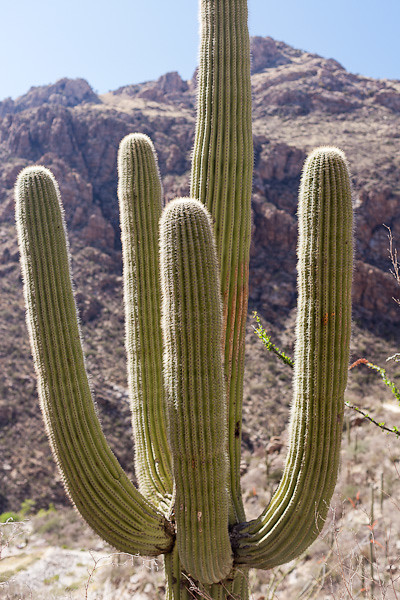
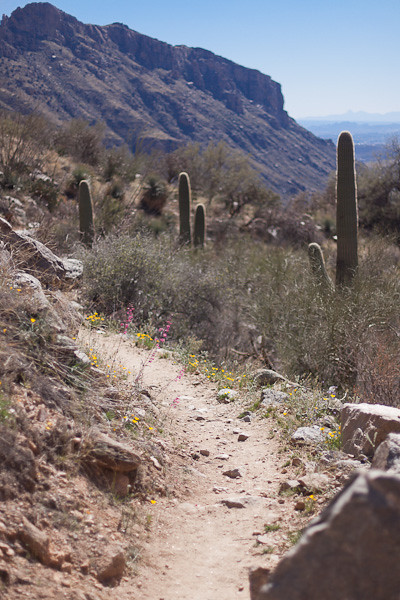
There is one tricky thing about hiking on a desert oasis on a mountain trail. The saguaro are conveniently within grabbing distance if one was to lose their balance. I started to reach out for a steadying cactus arm more than once before I realized what I was doing and quickly pulled away. This saguaro was a forty footer, but at my eye level on the trail I could see the upper third in great detail. Wow! Imagine what it will look like in another month, full of white cactus blooms.

Switchbacks on the Sabino Canyon Trail

Switchbacks on the Sabino Canyon Trail © 2012 Bo Mackison

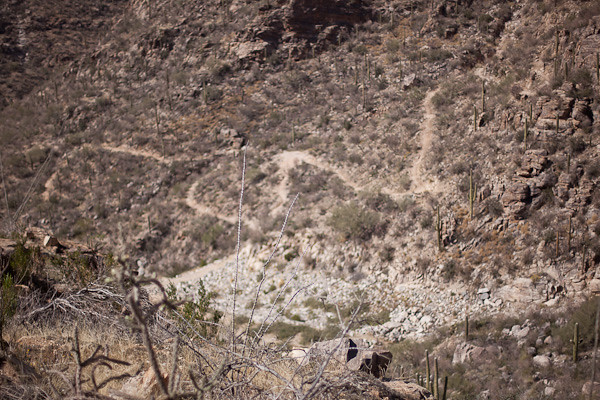
We looked back and laughed when we saw the trail we had just hiked, snaking up and down, switch-backing a mere 200 feet in elevation in a half mile.

It Seems the Trail Always Climbs Uphill

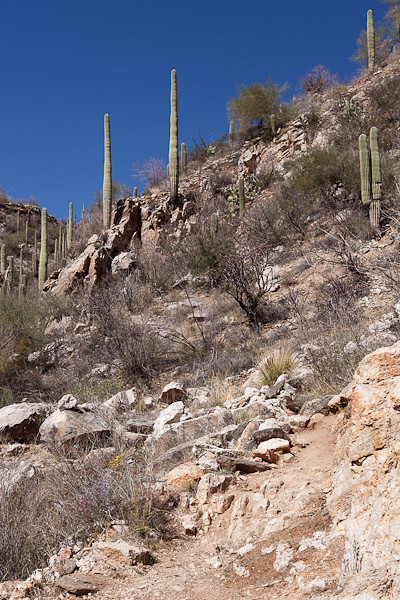
It Seems the Trail Always Climbs Uphill © 2012 Bo Mackison

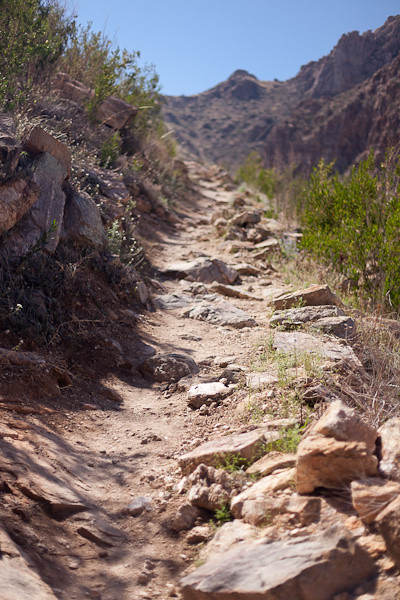
Rocks, rocks, and more rocks. Careful here to not trip and stumble, as the fall would be a long one. Since this area had a foot of snow earlier this week, the trail was bordered by lots of green — bushes, trees leafing out, wildflowers everywhere.

Wildflowers Along the Trail

Wildflowers Along the Trail © 2012 Bo Mackison

We both had had our exercise for the day when we reached the picnic area near the Visitor Center. And let me say — my peanut butter and strawberry jam on thick whole wheat never tasted better. And that cold bottle of water — perfect!

———–

Bo Mackison is a photographer and owner of Seeded Earth Studio LLC, is living in southern Arizona,  photographing and hiking the sky islands and giving thanks that she can see such sights.